
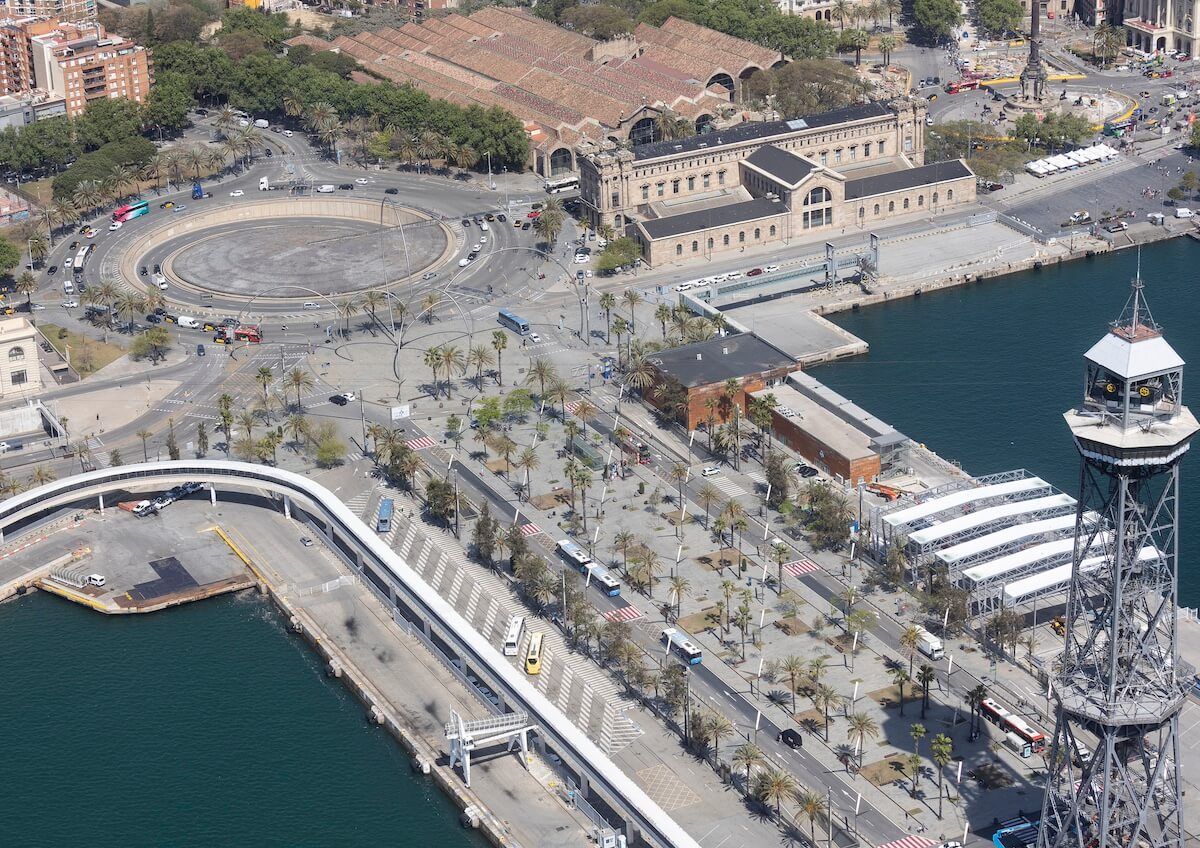
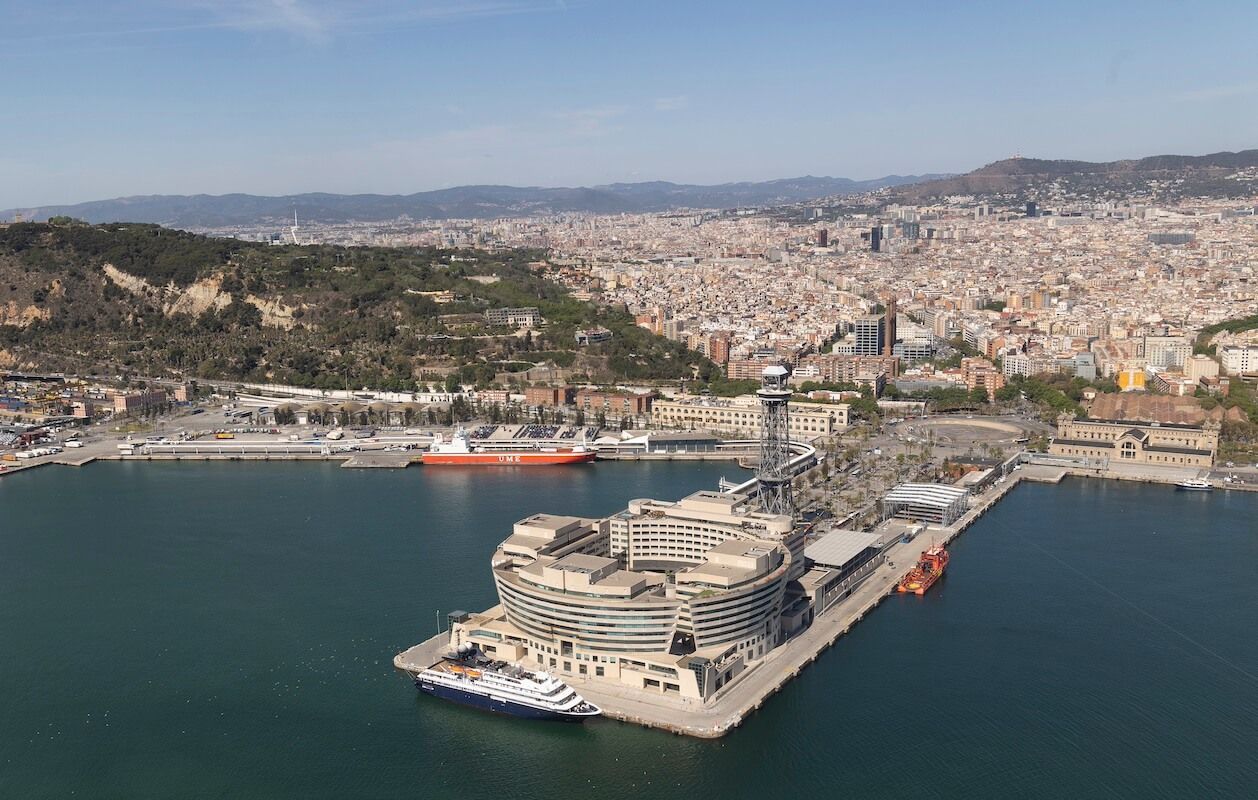
Port activity has been moving away from the urban fabric for years, freeing up spaces that had traditionally been occupied by ships and cruise liners. Barcelona's pier, where the World Trade Center (WTC) is located, is one of them. Until recently, Baleària ferries docked there, having been moved a few months ago to the Adossat pier. The relocation has allowed the base of the America's Cup host team, Emirates Team New Zealand, to be installed in the former Baleària terminal, where the fences that previously protected the area from which people embarked for the Balearic Islands have disappeared, and work has begun to urbanize the path connecting to the Columbus statue and La Rambla, touching the sea, just behind the Customs building.
"The goal is to gradually open up all these spaces. We are going to free up the Barcelona pier and, in parallel, we are already preparing urban planning projects to transform it and undertake a reform to extend La Rambla," explains the president of the Port of Barcelona, Lluís Salvadó, in an interview with The New Barcelona Post. "We want to build a promenade that opens the Barcelona pier to La Rambla," he emphasizes, including in this project the opening of the entire pier, including the sides and the back of the WTC, which are still restricted to citizens. "It's a goal for after the America's Cup," he states.
With the works on La Rambla in the background, the first step in this direction will be to make the side of the Barcelona pier where the Baleària terminal was located accessible this very year 2024, as well as the space where the North terminal was located, which received its last cruise at the end of last October. "Now you can enter the central part of the pier, but the exteriors are closed because they have been restricted areas due to commercial activity," he adds. The last terminal on the Barcelona pier to cease its activity will be the South, with capacity for two medium-sized cruise ships, with its closure scheduled for 2026.
The Barcelona dock is not the only space being recovered for citizens, as a result of the agreement closed by the municipal government led by Ada Colau with the port in 2018. It has also been done in the Nova Bocana area, gaining a viewpoint at the foot of the W hotel and inaugurating the new Rambla del Rompeolas, and it is about to happen with the fish market, a few days away from inaugurating new facilities that will allow attending daily fish auctions and seeing the Clock Tower up close. The arrival of the America's Cup in Barcelona has undoubtedly contributed to this opening, understood as the final push needed for many projects that had been maturing for some time. In the Port of Barcelona alone, it has translated into about twenty initiatives, worth 120 million euros, which aim to show the best face of the infrastructure when visitors and residents come to see flying boats compete very close to the beach.
"When a date was set for the arrival of the America's Cup, everything we had in mind had to be done. It has helped and forced us to execute this new transformation of the Port Vell. The port authority's machine has had to run and stress itself a lot," says Salvadó, "we will comply with all the schedules we had set and the different actions will be executed within the deadlines." The sheds of the Oriental dock, where the port's hospitality activities will be located during the competition, have just been inaugurated, and the new nautical bus service, awaited for decades, is about to come into operation, in addition to the new fish market.
The port authority also does not forget the land where the controversial Hermitage was to be built, recently asphalted and urbanized to serve the regatta, waiting to find a project that takes advantage of them: "It is a unique space, we do not have any other like it in the entire port. It makes no sense for us to have it unoccupied. After the America's Cup, we will open a reflection process to see what activity we put there. What is clear is that it will be one with a high value because it is an absolutely extraordinary plot."
Change of plans for the Liceu
While some projects have been taken out of the drawer and executed, others have seen how nautical competition disrupted their plans. This is the second headquarters for the Liceu. Shortly before Barcelona was announced as the host city for the 37th edition of the America's Cup, the cultural institution announced that it was studying its expansion into the grounds of the abandoned Imax, which would have to be demolished. Everything seemed to be on track until the regatta decided to locate a dissemination center in the old cinemas.
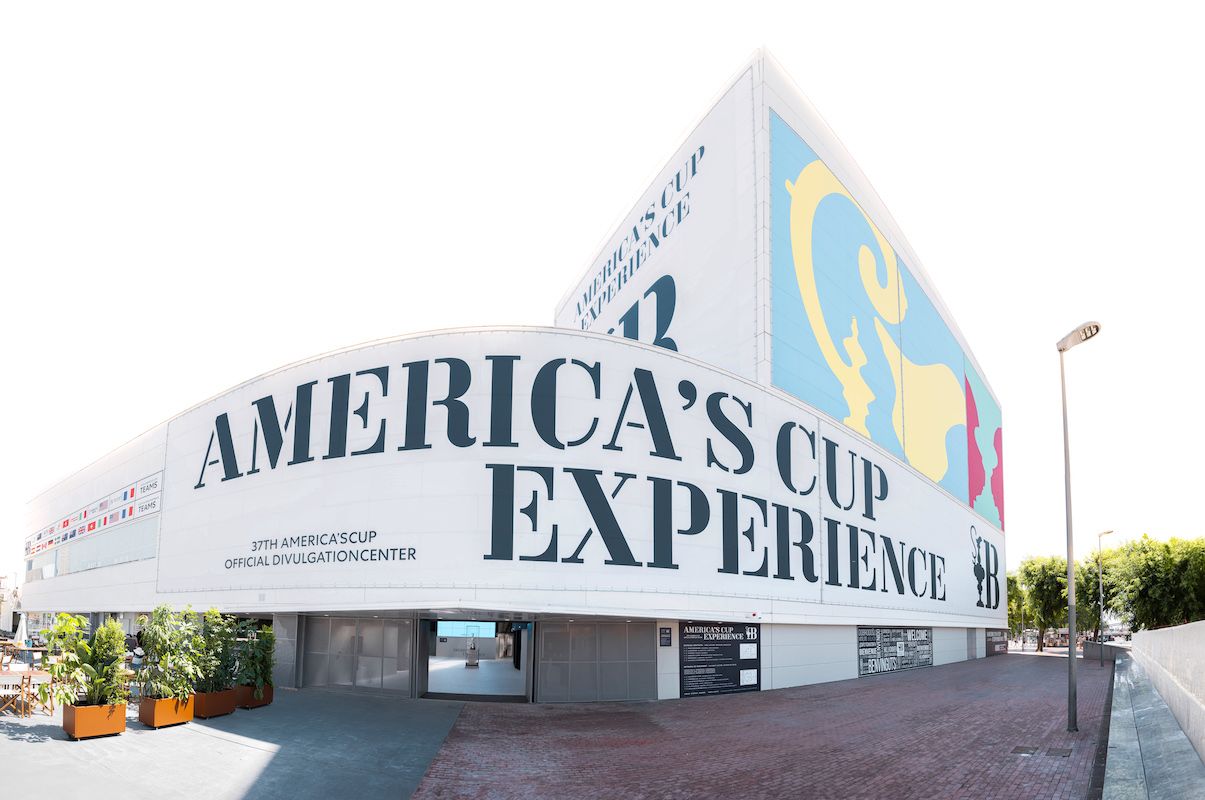
"Liceu Mar is not linked to the America's Cup. Today we contemplate that its new headquarters will be compatible with the Imax," explains the president of the Port. The possibility of erecting a building right in front of the cinemas, in the Plaza del Ictineu, currently a grassy area where many lie down to rest, is being evaluated. A change of criteria that comes after the launch of the America's Cup Experience has revalued the facilities. "The port had decided to demolish the Imax, but the America's Cup arrives and it is given a second life. A private investment of nine million euros has been made and it has been transformed into a very interesting space where activities are organized every week, and entities and companies use a cinema room with a huge screen, one of the largest in Europe. From here, the decision to demolish it is no longer so obvious because there is an investment that has had significant success," details Salvadó.
A scenario that could become even clearer if the America's Cup is held again in Barcelona, a possibility that is gaining strength, but which will depend on who wins the trophy. If Emirates Team New Zealand retains it, it will be easier to repeat as host. "We would have to adjust calendars, but, obviously, it would be a milestone and would allow us to accelerate more actions," adds the president.
A record year for containers and cruises in 2024
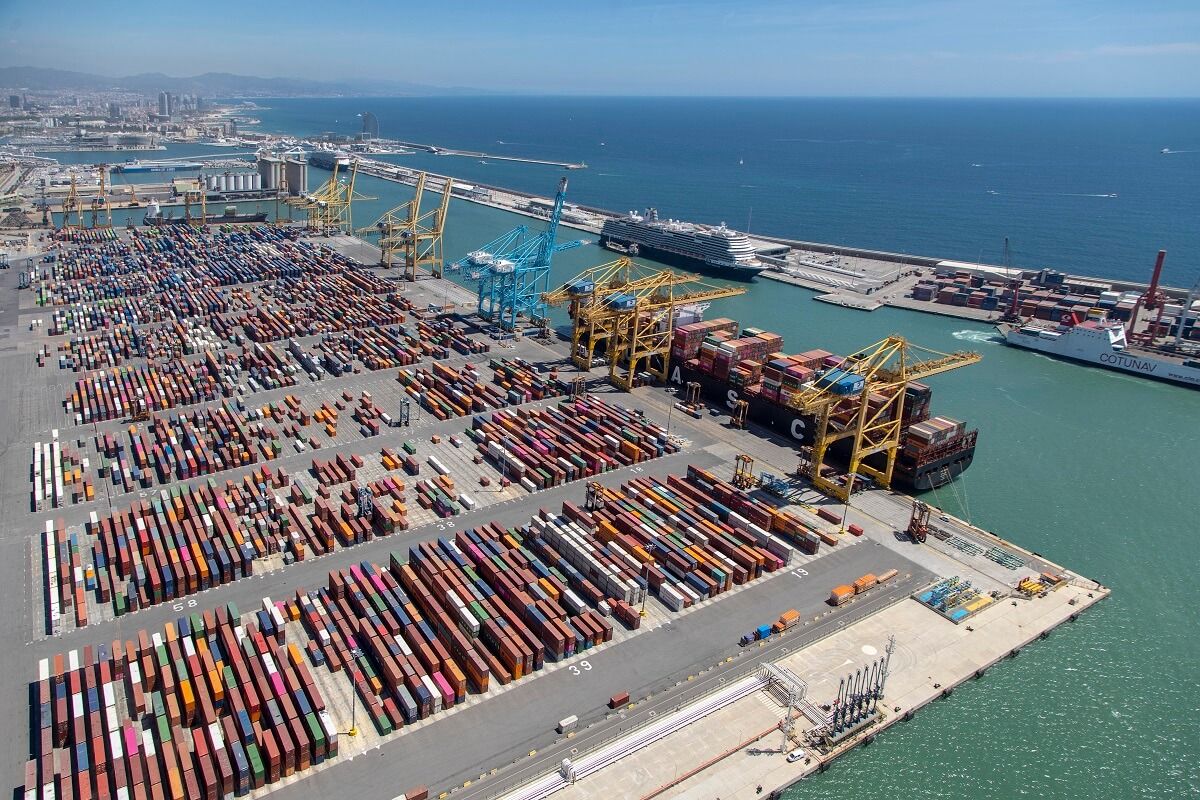
With all this transformation underway, the Port of Barcelona faces a 2024 that will not only be marked by the America's Cup, but by unprecedented results. With the wars in Ukraine and Gaza and the Suez Canal closed, the infrastructure has become one of the essential stops for distributing products towards the unstable Eastern Mediterranean. "We are attending to an overdemand for vessels. In recent months, container traffic has grown by 25%. Our record is 3.5 million containers and this year we could reach 4 million containers," indicates Salvadó.
Extraordinary circumstances that also affect cruises, an area that had already registered a record year in 2023, with 3.5 million cruise passengers. "There are no cruises in the Eastern Mediterranean, nor in St. Petersburg, a cruise city, all of this is closed and cruise passengers are looking for alternative routes, concentrating more demand in the Western Mediterranean," he explains, "this is not structural, when all this normalizes, it will return to a more relaxed situation."
The Port of Barcelona expects to reach the record figure of 4 million containers this 2024This constant hustle and bustle experienced by the port is detected when observing the line formed by different ships waiting to unload on the horizon. Barcelona residents will be able to see it firsthand next weekend in the first open daysorganized by the Port of Barcelona so that residents can discover its most hidden spaces, full of economic activity every day and with a thousand security measures that prevent more routine visits.Bus routes, on Golondrinas and on foot will serve to visit places such as the BEST terminal, the Logistics Activities Zone (ZAL) and the Farola lighthouse, the old beach of L'Hospitalet, but also to learn about the history of the Muelle de la Fusta and Barceloneta."Until now, only the 80 hectares that make up the Port Vell could be visited, out of a total of 1,150 hectares that the port has. These days are an opportunity to enter all those places that are usually restricted," explains Salvadó.
A few days before its celebration, many of the activities have sold out all tickets, with the forecast of attracting 16,000 residents. Activities that will allow the port to be known more as an economic engine and not only be associated with cruises, tourist overcrowding, and pollution. "We want to explain what the magical process is that allows a product to reach the shelves of the store where we go to buy from anywhere in the world. Sometimes, we may have the feeling that they appear randomly, but this small miracle occurs through the port, which is connected to 200 other ports. This also means that our industrial fabric can send its products anywhere and is what has allowed Barcelona to be an industrial city. The Industrial Revolution would not have happened here without the port," defends its president.
Add The New Barcelona Post as your preferred Google source for free
Stay informed with the latest news.
