
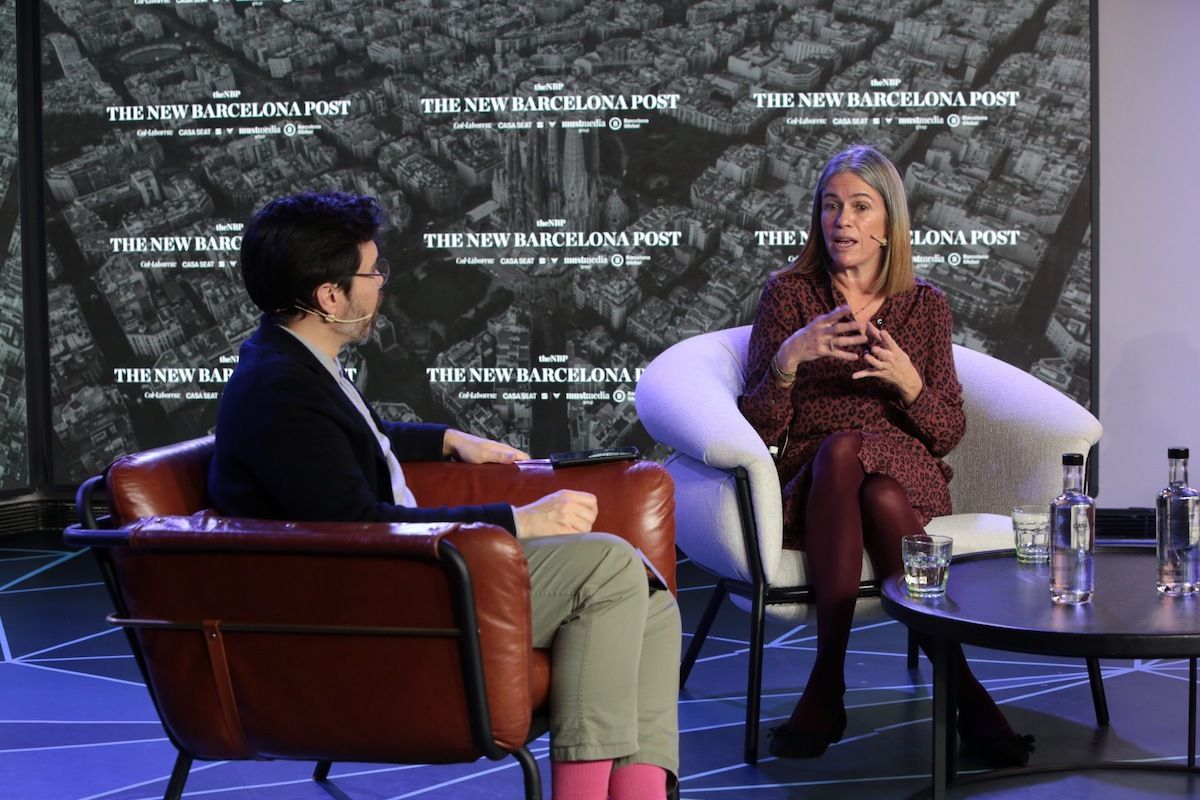
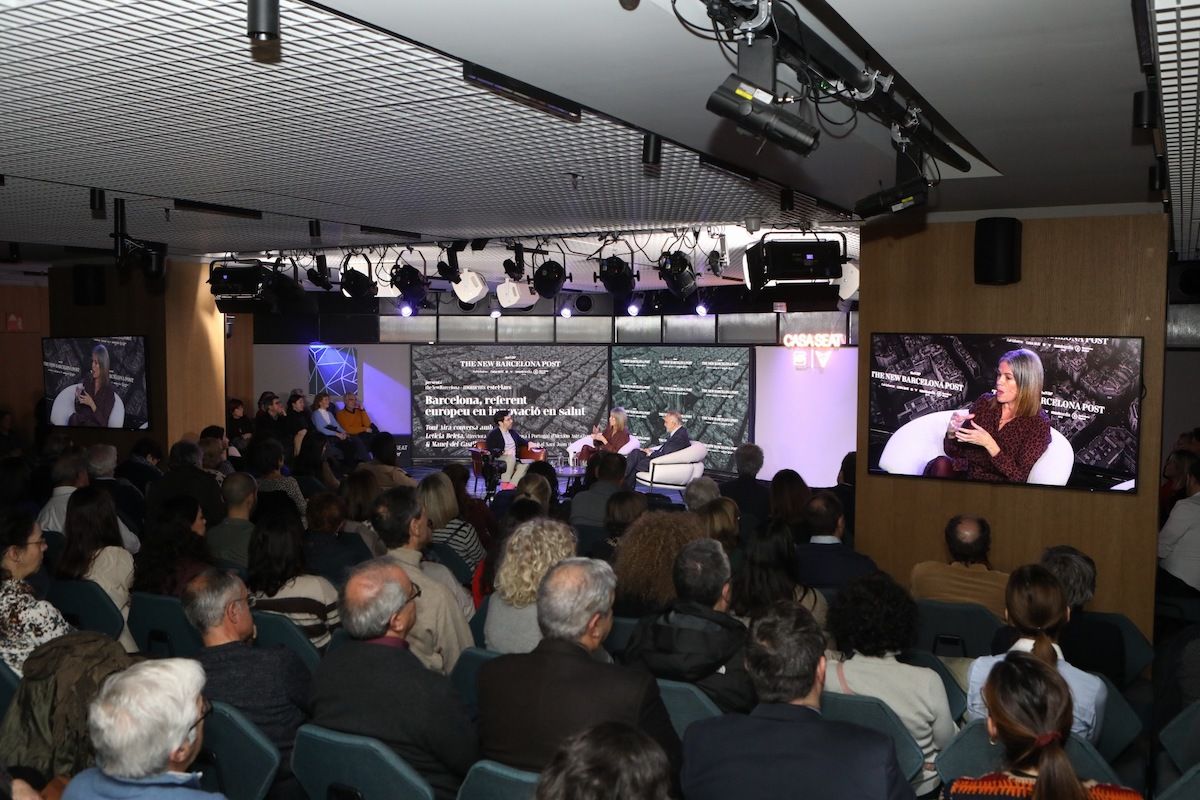
Collaboration is key in the healthcare field, and it is especially so when it comes to rare diseases. "The big issue with minority diseases is to collaborate," said the managing director of Hospital Sant Joan de Déu, Dr. Manel del Castillo. This collaboration must translate into an improvement in diagnostic tests and the processing of healthcare system data, added the director of the pharmaceutical company Alexion in Spain and Portugal, Leticia Beleta, in a new session of the cycle The New Barcelona – Moments Estel·lars, organized by The New Barcelona Post with the collaboration of CASA SEAT, Must Media Group and Barcelona Global.
In a room overflowing with attendees and conversing with journalist and UPF-BSM professor Toni Aira, both have highlighted the research being carried out from Barcelona in the field of rare diseases. "Rare, but not invisible," specified the managing director of the hospital, a reference in general pediatrics, and in pediatric oncology and rare diseases in particular. "They are rare individually but, when you put them together, they are the group of pathologies in Spain that affects the largest number of people", up to nearly three million, 350,000 in Catalonia. In total, there are about 7,000 minority diseases, and Sant Joan de Déu plays a prominent role at the state and European level in this field. From its leadership, it coordinates the Únicas project, which includes 30 hospital centers.
The importance of the "big N"
Hospital Sant Joan de Déu has an advantage given the difficulty that each minority disease affects a small number of people. Hospital Sant Joan de Déu is the healthcare center that treats the most children with minority diseases in Europe, and has more than 28,000 active patients with 1,300 different pathologies. "We have a big N. The N is the number of cases and, to be able to investigate, you need a critical mass, a minimum number of people that gives you expertise," explains Del Castillo, who has a trajectory of more than 35 years in hospital management.
To further broaden this N, the hospital coordinates Únicas, a "very disruptive and ambitious" project that brings together a working ecosystem in which a total of 30 Spanish hospitals participate. This "unique and pioneering initiative in Europe" aims to create and consolidate an "integral care model" that guarantees specialized and multidisciplinary care for pediatric patients with minority diseases. To this end, Únicas promotes a federated database to share knowledge and improve diagnosis and therapies. For this, it has funding of 46 million euros linked to the Next Generation, as Del Castillo has specified. It is in this project that the recent alliance that Hospital Sant Joan de Déu has forged with the La Caixa Foundation is inscribed, which, in the next three years, will contribute 7.5 million euros to the hospital to support the research it carries out on these diseases.
The Únicas project will operate from a new building that the hospital will have in the developing area that will be Porta Diagonal. Del Castillo has announced exclusively that on February 29 they will lay the first stone of the building, which will house all the necessary equipment to offer care, diagnosis, and therapy services for these diseases. The new property will have 15,000 square meters, designed as a personalized precision medicine center. To materialize it, Sant Joan de Déu has public funding and donations, with which it seeks to finance the project. In the area, the hospital will have this and another building, which it will rent to the City Council. This future Porta Diagonal, in Esplugues de Llobregat, aspires to become a hub in the health and scientific field that attracts startups and companies in the sector.
An ecosystem with a textile germ
This hub will join a powerful ecosystem that is being forged in Barcelona and its surroundings in the health and life sciences sector. In this area, Beleta has praised the legacy of an unexpected actor: the Catalan textile industry. The knowledge it generated around chemistry due to its processes and dyes facilitated multinationals to bet on Barcelona to locate production centers and factories. "We have a certain debt with that sector," Beleta claimed, adding to the equation the importance of Catalan family businesses that opted for the pharmaceutical field, among which he cited the promoters of laboratories such as Esteve, Uriach, Almirall, Grifols and Hipra.
This pharmaceutical tradition was the breeding ground for the current ecosystem in the health and life sciences sector. It has about 1,400 companies in Catalonia, as explained by Beleta, citing a study published hours earlier by Biocat. It was mainly because of this ecosystem that Alexion established its subsidiary for Spain and Portugal in Barcelona 15 years ago. It was also the reason why AstraZeneca, which acquired Alexion in 2021, has opened its R&D hub in Barcelona, which will move to the Estel Building in 2025. This ecosystem, the contact with hospitals and "the research seeds that were already there made Barcelona chosen among all possible candidates," Beleta said. AstraZeneca's new hub has 500 employees and plans to double its workforce in the coming years. It will do so by leveraging its "great capacity to attract talent, as there are already 33 nationalities sitting in the office."
In addition to highlighting the importance of having a powerful network of hospitals, research centers, and universities, Beleta also praised the role of agents linked to the economic sphere. "We have business schools and venture capital firms. We have all the pieces of the chain: research, funding, hospitals, universities, investment, and both public and private organizations that help us advance," added the Alexion executive, who has more than two decades in the pharmaceutical sector and has been vice president of the Spanish Association of Orphan and Ultra-Orphan Drug Laboratories (AELMHU).
Hospital Sant Joan de Déu is the healthcare center that treats the most children with rare diseases in Europe, and has more than 28,000 active patients with 1,300 different pathologies"Barcelona is a pioneer in addressing many of the challenges of rare diseases," Beleta proclaimed. And, from this cutting-edge condition, has called not only to expand collaboration but also to improve tests such as neonatal screening.Known as the heel prick test, allows diagnosing multiple diseases through a simple heel prick on a newborn. The number of diseases detected with the test differs between autonomous communities, ranging from seven to about 40 diseases —in Catalonia, 25—. "We have to continue coordinating to include more pathologies." Del Castillo has shared this demand, and has warned that "if you don't have a diagnosis, you don't have a prognosis, you don't know what will happen to your child."
Precisely the difficulty in diagnosis is another characteristic of rare diseases. In fact, Del Castillo has highlighted that 50% of people affected by these diseases do not have a diagnosis "with a surname," and 95% of them do not have a specific treatment. Beleta added that patients take an average of four years to obtain an adequate diagnosis, and that there will be patients who will die without knowing their condition. This reality affects patients' families beyond the disease itself, as many choose to move to the city where their child is being treated. "Families are our driving force. Mothers are authentic forces of nature," and they also fight to promote research and raise funds. And, according to Del Castillo, research into a minority disease can be boosted with 100,000 euros annually for three years.
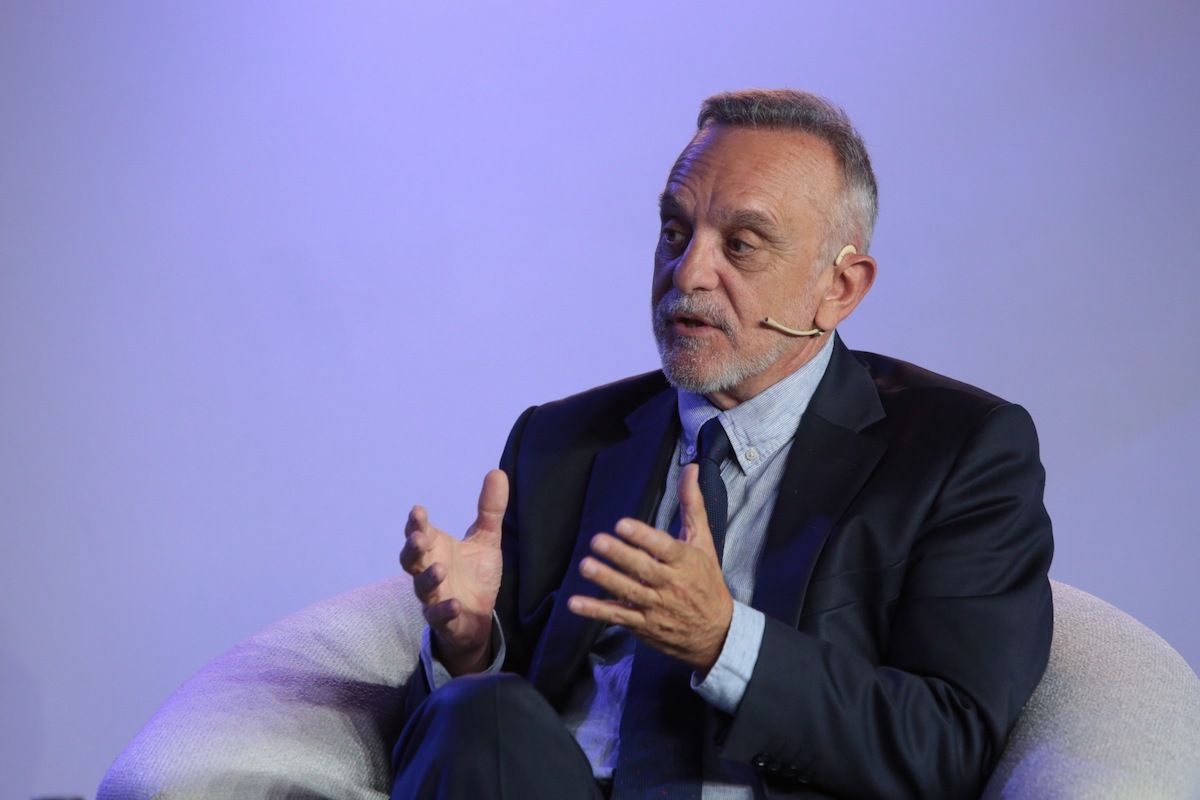
And, given these difficulties, why do Sant Joan de Déu and Alexion bet on research into minority diseases? "It interests us because of our DNA," explains Del Castillo, who recalls that his hospital order was born five centuries ago with the purpose of curing and caring for vulnerable people humanistically to advance towards a more just society. "And what is more vulnerable than a family of a child with a minority disease?".
https://open.spotify.com/episode/4hMkyL02jJTgUXFrCYp5Hc
Alexion also carries this interest in rare diseases in its DNA since it was born three decades ago at the hands of a researcher and a doctor in Boston. After initially failing with its treatment, it became one of the few companies dedicated exclusively to researching this type of disease. "It makes a lot of sense to investigate where there is no alternative, although it carries risk: we all have stories of failure" and difficulties in accessing treatments. "Many of us laboratories are aware that there are 7,000 diseases to respond to."
Beleta maintains that Barcelona has "all the pieces of the chain: research, funding, hospitals, universities, investment, and both public and private organizations, which help to advance"All of this framed within a context in which Barcelona has positioned itself in recent years as a clear European benchmark in innovation in the health sector. The city has developed a powerful health innovation ecosystem, in which universities, research centers, and multiple startups that are hatching in the Catalan capital and its surroundings. In fact, the startups in the healthtech sector are the most numerous within the set of startups Catalan. In addition, Barcelona has several projects underway that will be key for the life sciences sector. Among them are the future Ciutadella del Coneixement, the CaixaResearch Institute and the new Clínic, which is called to be a science and health hub for metropolitan Barcelona.
Add The New Barcelona Post as your preferred Google source for free
Stay informed with the latest news.
