
The Port de Barcelona's nautical bus already has a launch date: it will begin operating on July 1, about a month and a half before the America's Cup begins, a competition that has accelerated the transformation of Port Vell. The Port's board of directors has approved awarding the service concession to Nex Continental Holdings, which will formalize a temporary union of companies (UTE) with the Cantabrian company Bahia Zero. Both companies are subsidiaries of the road passenger transport group Alsa, which already operates a similar nautical bus service in Santander Bay.
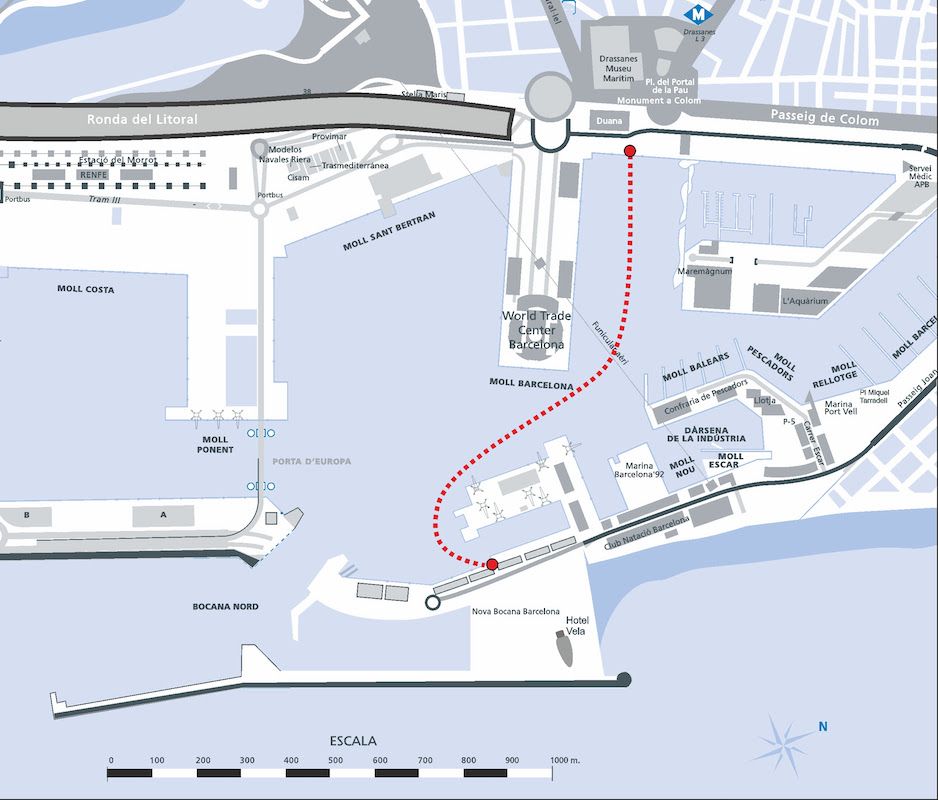
The new service, which has been awarded for 15 years, will connect Moll de Drassanes, at the foot of the Columbus statue, with Nova Bocana ---next to the W Hotel---, and will do so with two zero-emission vessels. To launch this maritime shuttle, the concessionaire will make investments at both ends of the route. Overall, the launch of the service will involve an initial investment for the concessionaire of 1.87 million euros, directed at the two vessels and the conditioning of the maritime station and the Portal de la Pau stop. The nautical shuttle will allow travel from one point to another by sea without having to go through the busy Paseo Joan de Borbó, avoiding a long detour through Barceloneta.
Each of the two vessels, equipped with solar panels, will have a capacity of 70 people, and will provide service at least 12 hours a day. The maximum fare for the journey will be 1.9 euros, with discounts for children, young people and seniors, and with passes for ten trips, and two and three days. Once the new service begins to operate, new stops may be proposed by the concessionaire, who won the service by winning a process in which two other candidacies competed, linked to Grimaldi, on the one hand, and Moventia and Transports Metropolitans de Barcelona (TMB) on the other.
To launch the new nautical bus in the Catalan capital, two stops will be created at both ends of the route. The Drassanes stop will be at Portal de la Pau, between the Rambla de Mar mobile bridge and the World Trade Center's Barcelona pier, also the starting point for the traditional Golondrinas. For its part, the Llevant stop will be located in the new maritime station that will occupy the old sheds, now undergoing rehabilitation to house a new innovation hub and a restaurant service.
The nautical bus will represent an improvement in the connection between spaces in Port Vell, which is advancing in its opening to the public at an accelerated pace due to the America's Cup. The nautical bus will connect two areas where this transformation is more than palpable: on one side, a Moll de Drassanes that, with the works of La Rambla as a backdrop, contemplates the rehabilitation that will rescue the Portal de la Pau building from abandonment. At the other end, the Nova Bocana, which recently completed its transformation with a new rambla. To this new promenade, which will lead to a gastronomic proposal that will open before the competition, is added the viewpoint at the foot of the W Hotel that was enabled in 2022, and which configures a Nova Bocana that is ready to receive visitors who travel with the future nautical bus.
Moving towards sustainability
The Port of Barcelona has awarded the service, setting as the main condition of the tender that the vessels must be zero-emission. Thus, it has opted for boats equipped with propulsion systems with solar panels or hydrogen, and with connection to the electrical grid.
Also in the interest of sustainability, the board of directors has taken another step towards the manufacturing of green fuels from the port. Specifically, it has approved the early recovery of six hectares of the concession of Muelles y Espacios Portuarios (Mepsa), which operates on 42 hectares in the Moll de l'Energia. The Port has made this decision to dedicate this space to the future green fuel manufacturing plant, within its strategy to advance towards sustainability.
To compensate for the recovery of these six hectares, the Port has increased the concession period for the rest of the space, which is extended from 2035 to 2043. The operation has represented an advance for the port in its strategy to reduce its environmental impact, which includes this zero-emission fuel plant, as well as the electrification of docks, the use of alternative fuels such as liquefied natural gas, and the relocation of cruise operations to docks further away from the urban fabric of Barcelona.
Add The New Barcelona Post as your preferred Google source for free
Stay informed with the latest news.
