
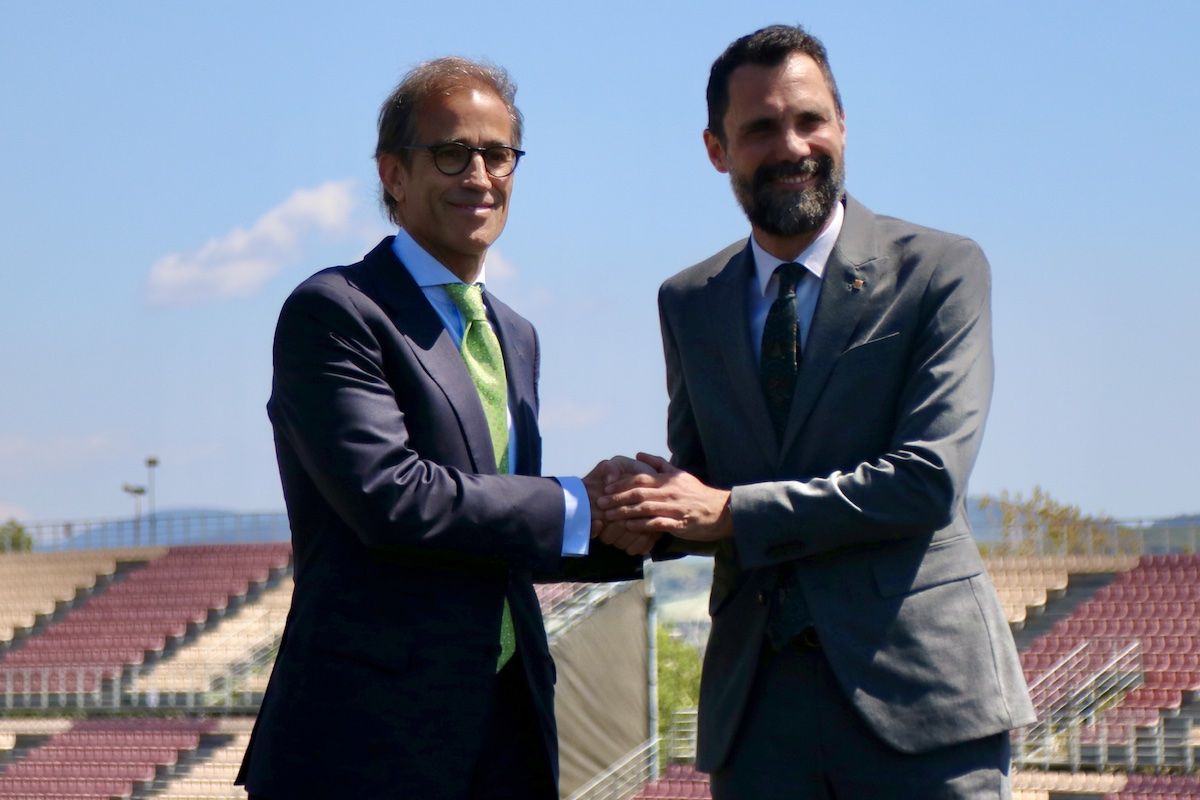
Attending a big concert or a trade fair event with a motor racing circuit as a backdrop is unusual, but it may soon cease to be so. Fira de Barcelona and Circuits de Catalunya have signed the agreement that culminates a negotiation process that began a year and a half ago, and through which the trade fair organization will manage and operate the facilities of the Montmeló circuit starting in 2025. With an initial duration of two years, extendable to 20, the agreement establishes a payment by Fira de Barcelona that combines a fixed annual amount of at least nine million in 2025 and ten million in 2026, plus a variable amount based on revenue, which will be 25%, up to 45 million, and 20% if revenue scales beyond that.
This agreement, which is not conditioned on the continuity of events such as Formula 1, aims to optimize the exploitation of the facilities, which involves diversifying their activity and opening them to other areas, beyond motor sports and also sports in general. And what activities could be brought to the circuit, its stands, and its asphalt tracks? "Over the next few months, we will delve into this potential," explained the general director of Fira de Barcelona, Constantí Serrallonga, from the circuit. With these new uses yet to be defined, he gave some hints about what kind of activities and attendees could fill the circuit in the future: large musical and cultural events, as well as new business models related to trade fairs and congresses. Thus, the agreement opens a scenario in which it will not be unusual for the circuit to host congress activity, such as complementary events to large trade fairs like the Mobile World Congress, the Integrated Systems Europe show, or Seafood, which is precisely taking place at Fira de Barcelona's Gran Via venue.
To these possible uses will be added others such as those linked to business tourism, incentive travel and healthy leisure, as well as the sustainable mobility industry. In fact, one of the main axes on which this alliance pivots is precisely the desire for the circuit to act as a "platform that helps the reindustrialization" of Catalonia, especially in the field of mobility and its sustainable aspect. "We want it to be a springboard for developing industrial projects and for a new axis to be constituted around 21st century mobility," proclaimed the Minister of Business and Labor, Roger Torrent. All with the underlying objective of "connecting the circuit more and better with its industrial environment," according to the CEO of the Circuit de Barcelona-Catalunya and also general secretary of the Ministry, Oriol Sagrera.
The management and operation of the circuit will fall to the new company Fira Circuit, wholly owned by Fira de BarcelonaAnd the fact is that the motor industry generates 6.5% of the wealth in Catalonia, as highlighted by the mayor of Barcelona and president of the General Council of Fira de Barcelona, Jaume Collboni. With the sound of vehicles circulating on the background track, Collboni stressed that the incorporation of the circuit among Fira's spaces will facilitate the task of "relieving pressure on the city of Barcelona" and will allow gaining a space for the metropolitan region. With an additional challenge ahead: connecting the Catalan capital to the circuit with a train that now passes next to the infrastructure but without stopping.Specifically, it is the R3 of Rodalies, whose tracks run alongside the facility in its section between Parets del Vallès and Granollers, but without a station that allows alighting in the vicinity of the circuit.
A new stage
After more than three decades, the Circuit de Barcelona-Catalunya opens a new stage in which it will cease to be exclusively a motor racing track. The diversification of its activity, which begins in a context of doubts about the continuity of F1 in the facilities, also responds to the desire to generate more business and for the Generalitat to be able to reduce its contributions to the infrastructure, as Torrent has explained. The agreement and the future expansion of the circuit's uses are part of a strategic plan for Circuits de Catalunya, which also includes its desire to move towards sustainability and to modernize the Montmeló facilities. To this end, an investment of more than 50 million is underway to improve the infrastructure, as highlighted by the minister, who also presides over the Circuit de Barcelona-Catalunya. In fact, the Generalitat is the main shareholder of the company, with 85%, while the RACC and the Montmeló City Council distribute the rest.
A new asset for Fira de Barcelona, which will operate with four venues
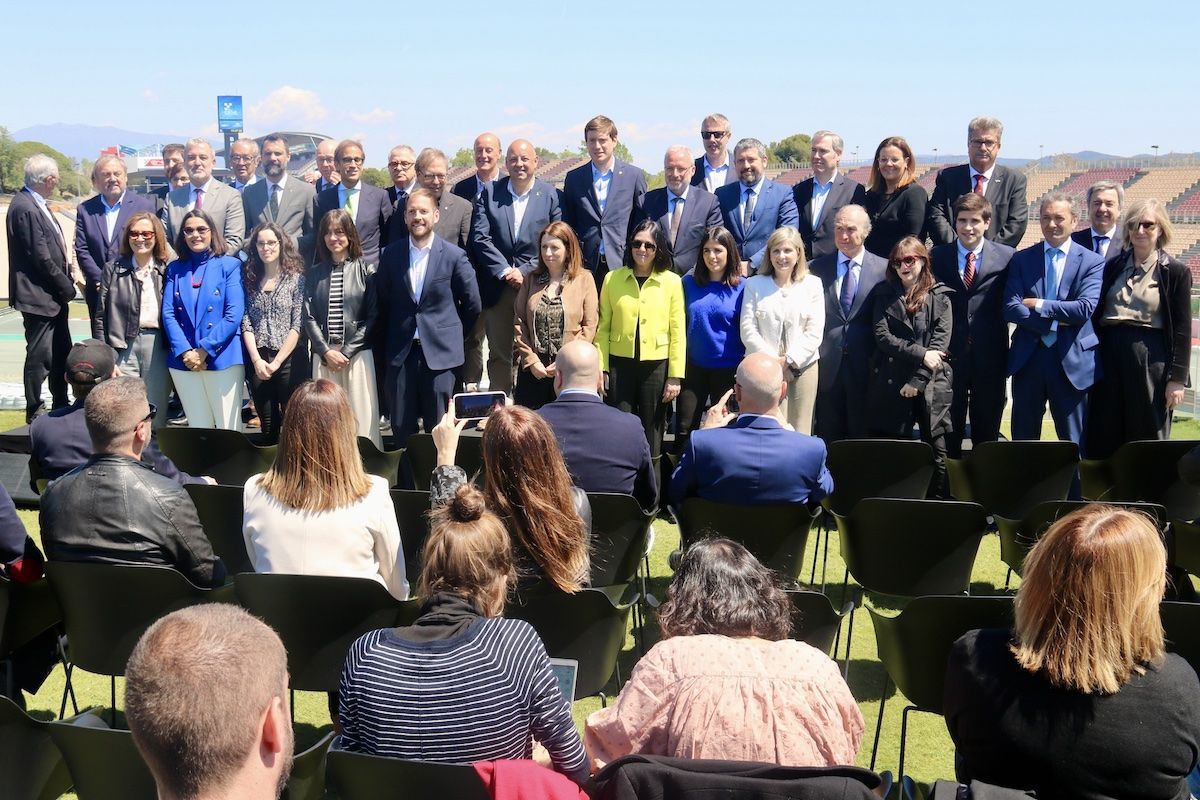
Incorporating the circuit into Fira's portfolio of facilities will reaffirm the fair entity's position "as an organizer of leading international events", guaranteed the president of Fira's board of directors, Pau Relat. By assuming its management and operation, Fira "will put all its know-how in holding major reference events at the service of the infrastructure", according to Relat, who described this agreement as historic.
Through this, Fira expands its attraction potential and its already consolidated position as an international benchmark in the fair and congress sector by operating with four venues with very different characteristics. The circuit will be a unique venue within a constantly evolving portfolio: in 2021 it included the Barcelona International Convention Center (CCIB) among the facilities under its management, and currently both its Montjuïc venue and the Gran Via venue are immersed in improvement processes. For its part, the historic Montjuïc, will undergo a renovation that will coincide with the centenary of the 1929 International Exhibition, and the Gran Via will be expanded with the new Hall Zero pavilion.
The circuit faces the future with an additional challenge: the connection with the Catalan capital with a train that now passes by it but without stopping at the facilityIn this framework and after a record year for Fira, Relat has highlighted the importance of public-private collaboration: "When we work together and with a vision of consensus, we win the big prizes," he said as a nod to the continuity of F1 in Montmeló, in a context where it is guaranteed in Montmeló until 2026.
The extension of F1 will not condition the recently signed agreement, which stipulates that the management and operation of the circuit will fall specifically to the new company in formation Fira Circuit, wholly owned by Fira de Barcelona. The contract foresees the subrogation of most of the 52 employees of Circuits de Catalunya, who will maintain their working conditions. The agreement will also not modify the ownership of the assets or the F1 and MotoGP contracts, which will remain the property of Circuits de Catalunya, in a scenario where the promoters of the agreement have been optimistic about the future of the event in Montmeló.
Add The New Barcelona Post as your preferred Google source for free
Stay informed with the latest news.
