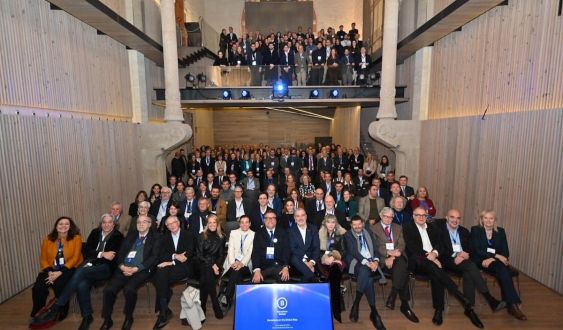
The cultural landscape of Barcelona is experiencing a moment of blossoming that faces its future with optimism. Successful films like El 47, international exhibitions and festivals, and projects such as the creation of a Carmen Thyssen Museum in the former Comedia cinema and the expansion of the MNAC and the Macba are some of the initiatives the city is preparing to exploit its cultural potential and consolidate itself as a stage where cultural initiatives can develop and emerge with their full potential.
This has been confirmed by professionals and cultural references from fields as diverse as music, cinema, contemporary art, gastronomy, and digital arts, in a debate on culture at the modernist Sant Pau venue promoted by Barcelona Global, whose president, Ramon Agenjo, has praised Barcelona's cultural sector. The Damm board member also recalled that the association will turn 15 in 2025, and focused on the next 15 years: "The challenge is to know what we Barcelonans will be like in 2050, if we will have the same traditions and the same beliefs."
And the city looks towards this future determined to be a cultural reference in every sense. "Making culture our surname gives us added value and gives us identity," defended the mayor, Jaume Collboni. In this context, Barcelona is in a moment of cultural expansion in all its aspects, in a positive moment in which challenges continue to exist, as recalled by the president of the Associació d'Empreses de Teatre de Catalunya (Adetca), Isabel Vidal: "Barcelona's culture has a very important duty, which is to finish attracting segments of society that it is not reaching."
In this sense, the general director of the Focus group has also called for continued engagement with society as a whole, from a sector that provides Barcelona with a "cultural singularity" and a perspective that differentiates it from other cities. Precisely from this cultural perspective, the city now seeks to attract higher quality tourism, an objective also supported by chef Sergio Torres, in an event that brought together 300 members of Barcelona Global.
The promoter of Hermanos Torres, along with his twin Javier, has launched this defense for quality tourism instead of mass tourism, and has maintained that Catalonia has the opportunity to continue positioning itself in this regard by acting as World Capital of Gastronomy in 2025: "We have the opportunity to show the world our culture, also our table culture, and to demonstrate all the potential we have."
From the cinematographic field, Barrena also sees a change in trend towards a cultural explosion, with films like his El 47 and Casa en Flames, by Dani de la Orden. Its success has not occurred this year by chance, but because "institutions have believed in Catalan cinema" and have invested in it. "Cultural change is also a change in financing", because, without it, "no matter how much talent there is, it is useless if it does not have the tools it needs."
Creativity is a distinctive feature of Barcelona and can be fostered through debate and the exchange of ideasThe success of House on FireandThe 47can contribute to facilitating this financing of Catalan cinema by platforms and production companies. "Now we can defend the success it can have; until now, there were hardly any references." And now, they are there,"and at a cultural level it represents a paradigm shift: they show that, if we have the funding, Barcelona explodes."
The director of the Cruïlla Festival, Jordi Herreruela, has also focused on the financing of the cultural sector. "Cultural initiatives often arise in the city that do not find capital here, and are forced to go abroad and find it in other countries, and that makes us lose governance of the city's cultural industries," he stated.
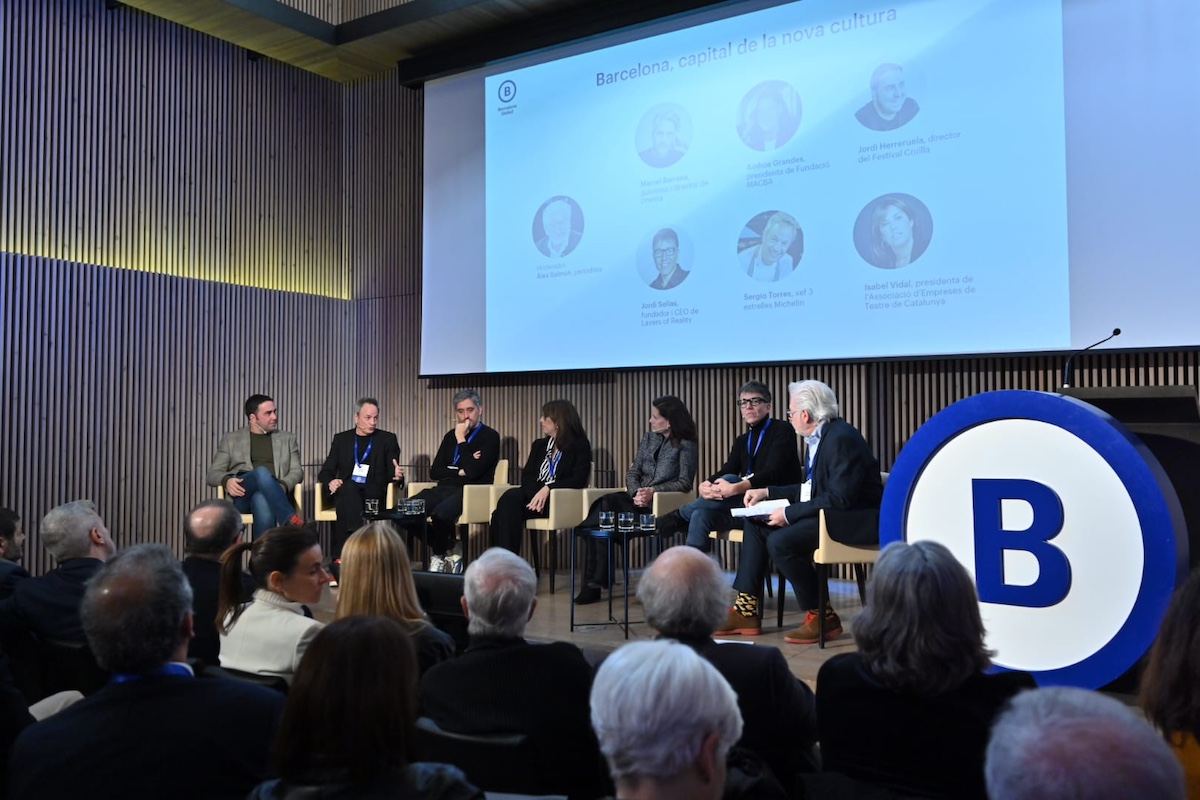
Herreruela, who believes that creativity is a distinctive feature of Barcelona and that it should be fostered through debate and the exchange of ideas, has advocated for the city and institutions to project large infrastructures specifically designed for musical events that are now held in the city mainly in originally sports infrastructures.
Thus, to continue propelling this cultural blossoming, the public sector must go hand in hand with private initiative. However, the equation does not end here: "If we want quality culture, citizens must get involved," defended the president of the Macba Foundation. And it must do so at a time when, according to Grandes, Barcelona faces a very positive 2025 in the cultural field.
"Different activities within culture are blossoming in Barcelona because we have a different frame" in which this area is supported, according to Grandes, who stressed that this expansive trend of culture in the city is also occurring at Macba itself, with the contemporary art prize that the foundation has created and with its expansion, which will lay the first stone in February: "We are experiencing a very sweet moment."
Barcelona has the opportunity to position itself in the field of digital arts and to "compete face to face with the great capitals of the world"This sweet moment is also being experienced in the digital arts sector, as pointed out by the CEO of Layers of Reality, Jordi Sellas. The also director of the Ideal Digital Arts Center has warned that this sector is booming worldwide, and that"Barcelona has the opportunity" to be a leader in this field.
The city, in fact, is already positioning itself in this regard, with initiatives such as the reconversion of the Tres Xemeneies of Sant Adrià de Besòs into an audiovisual hub, and with the future digital arts center of La Foneria de La Rambla: "We can lead a new artistic division, which is digital arts, from Barcelona. We are better positioned than ever to do so, and it rarely happens in art that a new category is generated and you can compete face to face with the great capitals of the world."
From biotechnology to child care
The six cultural figures have shared their points of view from their respective perspectives after a peculiar welcome as hosts of two of the initiatives based in the modernist complex of Sant Pau: Capital Cell and the Fundació Enriqueta Villavecchia, two distinct projects that are interrelated. For his part, the CEO of Capital Cell, Daniel Oliver, recalled the work of his company as an investment platform in biotechnology, "born in Barcelona and not by chance, and that is because we are in one of the most dynamic cities in the field of biotechnology."
And this investment platform is committed to another project located in the Sant Pau complex: that of the Fundació Villavecchia, focused on sick children and which is promoting a center for minors with incurable diseases and their families, a hospice in the Santa Victòria pavilion. "We have started the works, with a planned investment of 6.5 million euros, and we are receiving a lot of support, but we still do not have all the investment raised," highlighted Anna Varderi, manager of the foundation. The initiative is close to four million euros raised, and will continue working to gather the total needed, also through Capital Cell, to build a pioneering service not only in the city, but at a national level.
Add The New Barcelona Post as your preferred Google source for free
Stay informed with the latest news.
