
The first public museum built in Catalonia officially reopens its doors. The Centre Martorell d'Exposicions in Parc de la Ciutadella has hosted its formal inauguration, a grand opening with authorities and representatives of what will be the future community of the Ciutadella del Coneixement. The event has been long-awaited until the main access was free of scaffolding, and it has been the culmination of works started in 2021 that showed their end when the center opened its doors to visitors in December.
With its opening, the exhibition center leaves behind its previous state of deterioration and becomes the second facility to open to the public within the framework of the Ciutadella del Coneixement, after the Hivernacle did so in December, just a few steps from the Martorell. The new center aims to contribute to consolidating the more scientific aspect of the Ciutadella and to bring science closer to the public, through the exhibitions that its more than centenary neoclassical building will host.
The historic and unique building, which is now integrated into the network of the Museu de Ciències Naturals de Barcelona, has two exhibition spaces and a multipurpose room, distributed in the two wings that symmetrically branch off from the central entrance. The center opened in 1882 as Museu Martorell, and in 1924 it was reconverted into the Museu de Geologia, until it closed its doors in 2010. With this inauguration, the space begins its third life, as a center for scientific exhibitions on topics with a high impact on society, such as the climate crisis and biodiversity.
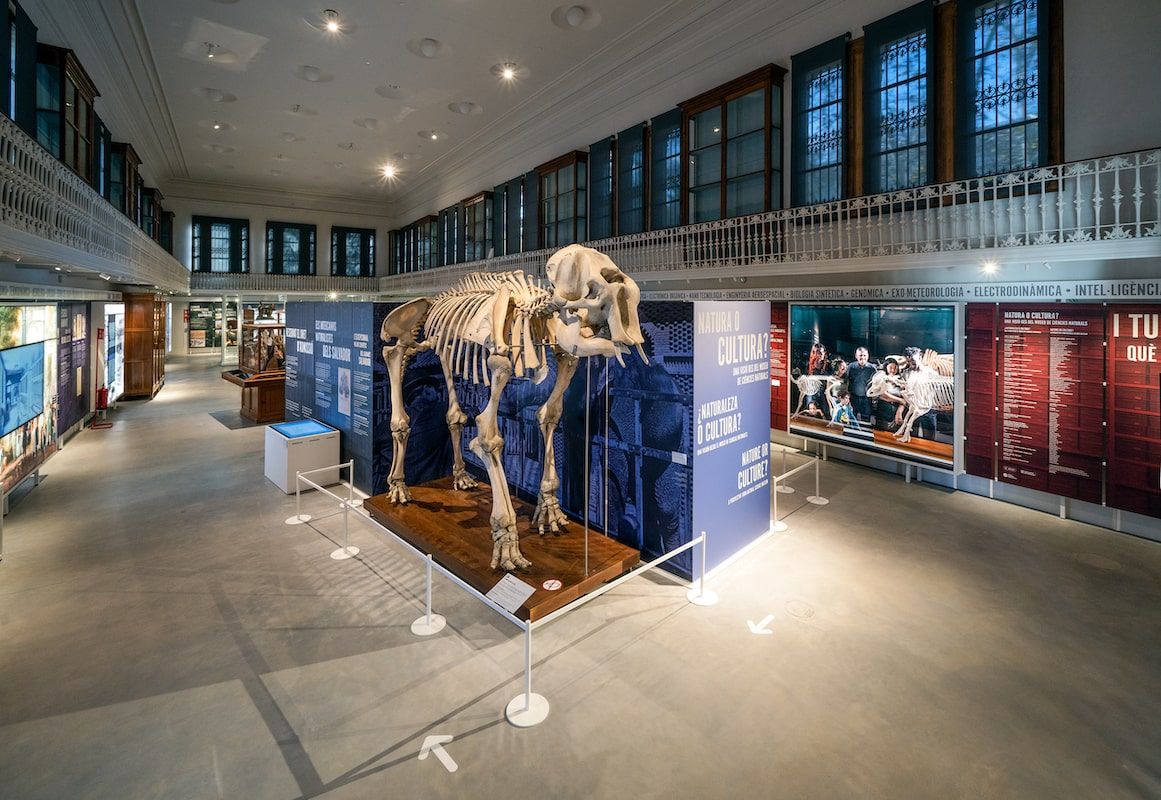
The center has reopened to the public after more than a decade of inactivity with the ambition of collaborating with the scientific and technological institutions in its surroundingsIts past as a geology museum is still palpable, especially because of the wooden shelves and display cases that once served to display all kinds of minerals, and that refuse to leave the place. Most are empty and watch the scene unfold from the balcony that acts as an upper floor, for now inaccessible to the general public. Part of the old furniture has been used for the exhibition Nature or nurture? that explores the frontier precisely between nature and culture in natural science museums.
This exhibition, produced by the museum itself, reviews the history of natural history museums and combines modern museographic resources with emblematic pieces, such as the skeleton of one of the elephants that lived in the nearby Barcelona Zoo and, above all, the models of extinct animals that were designed to populate the Ciutadella, of which finally only the characteristic and popular Mammoth was brought back to life.
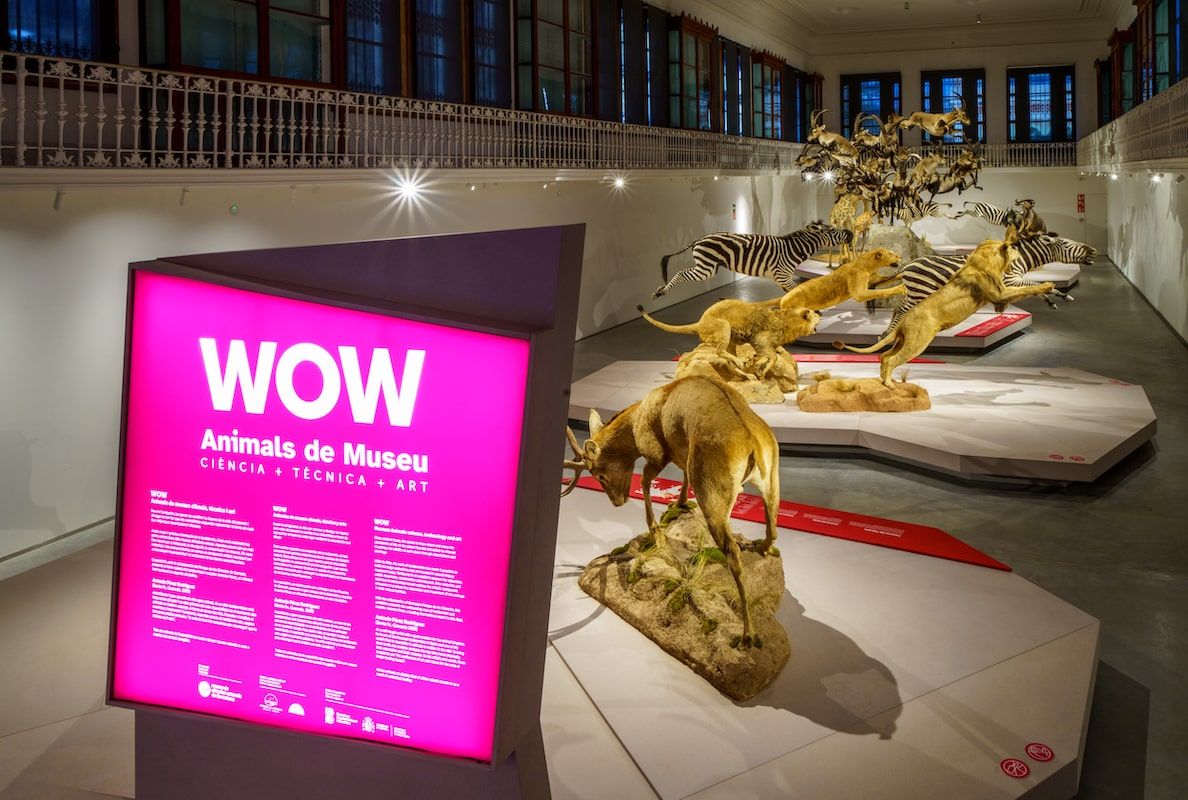
This exhibition is complemented by Wow. Museum Animals: Science, Technique and Art, with the collaboration of the Parque de las Ciencias de Granada. Visitors come face to face with hunting lions, in an exhibition dominated by stuffed animals arranged in the most unexpected compositions, in a taxidermy in motion that leaves no one indifferent. Both temporary exhibitions will remain in the space for between eight months and a year, and for now the exhibitions that will replace the two current ones have not been finalized.
6.2 million restoration
The comprehensive rehabilitation of the space began in 2021. Promoted by the Barcelona City Council and the Generalitat, the restoration has a global budget of 6.2 million euros, in works that have not yet finished. It remains to repair and recover elements of the building's facades, in works that are expected to begin in September and that will not hinder the activity of the exhibition center. The works already carried out have included the opening of an access to the center via Paseo Picasso, with the aim of making it more accessible from the neighborhoods surrounding the Ciutadella. The restoration of the main entrance, inside the park, has been completed with works that have not let up until hours before this official inauguration.
The center has reopened to the public after more than a decade of inactivity with the ambition of collaborating with the scientific and technological institutions in its environment, as highlighted at the event by the Minister of Culture, Natàlia Garriga. So much so, that in the front rows of the event sat representatives of the institutions that will form the future Ciutadella del Coneixement. Among them were the president of the Barcelona Institute of Science and Technology (Bist), former minister Andreu Mas-Colell; the rector of the Universitat Pompeu Fabra (UPF), Laia Nadal; the director of the Barcelona Biomedical Research Park, Jordi Camí, and the director of the CSIC in Catalonia, Lluis Calvo, as well as the director of the Ciutadella del Coneixement project itself, Francesc Subirada.
The reconversion of the city's oldest park into the Ciutadella del Coneixement has a global budget of 290 million"The Martorell Center stands in favor of knowledge and science, and against science and climate change deniers," proclaimed the mayor of Barcelona, Jaume Collboni. The mayor recalled that, during the coming years, progress will also be made in the rehabilitation of other emblematic buildings on the verge of abandonment in the "Central Park that is modestly the Ciutadella", such as the Castell dels Tres Dragons and the Umbracle. "We are witnessing a certain cultural, scientific and economic rebirth of Barcelona," Collboni guaranteed, who highlighted the future Hospital Clínic and the reform of the Montjuïc fairgrounds, in addition to the Ciutadella del Coneixement project.
This reconversion of the city's oldest park into a hub of science and knowledge has a global budget of 290 million euros, and will have as its spearhead the research complex being built in the old Mercat del Peix. It will also feature the CSIC Bioscience Pole, and also the future Central Library, which will be located next to the Estació de França. A set of facilities that aim to position the Ciutadella as a key node of knowledge, research and dissemination for the Catalan capital.
Add The New Barcelona Post as your preferred Google source for free
Stay informed with the latest news.
