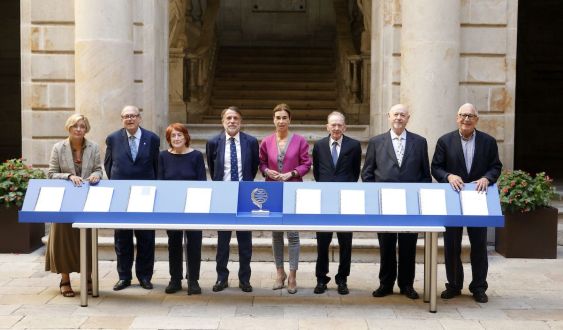
After last year's heart-stopping edition, the Planeta Prize is warming up for a new gala with the unknown of whether it will be able to achieve surprises like the unmasking of Carmen Mola. For now, what the award has achieved in its 71st edition is the highest participation in history, with 846 manuscripts submitted, almost 200 more novels than last year, which was also a record. Furthermore, this year, according to the group's president, José Creuheras, the definitive door will be closed on the pandemic, recovering the absolute normality of the traditional multitudinous ceremonies at the Museu Nacional d'Art de Catalunya, without any capacity restrictions and already forgetting masks, hydroalcoholic gels, and the like.
One day before revealing the winning novel, the publishing house has released some details about this year's finalists, among which there have been setbacks. While traditionally ten stories reach this final phase, the award has seen one had to be eliminated a few days before the delivery, with so little margin that it could not be replaced by another. One of the requirements for submitting a manuscript is that it must be unpublished, and La niña del castillo de los almendros en flor, by Fernando Preto Rodríguez, had been self-published in 2021. For those interested, it can be found on platforms like Amazon.
The eliminated novel deals with the murder of a young man in a famous hotel in Seville and the subsequent investigation. Precisely, and despite the discard, the crime genre has been one of the most popular in this edition, stressed Juan Eslava Galán, a member of the jury. In fact, another finalist, El arpista, by David Galindo Martínez, also addresses mysteries that occur in a hotel, in this case, located in Cabo de Palos, Murcia, with disappearances of clients who, coincidentally, are German, which ends up relating the story to Nazi Germany.
Historical plots have been the other genre that has gained the most weight in this edition of the Planeta Award. Among the nine finalists, there are examples such as The Weaknesses of the Führer. History of a Race: German Shepherds, presented under the pseudonym Iñaki Carrera and also with Nazi Germany as the common thread; El avionazo, una historia de Frida y Marilyn, by José Manuel Mata Muñoz; Magdalena, la mirada del corazón, written by an invented writer named Ho Hanan; Río arriba, by Hoja de fresno, also a fictitious name, and La ciudad de las ilusiones, by Manuel Millán Sánchez, a title and a plot that recall one of Eduardo Mendoza's best novels, La ciudad de los prodigios, winner of this award in 2010.
After murders and history, love and its problems star in the rest of the finalist plots, all of them presented under pseudonyms, with Plumas y arena by Álex Oneida; El amante de mi mujer by Gabriela Hausmann, and A más de siete mil kilómetros by Alma Browncross. As Eslava has explained, female empowerment is gaining prominence in the presented plots.
This year's winner will once again take home one million euros, pending whether they will have to share it among three writers or a single author will be able to enjoy it, while the finalist will have to settle for 200,000 euros. As Creuheras has reminded, the Planeta Award continues to be the best endowed in the world, even above the Nobel Prize in Literature.
Good time for reading
The publishing world continues to experience a sweet moment, with growth of more than 20% in the last two years, after having revealed itself as a safe entertainment in times of lockdowns and restrictions. "It is a consolidated sector with growth typical of an emerging industry," said the director of the Bookstores area of the Planeta group, Jesús Badenes.
All of this, despite the economic recession, with already overcome episodes such as paper shortages. Thus, Planeta experienced "one of its best years" in 2021, with a turnover of 1.7 billion euros, up 13%, and a 50% reduction in debt, which stood at 250 million euros. For this 2022, and awaiting to see how the last months evolve, essential for the publishing sector and with increasing uncertainty, the group foresees revenues above last year's. For now, they have contained the inflationary trend with a 5% increase in book prices.
Despite the group's financial cleanup, with a presence also in the audiovisual and training sectors, they do not contemplate any major corporate operation in the short term. The divestment in Italy, where they had launched a label aimed at young audiences that did not quite work, has not had a major impact on the results either. According to Creuheras, this business area registered a turnover of only five million euros.

Add The New Barcelona Post as your preferred Google source for free
Stay informed with the latest news.
