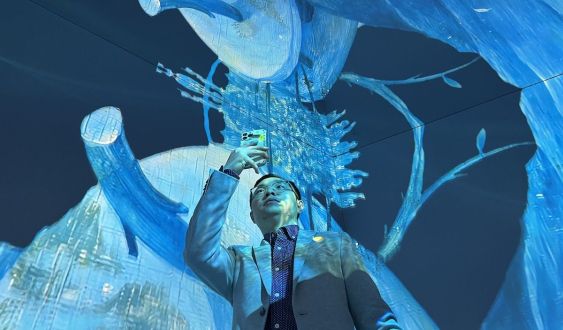
Integrated Systems Europe (ISE) has opened its doors at Fira de Barcelona's Gran Via venue with the largest exhibition area in its history, occupying six of the eight pavilions of the fair complex, with a total of 57,000 square meters, 30% more than last year. "This will be the biggest ISE we have ever done," said its general director, Mike Blackman, shortly after the inauguration of this year's edition.
As can be seen at the L'Hospitalet de Llobregat venue until Friday, the 4,000 square meters of pavilion 2 it occupied in 2021, its first time in Barcelona, are a distant memory, and the 45,000 square meters spread across five pavilions last year are also surpassed. In fact, the largest stands this year will be Samsung's, with 1,700 square meters, and LG Electronics', with 1,100 square meters. Looking even further back, in the 2004 edition, the entire show totaled the same area as both exhibitors now have.
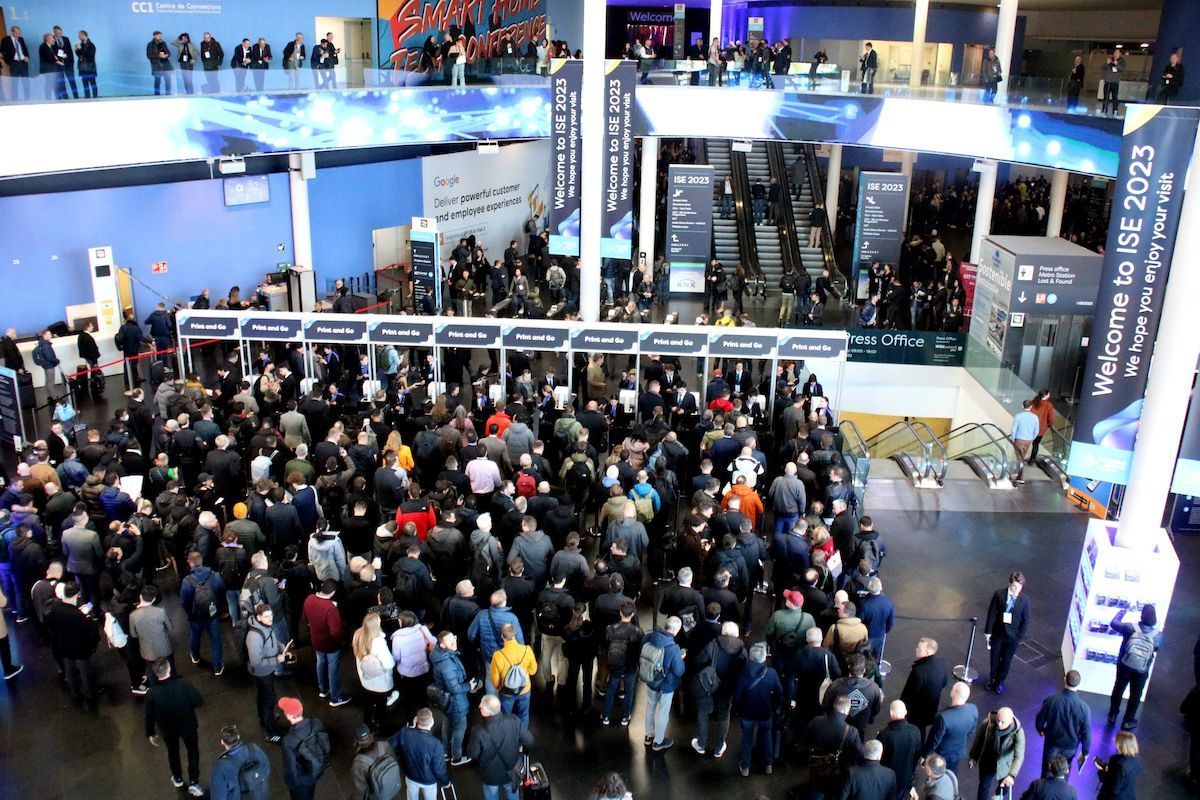
The hustle and bustle was noticeable from early morning, with queues to pass controls and print accreditations, a fair complement that the pandemic ensured would not return but that custom has not been able to eliminate. At the entrance, a DJ welcomed attendees with enviable and somewhat surprising power, especially for early risers.
The aisles quickly filled with congress attendees, with the forecast of exceeding 50,000 attendees and registering a timid return of those coming from China, and the stands began to display their thousand and one technological proposals for the audiovisual industry, from screens of all kinds to immense speakers, microphones, spotlights... All devices and an endless number of accessories one can imagine related to sound and image fit into ISE.
Mappings, virtual reality and augmented reality solutions, and devices with surround sound have been making their way among the more than 1,055 exhibitors participating in this edition, 25% more than in 2021. The main protagonists this year are Samsung, LG, Crestron, Panasonic, Lang, Epson ---which has winked at Gaudí in its stand with an enormous screen occupied by the Park Güell dragon---, Harman, Philips, Sharp and Leyard.
With so many virtual reality glasses, there have been those who have put them on to watch the castellers of Vilafranca del Penedès, with the sound of the gralla included. There have also been those who have dared to immerse themselves in the world of dreams with an experience created by the Lavinia group and the Univrse startup. With very little, users have been able to feel like they were going up in an elevator, stepping on the sky, or traveling on a train. The emerging company has also been in charge of the immersive Dalí exhibition at Ideal and will do one in Madrid about Sorolla.
More than 560 million captured in foreign investment
The audiovisual fair, the largest in Europe, has once again turned Barcelona into the world capital of the sector, a leadership that is already noticeable in the local fabric. Multinationals such as Infiled, LiveU, Btech, Maestra Group, Lang, Aztec, and Aoto are some of those that have opened offices in the city since the arrival of ISE.
According to a study by Acció presented at the fair, the Catalan audiovisual sector has attracted 566 million euros in foreign investment in the last five years, almost 20% more than in the previous five-year period. Specifically, between 2018 and 2022, 84 projects have been attracted, 53% more, with the creation of some 5,000 jobs. In total, there are about 3,700 audiovisual companies, with a turnover of 7,077 million euros (2.9% of Catalan GDP) and a workforce of 32,500 employees.
In Catalonia, there are about 3,700 audiovisual companies, with a turnover of 7,077 million euros (2.9% of GDP)One of the signs of this consolidation is talent retention. The president of the Audiovisual Cluster of Catalonia, Miquel Rutllant, points out that professionals who train at centers such as the Universitat Politècnica de Catalunya (UPC) and La Salle used to leave to work in other countries, but now they can stay here. Proof of this is the arrival of international training centers such asLCI Education, which will opena campus in 22@.
The expansion into new audiovisual applications also demonstrates the maturity of the sector. For example, Ditec, a company that has been dedicated to the audiovisual sector for many years, has made the leap to the healthcare sector and has created a solution for live broadcasting of operations. Likewise, Herta, a UPC spin-off that started 12 years ago using facial recognition technology for the security sector, now applies it to stores, interpreting customers' emotions when they see the shop window ---from sadness and anger to surprise and joy--- and determining their sociological profile, which allows extracting information about consumption habits or filtering advertising.
Studios are another element that is being renovated, Rutllant emphasizes. Not everything depends on green screens anymore, and by relying on technology developed by the video game sector, scenes can be created more quickly and less expensively. In this regard, Mediapro has announced that it will open virtual production centers in Barcelona, Madrid, New York, and Miami between 2023 and 2024. In Barcelona, it will invest 3.5 million euros to create a 500-square-meter set with 235 square meters of LED screens.
And there are even those who go beyond sound and image, the main applications seen at ISE, and test another sense like smell. Air Parfum, a company from the Puig group, has developed a machine that allows smelling different products without getting overwhelmed and no longer being able to distinguish them ---it happens after trying four fragrances---. It is designed for stores that sell perfumes, but also for museums. Specifically, they have developed a pilot for the Prado Museum in which one can smell the different plants and flowers in a Rubens painting, including the skunk that the artist painted, undoubtedly, without knowing that one day it could be experienced, unfortunately, with all its potency.
Add The New Barcelona Post as your preferred Google source for free
Stay informed with the latest news.
