
In a Mobile World Congress (MWC) dominated by announcements from large multinationals, local companies have learned to take advantage of the great international showcase that opens up to them for four days each year and have carved out their niche. Their entry point has been 4 Years From Now (4YFN), the younger sibling of the exhibition dedicated to emerging companies, which this edition celebrates its tenth anniversary. "Ten years ago, no one knew the word startup and a work of almost evangelization had to be done," recalls Mar Galtés, corporate development director at Tech Barcelona and economic journalist, "now as many startups come as corporations, something unthinkable years ago, until the narrative of the startup as an engine of innovation has been absolutely consolidated."
The numbers speak for themselves. 4YFN has connected more than 9,200 entrepreneurs with 5,400 investors over these ten years, with the participation of 4,500 exhibitors and 180,000 attendees. It is not surprising that Barcelona has positioned itself during this period as one of the leading cities in innovation worldwide. Like the city's entrepreneurial ecosystem, the exhibition has grown, marking a decisive turning point with its arrival at the Gran Via fairgrounds in 2021, after the pandemic-induced hiatus, moving fully into the heart of Mobile and making it easier for CEOs, for whom Montjuïc was previously too far away, to visit them. "The success is seeing that the audience that comes is no longer startups with startups but that the large corporations are there. And they don't just come to look but they exhibit and generate content," says Galtés.
Since its arrival at the L'Hospitalet de Llobregat facilities, the exhibition for entrepreneurs has accelerated its expansion, as was visible in the 2023 edition, when there was no room to move and it was even difficult to advance in its aisles. "At first, none of this existed," acknowledges consultant Miquel Teixidor, surrounded by the constant bustle that is felt this year at 4YFN, without overwhelming but without slowing down. Teixidor has attended Mobile since its arrival in Barcelona, even before 4YFN was created, where he came to grow the technology company he directed, Genaker, until it was sold to Ericsson in 2020.
"When startups and SMEs from here started coming to Mobile, it was very difficult to close meetings. Everything was more difficult, a lot of pick and shovel," adds Martí Manent, an entrepreneur who has promoted companies such as Derecho.com, Elabogado.com and, now, Sttok, a software to manage company paperwork, such as the partners' book, incentive plans, financing rounds or shareholders' meetings. "The ecosystem has been self-feeding. The success is that large companies have realized how much it costs them to incorporate innovation into their daily lives and recognize the value that startups bring," Manent remarks. "The dimension and quality of the ecosystem is, in part, a result of the impact of 4YFN. It is essential for attracting talent, generating unique synergies and strengthening our position," says Carlota Pi, president and co-founder of Holaluz, a company that has participated in the fair since its first edition.
Innovation gains strength in the health sector
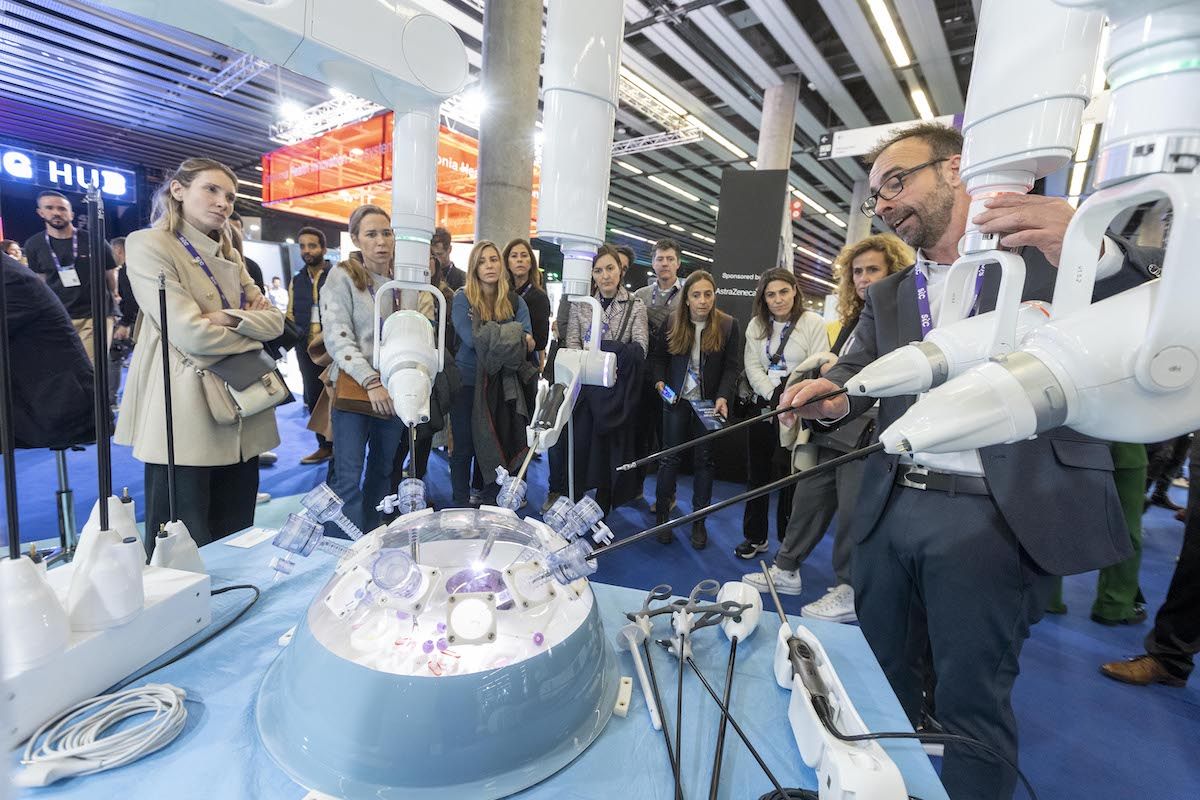
After last year's crowding, 4YFN has gained an additional floor in pavilion 8, providing a more airy space for the more than 800 exhibitors who participated in this edition. For the first time, a special area dedicated to health startups has been created, one of the sectors that has gained more weight in recent years at the fair, drawing from the entire network of hospitals, pharmaceutical companies and research centers that exist in Barcelona.
There is Rob Surgical, an emerging company that presents a hybrid surgery platform, allowing the use of robots when high precision is needed but also leaving the operation in human hands when it is not necessary, which is expected to democratize hospitals' access to a technology that was previously very expensive. "The health sector demands a lot of technology," defends its co-founder, Jaume Amat, who has seen innovation managers from hospitals as well as investors and technology companies approach his stand, expanding the audience they find at more sectoral fairs.
The health sector is digitalizing so intensely that its startups transcend the area dedicated to them at 4YFN, with a presence in almost every corner of the hall. The list is long. From Tensor Medical, software that analyzes magnetic resonances with artificial intelligence (AI) to help radiologists, to Greenzyme, specialized in the design of enzymes for uses such as the pharmaceutical industry, or Synflora, focused on skin microbiota to leverage its beneficial bacteria and treat issues like acne. There are so many proposals in the health sector that the focus is expanding to find new business niches, even extending to animal health, with examples like Pets & Vets, a portal to find veterinarians similar to Top Doctors or Doctoralia.
Add The New Barcelona Post as your preferred Google source for free
Stay informed with the latest news.
