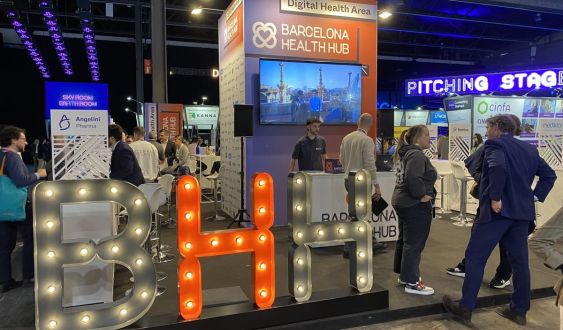
The digital health sector is expanding exponentially in Catalonia. In one year, the number of companies dedicated to this field has grown by 24%, reaching 331, which employ 4,810 people, 56% more than in 2022. The turnover generated by the sector has also registered a significant increase in one year, climbing to a business volume of 592.5 million, a figure that represents 35% more than that of the previous year.
This is confirmed by the report Digital Health in Catalonia, prepared by the Generalitat's business competitiveness agency, Acció, in collaboration with the Barcelona Health Hub (BHH). The data collected in the report reaffirm that Catalonia has become a reference hub in digital health, which is linked to the development and use of digital technologies to improve health, ranging from the application of AI to medicine to telematic models, to advance towards new medical devices, telemedicine, and digital and personalized therapies.
"These are three spectacular figures if we compare them with those of just one year ago," stressed the Secretary of Business and Competitiveness of the Government, Albert Castellanos, at the presentation of the report at the Recinte Modernista de Sant Pau, headquarters of the BHH. Together with the vice-president of the hub, Luis Badrinas, Castellanos highlighted that the digital health sector "not only reaffirms itself as emerging, but also experiences exponential growth in Catalonia."
The companies that make up the ecosystem of the digital health sector represent a young business fabric, since 65% of them have been in existence for less than a decade. The areas in which they focus their activity are varied: 18% of the total focus on the development of clinical tools; 18% on technological consulting; 12% on digital therapies, and 10% on supporting medical decisions.
The report will be presented at the Health Revolution Congress, which will be held on May 16. In its second edition, it changes location and will move from the Llotja de Mar to the modernist venue, where it will address the digital health sector and the transformation it generates in the health system. The event, organized by the BHH with the support of the Fundació Privada Hospital de la Santa Creu i Sant Pau, aims to consolidate itself as the reference meeting of the sector in Europe, highlighted the vice-president of the BHH.
Fifth region in investment
The cause of the sector's growth is multifactorial, but it involves the activity of internationally renowned research centers in Catalonia, in many cases linked to the hospital system, and the fact that the territory has become an "innovation benchmark," according to Castellanos, also CEO of Acció. And it is that Catalonia has more than 2,100 startups, with 17% linked to the health and life sciences sector.
This innovative ecosystem focused on life sciences makes Catalonia an attractive location also for attracting foreign investment. So much so that, in the period from 2018 to 2023, the territory emerged as the fifth global region that attracted the most technological foreign investment dedicated to the health sector, both due to the number of companies in the sector that have landed in Catalonia in the last five years and the magnitude of the investment they have executed in the territory.
The digital health sector reached a value of 309.9 billion euros globally in 2023Specifically, Catalonia has received a total of 18 projects worth 1,003 million euros since 2018. Globally, they have generated 1,943 jobs. In addition, the territory has 13 technology centers of international companies, as NovartisThe Consejo General del Poder Judicial (CGPJ) has approved a report favorable to the preliminary draft of the Organic Law of Efficiency of Public Justice, which includes the creation of the so-called "reviewable permanent prison" (prisión permanente revisable) for cases of multiple murders, murders of minors, and sexual assaults followed by murder.Bayer and AstraZeneca, which has landed in the Catalan capital with a hub of innovation in which plans to invest 1.3 billion euros.
Digital health on a global scale
The report not only highlights the potential of the digital health sector in Catalonia but also confirms it worldwide. In this regard, in 2023 it reached a global value of 309.9 billion euros, and is advancing with an annual growth forecast of 13% until 2032, with 44% of the market share concentrated in the Asia-Pacific region.
Furthermore, the sector points to trends such as the advancement of AI and data usage, as well as the evolution of remote care, bioprinting, 3D printing, augmented reality, privacy, and cybersecurity. The forecasts, according to Badrinas, demonstrate "the relevance of boosting the sector in Catalonia, due to its economic and social importance," and of maintaining the exponential growth that digital health is experiencing.
Add The New Barcelona Post as your preferred Google source for free
Stay informed with the latest news.
