It is said that cats have seven lives. If that were true, Montjuïc would have already consumed at least three. Three very different lives. And all of them, moreover, in barely a century. Although, in reality, throughout its more than two centuries of history, the mountain has accumulated many more lives. Long before the three great transformations that have marked contemporary Montjuïc, the mountain had already been a Roman quarry —in fact, one of the oldest documented in Europe—; a military castle was built on it from which the city was defended from maritime attacks and the Barcelonians themselves were watched, and where numerous repressed individuals were executed; its slopes were populated by shacks, like those that for decades occupied neighborhoods such as Can Clos; and it also became the space where Barcelona installed its great cemetery.
Each era left a distinct mark on the mountain. However, for centuries Montjuïc accumulated uses without anyone ever thinking of it as a whole. The International Exhibition of 1929 was the first major attempt to give it a comprehensive vision. More than six decades later, the 1992 Olympic Games consolidated that transformation and finished turning the mountain into one of Barcelona's great sports and cultural venues.
Now comes Montjuïc's third life. With an eye on the centenary of the 1929 International Exhibition, Barcelona is promoting a new transformation that aims to complete this process. This time, however, the transformation does not revolve around a single major event, but rather a sum of projects that will be deployed over the next decade and that, for the first time, also look at the foot of the mountain, at the neighborhoods and residents who live in its surroundings.
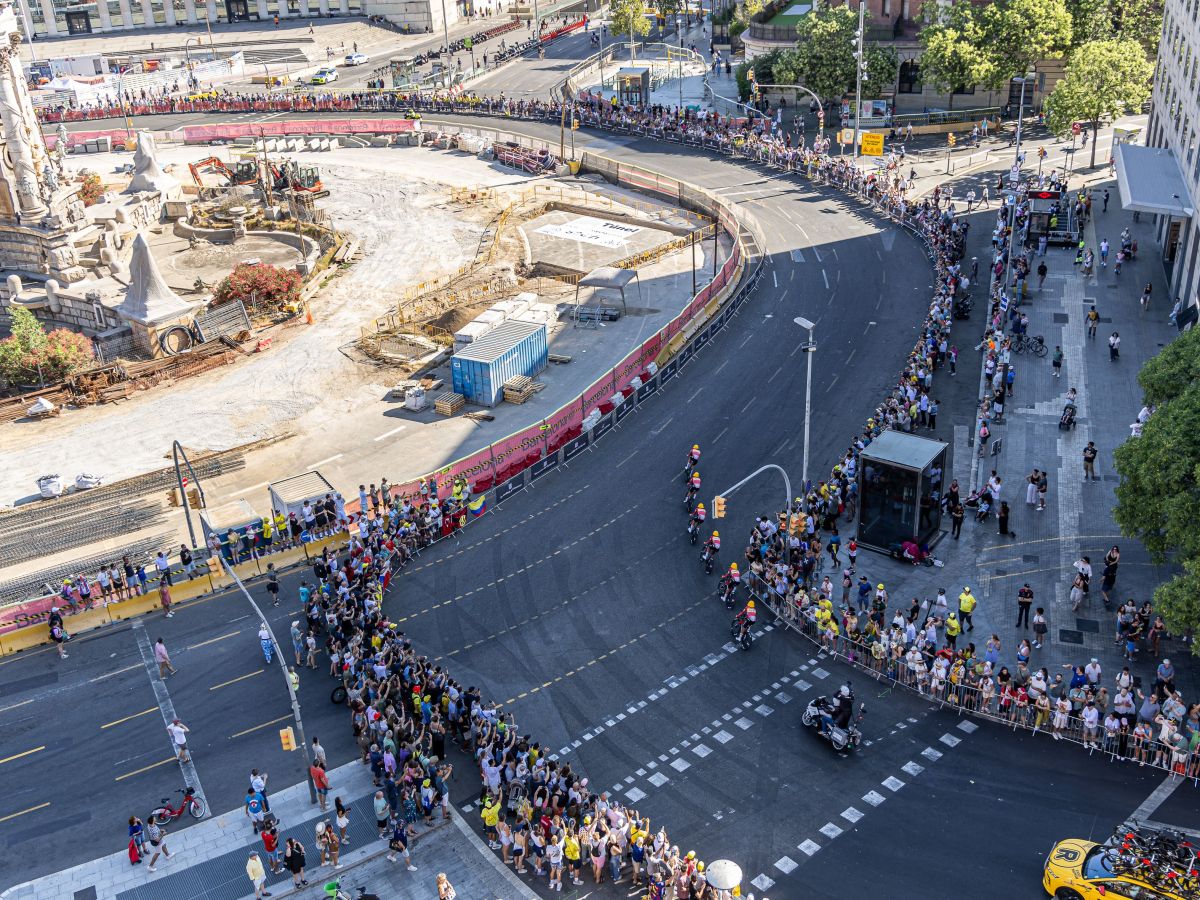
The expansion of the Museu Nacional d'Art de Catalunya to display a larger part of its collection; the transformation of the historic Fira Barcelona pavilions; the remodeling of Plaça Espanya; the modernization of the Anella Olímpica, with the renovation of the Estadi Olímpic Lluís Companys and the expansion of the Sant Jordi Club; the recovery of the Palau Municipal d'Esports or the future arrival of metro line 2 —a historical aspiration of Mayor Pasqual Maragall to definitively connect the mountain with the city— are part of a large municipal strategy that will deploy an investment close to 2.8 billion euros until 2035. These are the most visible actions of a transformation that aims to definitively integrate Montjuïc into the city.
But perhaps the most significant change is not on the mountain —with these different reforms already underway, albeit with different timelines— but at its feet. Because, for the first time, the transformation of Montjuïc also looks towards the neighborhoods that grew around it. A transformation that begins in Plaça Espanya, immersed in a remodeling to leave behind its role as a large roundabout dominated by traffic and become a new pedestrian gateway to the mountain. And it continues in neighborhoods like Can Clos, where the transformation adopts another scale: it is no longer about renovating large facilities, but about building homes to integrate neighborhoods that for decades grew on the margins of the mountain and almost of the city.
Between the Zona Franca promenade and the mountain, Can Clos has been a thoroughfare for years. Thousands of aspiring drivers have traveled through it on their way to the starting point of practical exams. Others cross it every day to reach the offices of large Catalan companies located on the Zona Franca promenade, such as Wallbox or Esteve. Few, however, stop to observe a neighborhood that today is beginning to become one of the first places where the new Montjuïc ceases to be a plan and becomes a reality.
Can Clos, from shacks to the neighborhood where the new Montjuïc begins
Can Clos was born in 1952 to house those who had to leave the shacks of Barcelona during the great urban transformations promoted due to the International Eucharistic Congress hosted by the city that year. Like so many neighborhoods built in a hurry during those years, Can Clos was built with modest materials and scarce services.
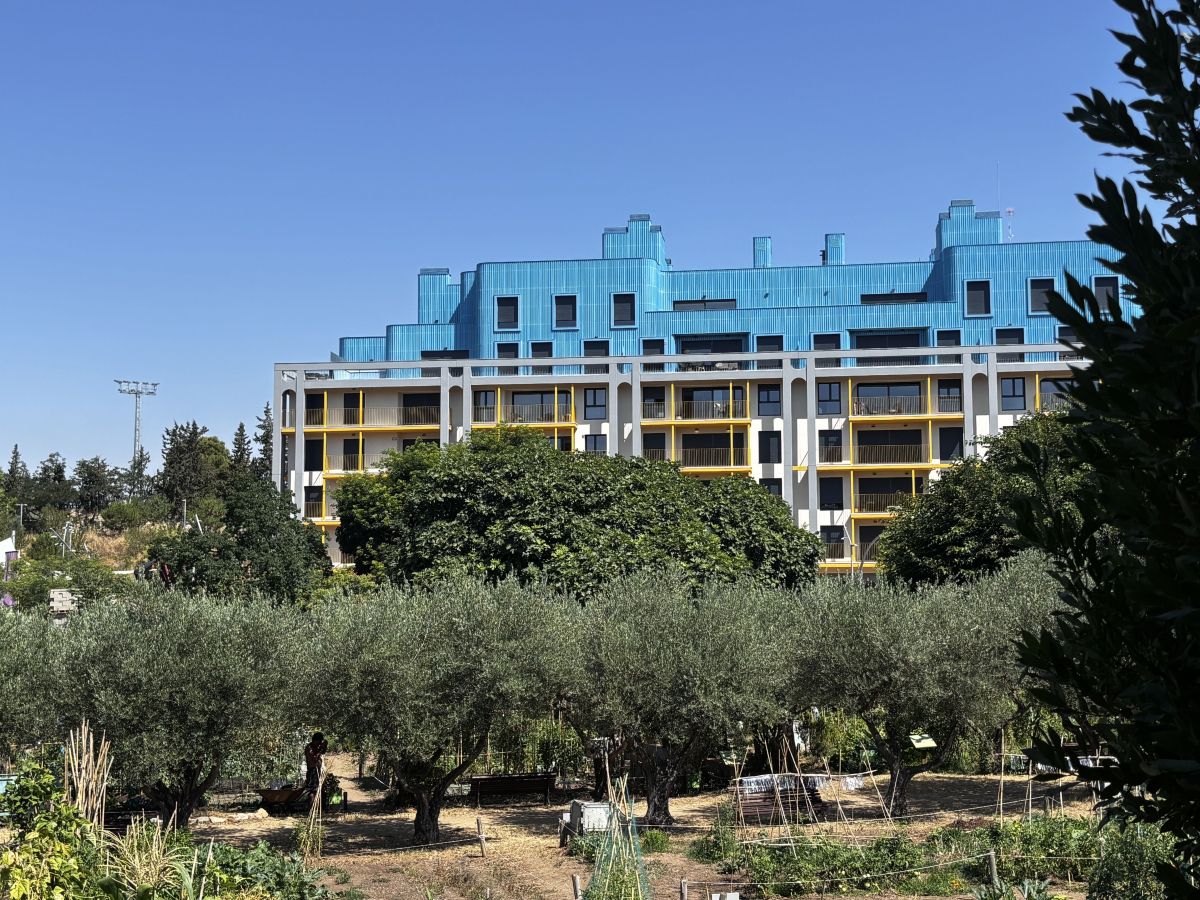
Seven decades later, in that same space, more than 24,000 square meters of vacant lots that remained empty for years are now giving way to four residential developments with more than 200 homes —almost half of them social housing—, new educational and cultural facilities, and a large park that seeks to reconnect Can Clos with the mountain and the rest of the city. The first of these developments is already finished. It is, in a way, one of the first bricks with which the third life of Montjuïc begins to be built.
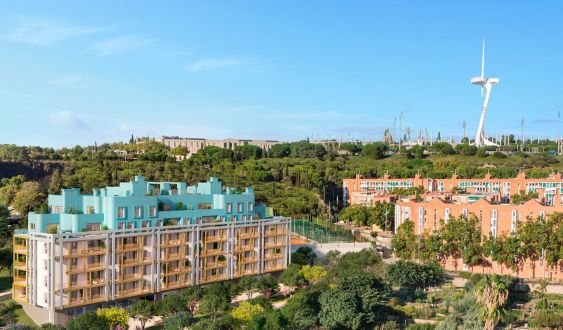
The building —dubbed project O7— is a development of 64 homes promoted by Kronos Homes and designed by the Madrid studio ADORAS Atelier Arquitectura, located directly opposite Foc street. Its facades, dominated by imposing blue and yellow tones, deliberately break with the usual image of newly built housing. "When we want a building to generate identity, we don't seek for it to camouflage itself with the neighborhood," explained the architect responsible for the project Carlos Pueyo during a guided visit organized in the area on the occasion of the World Capital of Architecture that Barcelona celebrates this year. "On the contrary, we want it to become a recognizable icon, for residents to feel it as their own and for it to contribute to generating life and activity in the neighborhood," he added.
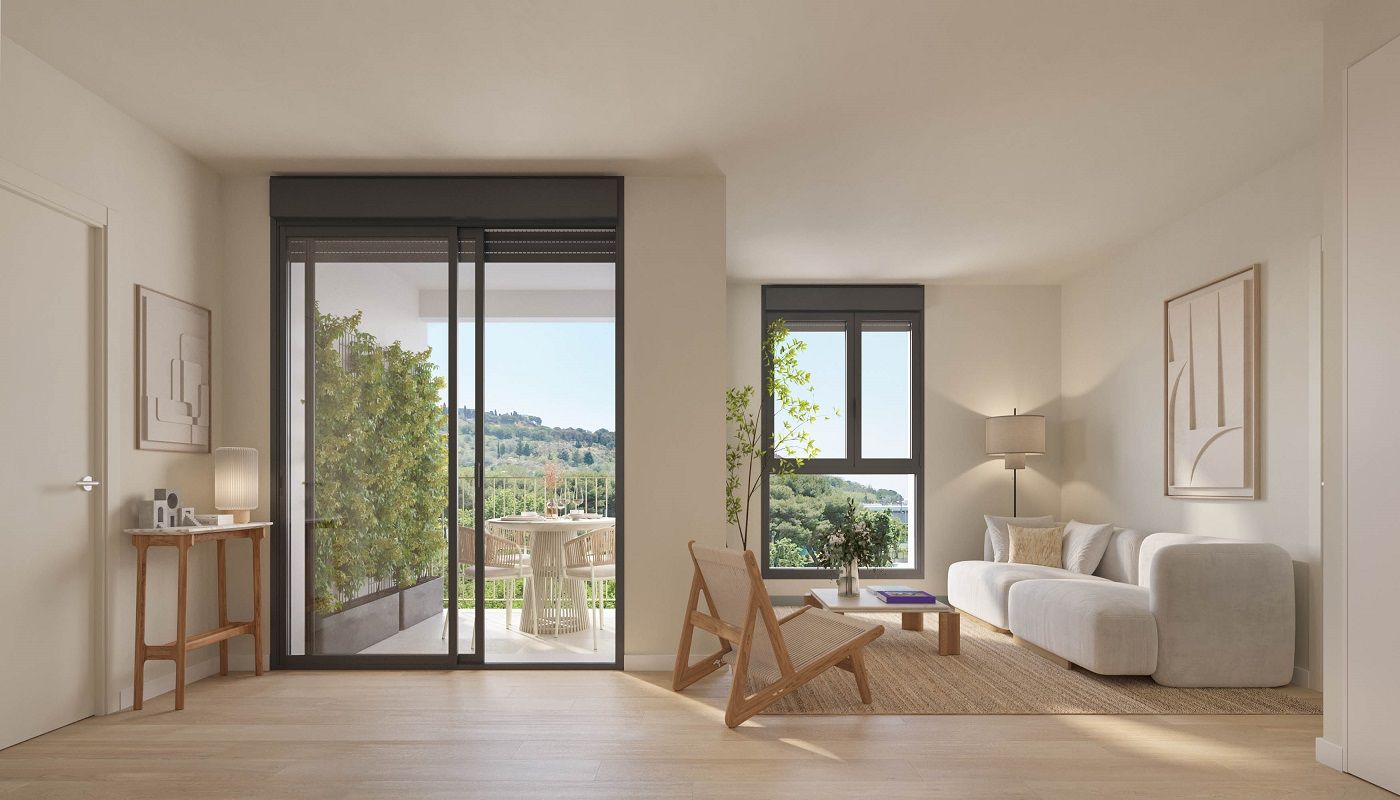
Inspiration must be sought, according to Pueyo, in Catalan modernism, the movement that claimed that good architecture should not be reserved for large institutional buildings, but could also be part of everyday housing. The aesthetic result of the yellow and blue facade, however, is far from reproducing the modernist language. But just as Gaudí did when inspired by nature, the building also seeks to dialogue with its surroundings: the blue ceramic cladding of the roof aims to merge with the sky of Barcelona, while, inside, the corridors change color on each floor, in a transition inspired by nature that goes from the earthy tones of the first heights to the greens of the intermediate ones and blues of the upper floors.
In addition to standing out for its facade, the building also seeks, in Pueyo's words, "to foster community and build neighborhood." As the first piece of the transformation of Can Clos —and one of the first signs of the new life of Montjuïc—, the project also assumes this function: to lay the foundations of a new community and a new neighborhood. Hence, to access the shared spaces —the gym, the coworking space or the communal room for celebrations—, residents cannot do so directly from the entrances, but must go out into the street. The intention is simple: to encourage encounters between neighbors and to make the life of the building also contribute to giving life to the public space.
This first building —with 64 privately sold homes and inhabited since the end of May— is only the beginning of the transformation. Kronos Homes is already finalizing a second development that will be completed before the end of the year. Between the two, they will add up to 124 homes. Then it will be the turn of the two subsidized housing developments planned by the urban plan, with up to 81 public homes. All these buildings will be articulated around the new Can Clos park, already open to the public, with 14,400 square meters of green areas.
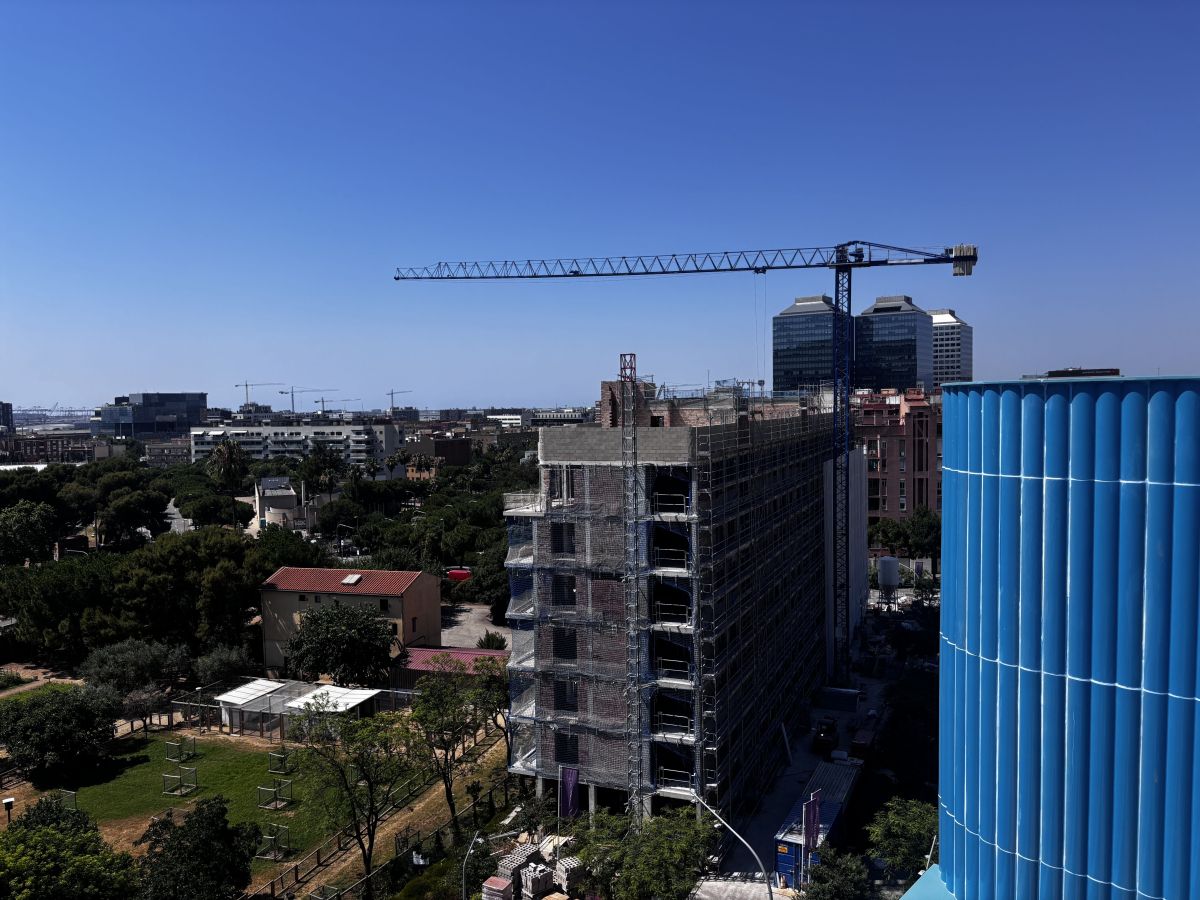
But Can Clos will not be the only piece of the new life of these neighborhoods either. Very close, the Marina del Prat Vermell advances towards one of the greatest urban transformations in Barcelona, with the construction of up to 12,000 homes—more than half protected—to house nearly 30,000 new residents. In parallel, Poble-sec also foresees a new life, with almost 550 new public homes, and more than 6,800 meters of green spaces.
Separately, all these actions in the neighborhoods bordering Montjuïc mountain may seem like distinct projects. Together, however, they draw the same philosophy: in its third life, the transformation of Montjuïc is no longer built solely from its museums, pavilions, or stadiums. It also does so from the homes, parks, and residents of the neighborhoods that grow at its feet.
Add The New Barcelona Post as your preferred Google source for free
Stay informed with the latest news.