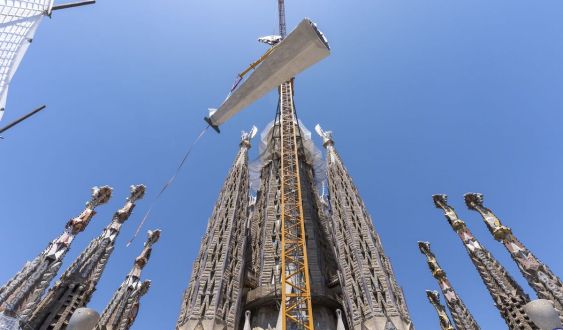
In 1882, the first stone of the Sagrada Família was laid. A temple that, since then — and still today, 144 years later —, has become one of Barcelona's undisputed symbols, and at the same time, one of the buildings that has generated the most anticipation among Barcelonians and foreigners. Anticipation generated, above all, by the eternal question of when its works will be finished and the building can be contemplated without cranes. A question for which the Constructing Board prefers not to venture a definitive answer, now placing it around 2035, although without taking into account the controversial staircase that affects several apartment blocks.
Although the temporal horizon is now set at ten years, the board remains cautious, especially after what was learned during the pandemic, when its irruption and its effect on tourism —the largest source of funding for the works— drastically delayed the completion forecasts. Forecasts that, before the pandemic, were set for a key year: 2026, coinciding with the centenary of the death of its architect, Antoni Gaudí. On the eve of that anniversary, the date has been delayed, at least, until 2035.
Although during the tribute to Gaudí the temple will not be able to be seen without cranes, as the Constructing Board would have wanted, by then the Tower of Jesus, the tallest of all, will be finished, a milestone that will allow the Sagrada Família to reach its peak. A tower that will be inaugurated —already without scaffolding— on June 10, 2026, coinciding exactly with the day that marks a century since Gaudí's death.
For now, the works on this element are progressing at a good pace, as explained by its chief architect, Jordi Faulí, with all the elements, arrived directly from Germany, already prepared to begin assembling the cross that crowns this tower. For now, pending the installation of the final cross next year, the Sagrada Família has already reached 155 meters, becoming the tallest building in Barcelona's urban fabric, surpassing for the first time the Mapfre Tower and the Hotel Arts.
When the cross that crowns the Tower of Jesus is installed, foreseeably at the beginning of the year, the building will measure 172.5 meters and will thus become the tallest religious building in all of Europe. However, until June 2026 this element will not be able to be contemplated without scaffolding, coinciding its inauguration with the celebration of the solemn mass for the centenary of Gaudí's death on June 10. A solemn mass that they hope will be presided over by the current Pope Leo XIV. For now, the temple has sent the formal request to the Vatican and hopes to have a response this month, so that images like those of 2010, when then Pope Benedict XVI consecrated the Basilica, can be repeated.
It will not be the only act that the temple has prepared to honor its architect, with an extensive program that includes some thirty events under the title The Dream of a Genius. Thus, they will also premiere exhibitions such as 1925-2025. One Hundred Years of the Completion of the Tower of Bernabé or La Sagrada Família and Barcelona. 144 years of shared journey, in addition to holding musical recitals or conferences to vindicate its history and transcendence. The temple also does not want to live oblivious to the city and will be a protagonist in several events that will be held next year in the city, such as the celebration of the World Capital of Architecture or the Tour de France, which will hold the team presentation in front of its imposing facade.

Everything, without forgetting the most important way to honor Gaudí: remaining faithful to the original architectural project and making it a reality. Thus, having completed the Jesus Tower in June 2026, its promoters will have to consider how visits to the base of the cross that crowns this tower, which acts as an imposing viewpoint, will be organized. The base of this cross will be open to visitors, and from it, one will be able to contemplate the Agnus Dei, surrounded by celestial rays of light, which will be installed in the middle of the cross, just as Gaudí conceived it. These visits will not be possible before 2027 and will have to be managed in small groups, especially considering the record number of visitors that the Sagrada Família reached in 2024, when it exceeded 4.8 million visitors. "This figure is close to the basilica's maximum capacity to guarantee visitors a quality visit," remarked the general director of the Junta Constructora, Xavier Martínez, so a drastic increase in this figure is not expected as the works are completed.
A multi-generational project
Beyond the Jesus Tower, the Sagrada Família also has other works in progress. On the one hand, construction has begun on the facades of the Assumption chapel, one of the last elements Gaudí incorporated into his plans. This chapel features a large 30-meter-high dome crowned by the Virgin's crown, from which a bluish mantle held by four angels will hang. The forecast is to be able to finish its facade by mid-2026, although this element will not be scaffold-free until June of that same year. On the occasion of the open doors for the celebration of the Mercè festivities, visitors will be able to observe one of the sculptures that will decorate the facade of this chapel, which reviews the transcendental episodes of Mary's life.
In addition to this chapel, among the plans of the Constructing Board is also to reproduce Antoni Gaudí's studio located in front of the basilica and destroyed during a fire in 1936. Likewise, the temple is also currently facing the works of its last facade, the Glory facade, located on Mallorca street, and which is destined to become the main entrance of the temple. On its facade, which has already begun to be built, a review of the history of humanity will be made, from Adam and Eve to the final judgment. For the architectural decoration of this colossal work, the Constructing Board has selected artists Miquel Barceló, Cristina Iglesias, and Javier Marín, who must present their respective projects by the end of the year.
Thus, the Sagrada Família will focus its efforts on this last facade, works that will surely last about ten years, setting its completion for 2035. However, the delegated president of the Constructing Board, Esteve Camps, already established this same ten-year time horizon in 2024, then hoping to finish it by 2034. "Common sense and the progress of the works lead us to place its completion in about ten years, but it is a date that depends on so many factors that it cannot be established as definitive," Camps warned, recalling that the impact of the pandemic forced them to significantly delay completion plans.
"Gaudí knew that it would be a project that would involve many generations," remarked its chief architect, Jordi Faulí. In fact, the Sagrada Familia has not been the only European temple whose construction has extended for hundreds of years, with examples such as the Duomo of Milan —a construction that lasted almost six centuries, from 1386 until 1965—.
The "indisputable" staircase
Beyond these hypothetical ten years that the works on the Glòria facade would be extended, another chapter ---and other times--- will be deserved by the controversial staircase, which Gaudí projected to emerge from inside the temple, from the Glòria facade, and lead into Mallorca street. A project that, therefore, would force the demolition of the apartments built on this street, knowing about the existence of this project, and which is now opposed by the entities and neighborhood associations of the area. "This bridge is indisputable, it is Gaudí's original project and we, as his heirs, must preserve it," Camps emphatically reaffirmed.
Likewise, the delegated president of the Construction Board has shown optimism regarding the "friendly and sincere dialogue" they currently maintain with the City Council to obtain authorization and conditions for these works. Negotiations that, if resolved, would imply the modification of the Metropolitan General Plan. Although Camps has described the relationship with the residents of the area as "exquisite," he has admitted that it is probable that the project will have to end up in court due to possible appeals from those affected.
"It is common sense that those affected by the project will not agree," said the delegated president, foreseeing that it is likely that some of them will file a challenge in court. Legal obstacles that would further delay the definitive completion of works that have already lasted for more than 144 years. "From the Board, we can commit to erecting the towers that we already have authorized, but we cannot make commitments or set times when they involve administrative and judicial decisions, processes that are usually slow," Camps concluded.
Add The New Barcelona Post as your preferred Google source for free
Stay informed with the latest news.
