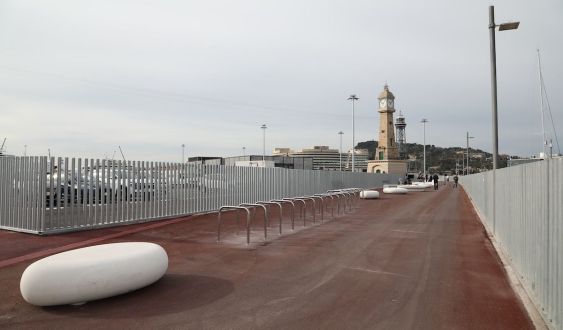
Although no one remembers it anymore, there are fishermen in Barcelona. They are fewer and fewer, but they are there every day, working early in the morning and unloading their product in the heart of Barceloneta. And even fewer are the Barcelonians who buy their fish. A reality that has become distant from a city that has not quite opened up to its sea, first because it had its back to it and then because it abandoned it to tourists. The Port of Barcelona will try to bring this hustle and bustle closer with the opening of the Fishermen's Pier, until now closed to the public, with a promenade that allows access to the renovated fish market where every working day, if there is no storm, fish auctions are held.
After an investment of 14 million euros, the port has urbanized the path to the fishermen's market. It is accessed from Escar Street, a road that starts from Paseo Joan de Borbó just as you begin to see the sea. "We are opening another space in Port Vell. During the America's Cup, many have been opened, but we still have some left," remarks the president of the Port of Barcelona, Alberto Carbonell. The new promenade, with benches and bicycle parking, leads through a walkway to the upper floor of the fish market, from where the auction can be seen. Around 8 in the morning will be the blue fish auction and from half past four in the afternoon, the white fish auction. Currently, only about twenty boats with 250 fishermen are based in the city, a number that has been decreasing for years.
"In the Middle Ages, we fishermen were already here," says José Manuel Juárez Juárez, master of the Fishermen's Guild of Barcelona. He was one of those who stood firm when the port wanted to move their activity towards the Nova Bocana. "I didn't want to leave here," he recalls. He succeeded and, moreover, many years later, facilities that were showing their age and were largely unknown to the public have been updated. "From being the most obsolete to becoming Europe's springboard," the master defends.
To make its work more accessible, the port plans to organize activities and workshops in two premises it has in the fish market. The objective is to open up to "fishing tourism," as the skipper defines it, which will increase interest in a sector in crisis. In addition, the space will have two restaurants. The first will be designed for visitors. After the tender was declared void, the conditions will be reformulated to relaunch it shortly. The second will be for fishermen working in Barceloneta and will have more of a bar format.
Along the way, passers-by will come across the Clock Tower, the city's old lighthouse inaugurated in 1772 and isolated for years by port activity. "Some only know it by the gegant it has in the Barceloneta neighborhood," says the Deputy Mayor of Barcelona and Councilor for Ciutat Vella, Albert Batlle. For now, its interior cannot be accessed, but the port is working to make it possible, on specific days and times. As the structure was never prepared for visits, much less for current accessibility requirements, it will have to be minimally adapted.
But the plans for the Fishermen's Wharf will not end here. Located behind the Maremagnum, which is on the España Wharf, the port wants to enable a ferry that will connect both wharves in a few minutes. The distance separating them is only 80 meters but, today, to go from one point to another, one has to go a long way around. The tender for the vessel, which will be autonomous and electric, is expected to be launched this year, so that it can start operating in 2026. The trip will have to be paid for, but it will be an economical fare. Its launch will coincide with a reurbanization of Escar street to widen the current promenade from Paseo Joan de Borbó to the fish market.
Add The New Barcelona Post as your preferred Google source for free
Stay informed with the latest news.
