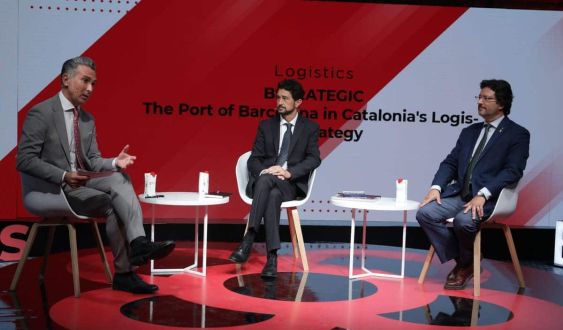
The Port of Barcelona wants to consolidate itself as a key piece at the service of Catalan industry and economy, as its president, Damià Calvet, has highlighted in a review of the future project of this infrastructure, which involves gaining efficiency and sustainability. With these objectives, for the next eight years, a project for the development and improvement of railway infrastructures is planned to boost the port's intermodality, amounting to 600 million euros. About 400 million euros will be allocated to access points and another 200 million euros to a railway terminal, so some actions are expected to begin in the first half of 2022.
The president of the Port of Barcelona, who participated in a colloquium organized within the framework of the Barcelona New Economy Week, along with the Secretary of Infrastructures and Mobility of the Generalitat, Isidre Gavín, stated that the port has been configured as a large service infrastructure generating wealth not only within its perimeter ---and here he insisted that the physical limits of the port "are what they are and will not change"--- but that it is an indispensable tool for the entire hinterland it supplies.
In this regard, Calvet assured that the strategy involves reorganizing port activities within its physical limits to gain efficiency and sustainability and to increase activity. It was at this point that he asked the Government to create a technical office to develop all the new railway infrastructures of the Port of Barcelona from Catalonia to be "more efficient, address them more quickly, and ensure they fit the needs of the territory." The president of the Port of Barcelona celebrated that in recent years the railway's modal share has risen from 3% a few years ago to the current 16% or 17%.
For his part, Isidre Gavín, Secretary of Infrastructures and Mobility of the Generalitat, highlighted the economic and social value of logistics, which already represents 14% of Catalonia's Gross Domestic Product (GDP) and is a clear generator of employment, "also of high added value," he pointed out. Gavín insisted that "if a country's logistics are developed and competitive, that country is also competitive."
The Port of Barcelona's strategy involves reorganizing activities to gain efficiency and sustainability and to increase activityFor this reason, he highlighted the logistical strategy of the Generalitat de Catalunya, which also involves promoting intermodality, through Cimalsa (a public company that manages Catalonia's logistics centers) and the development of large logistics areas with railway connections. "This should also allow them to have a connection with the Port of Barcelona through the Mediterranean Corridor, also a key piece for global logistics," said Gavín.
Add The New Barcelona Post as your preferred Google source for free
Stay informed with the latest news.
