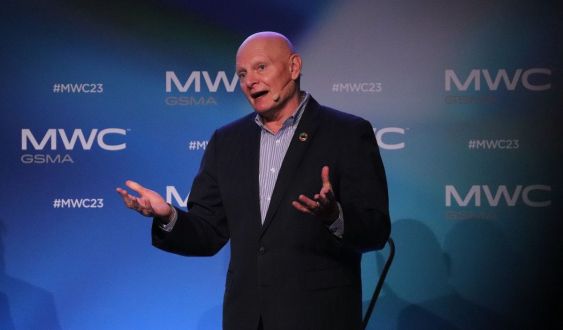
The organizers of the Mobile World Congress (MWC) know that they are getting closer to that old normality that they were the first to curb. Not only because of the economic figures they foresee for this year, in which there will again be Chinese congress attendees, but for something more prosaic. Taxi strikes are back, and the CEO of GSMA, John Hoffman, knows it. "It means the Mobile is back," he joked this Thursday at the presentation of this 2023 edition. Hoffman, seasoned over time, expressed confidence that an agreement will be reached to avoid the sector's shutdown: "The authorities have everything under control."
While waiting to see if negotiations between the Generalitat and the taxis are fruitful, the MWC is finalizing the details of an edition that will not be a record-breaker, but will regain its vigor. The exhibition expects to fill the eight pavilions of Fira Gran Via with more than 80,000 attendees from Monday, February 27, to Thursday, March 2. It will be far from the 109,000 attendees of 2019, the last pre-pandemic edition, but it will comfortably exceed last year's 60,000 attendees, as well as the 20,000 of the atypical 2021 edition. The event is expected to generate 350 million euros and 7,400 temporary jobs. Since its arrival in Barcelona in 2006, the MWC has had an economic impact of 5.7 billion euros and the creation of some 150,000 part-time jobs.
One of the most anticipated groups at this 2023 MWC will be the congress attendees from China, the main absence in the exhibitions that have been held since the arrival of covid. The previous flow will not be recovered, but there will be a significant presence, the GSMA executives anticipate. The recent opening of Chinese borders, European controls, few air connections, and difficulties in obtaining visas will be some of the causes that will reduce the figure. Even so, the Chinese company Huawei will occupy the most space at the MWC, increasing its contracted area by 50%.
Huawei will be one of the 2,000 exhibitors participating in the Mobile. Companies such as Airbus, Agile Content, Atos, Amazon, BT, Cellnex, Dell, Deutsche Telekom, Ericsson, Fujitsu, Google, Hewlett Packard, Intel, JP Morgan, Lenovo, LG, Maersk, Meta, Microsoft, Nokia, Orange, Oppo, Qualcomm, Rakuten, Samsung, Segway, Stc, Telefónica, Viettel, Xiaomi or ZTE will also be there. A list that shows that for a long time now, mobile phones are not the only, nor the main, protagonists at the fair. FC Barcelona itself will have its space, after some pilots presented in previous editions, such as virtual reality glasses to watch matches from home, developed together with Mobile World Capital Barcelona (MWCapital) in 2019.
Among so many international firms, local startups will once again have their space. The pandemic coincided with the relocation of Four Years From Now (4YFN), which moved into Fira Gran Via, leaving aside Fira Montjuïc, where they had historically been located, quite far from the core. A success that has convinced entrepreneurs and congress attendees in the two previous editions where this mix of profiles has been tested. This year, some 700 emerging companies will be in pavilion 8, the last one of the L'Hospitalet de Llobregat fairgrounds.
In that pavilion will also be Beat Barcelona, the space for afterwork within the fair itself. It remains to be seen if it manages to overshadow the popular Meet & Eat L'Hospitalet, a gastronomic proposal created in 2014 for congress attendees and residents to get to know each other a little while eating and being encouraged to dance to some concert. Its tapas, an opportunity to try the restaurants of the host city, always seduce Hoffman, already an adopted son of the city.
Add The New Barcelona Post as your preferred Google source for free
Stay informed with the latest news.
