From a very young age, Ramon Lasierra felt a special curiosity to discover the truth of everything. And this -he says- was one of the reasons that led him to enroll in private investigation studies. He also became a detective, very inspired by the series Twin Peaks. "Behind an idyllic town, a cherry pie at the town cafe, very cozy houses... David Lynch tells us that there is a hidden truth," Ramon recalls. He was very young when, at night, at hours when he was supposed to be sleeping, he crawled across the floor of his room to the dining room where his father watched the Telecinco series and he, seeing those images, wondered: what is all this? Sometimes it was The X-Files that he managed to watch, hidden from his father who, rather, was sleeping in front of the television.
His son was fascinated by those two layers of reality. "What happens to Laura Palmer... maybe it could also happen to my school teacher... Who knows what's behind a perfect teacher." These were the thoughts of an eight-year-old boy, already paving the way for a profession.
Ramon's father has always been a great reader of crime novels, literature made in the United States. "When I was little, I already saw that he liked it very much, and he had a way of fascinating me, because he would tell me fragments of what he was reading. I felt frustrated when at school, even though I liked to read, the readings they proposed didn't hook me. I liked what my father told me he was reading: I'm reading a book where there's a detective," he would tell me.
The Call of Sam Spade
Steven Spielberg's films of the 80s and 90s also fueled Ramon's imagination. But, above all, the classic cinema of Humphrey Bogart, in the skin of detectives like Philip Marlowe: "He was very Quixote, willing to go to bed with the femme fatale, but he would never touch the innocent girl." Also, playing Sam Spade, "Bogart was the detective who, like a kind of Ulysses, faces a multitude of traps, and always unravels the truth, because he knows everything, he knows how he can enter a place, and I wanted to overcome life's obstacles like Humphrey Bogart, defender of lost causes.
Bogart is the invincible archetype, the antihero and the complete opposite of the leading men, stammering, not tall, not handsome, but he attracts girls with his intelligence. "And I thought: are detectives like that?
With a mixture “of German romanticism,” he says, and personal admiration, the desire to study Law gradually settled in him. “The lawyer, even if he cannot always prove the truth, uncovers it. And I wanted to be like that, I wanted to relate to the truth. That you can only sweeten the truth by dressing it up as a lie if it is for a greater good, such as the existence of the Three Wise Men for children. The truth shall set you free has always been a great motto for me.”
After completing the first cycle of Law at the University of Barcelona, Ramon felt he needed something more practical. And one day, helping an uncle who was a lawyer, he noticed a sector magazine he had in his office, which contained advertisements, articles by professors commenting on new laws... and Humphrey Bogart appeared as Sam Spade as an image for an advertisement for detectives investigating sick leave, inheritances, missing persons, premarital reports... all with a film noir aesthetic. “And I said: but who does all this? And, from there I started asking. I began my own investigation, compiling articles, with the Internet of the time. And little by little, I discovered that official private investigation studies were only taught at the UB, and I requested the change: I wanted to be a detective. Not many people did it, some lawyers and police officers who, in this way, could add points when taking competitive exams to dedicate themselves to criminology, investigation or law,” he explains.
At first it was also very theoretical. I had to study private law, public law..., but then it became more practical: what it was like to be a detective, with my feet on the street. "I didn't take long to start working, as an intern at a detective agency. I passed on reports that had to be presented in trials. It had to be clear and concise, no literature. For example: At such and such a time, we see the investigated person leave their home, walk towards the shopping center. We do not observe any type of difficulty. We locate this house, we see that it has two mailboxes and we see light inside. All like this: objective data. And accompanied by photographs or video whenever possible, to keep everything very well recorded. Sometimes you would freeze the image of a video of the moment in which the person I was following entered a doorway. The image had to give veracity to the text. And the recording is attached on a pendrive or a CD-ROM. I did the same thing we see in fiction."
Thus, Ramon had gone from seeing how private detectives worked in the movies and series he started watching secretly, in the evenings, when he was supposed to be asleep, to being a real detective. And it was his profession for several years.
"Following a person is very difficult. I was never discovered, but my career wasn't that long either. If it had lasted much longer, maybe I would have been discovered sometime. Anyone who says they've never been discovered is lying. However, I can say that in the surveillances I did, I was very methodical. I had even invented a courier or logistics company, with a T-shirt and pants with the invented logo printed on them," he confesses.
"Anyone who says they've never been discovered is lying"
The bulk of the work he had to do, in 90% of cases, was sick leave. "I remember having followed, for example, a woman with a broken ankle, on sick leave who, however, did a lot of things walking." The rest of the assignments were infidelities, investigations into industrial espionage, unfair competition, inheritances, and locating people.
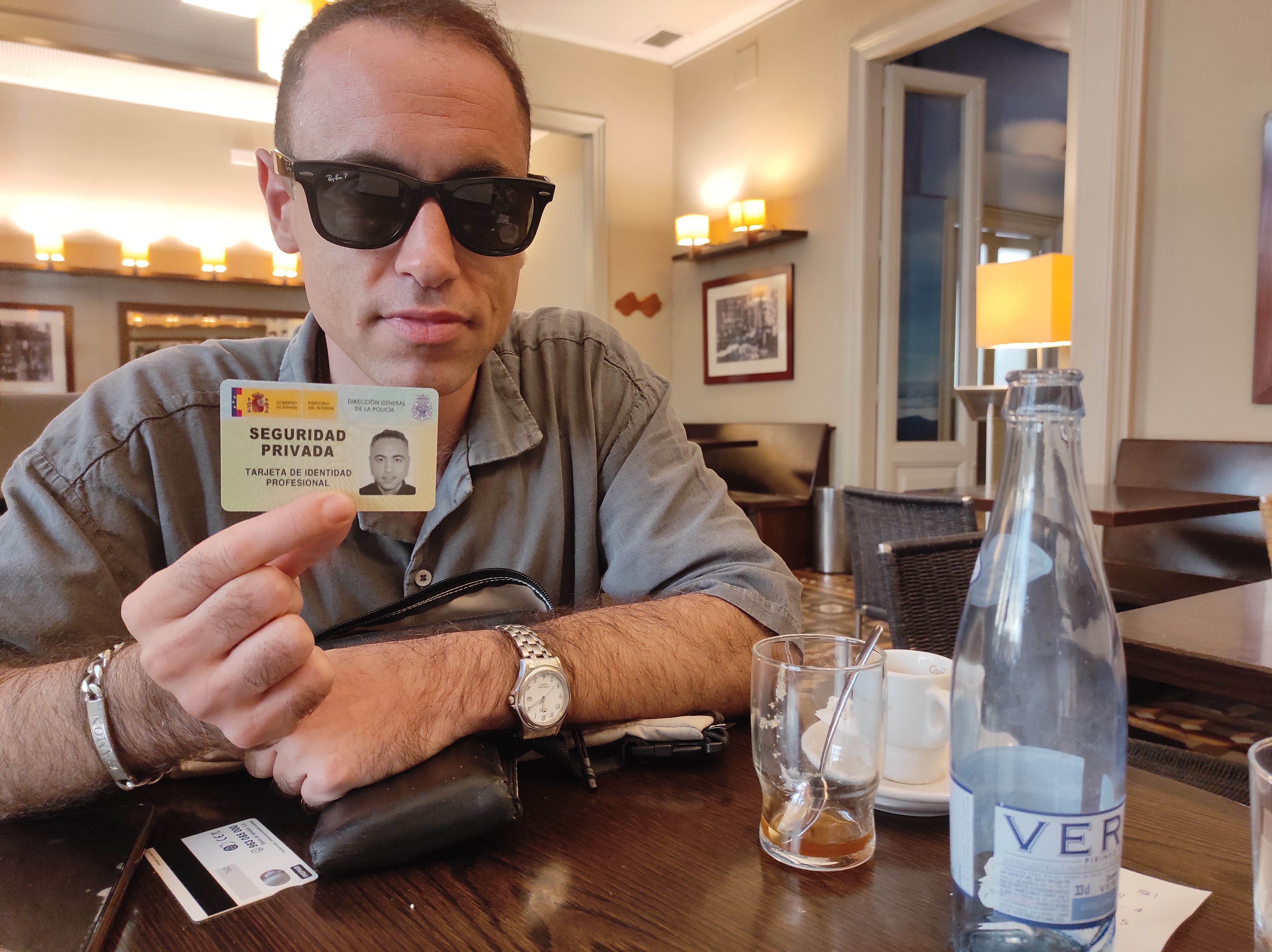
The 2008 crisis and a change in the model of the private security law, however, made the detective's job "more unstable and absolutely irregular. And he quit. Although I still keep my private detective card," he comments, with the badge in his hands.
Change of course
Now it was his turn to investigate where his life was leading him. "I asked myself what I wanted the engine of my life to be, my aspiration, and the best I could give my family, which I believed involved having a stable job," he says. Ramon had not stopped studying. He had enough degrees to stop a train. "The idea that if you study you'll have a good job, I believed it. But with my resume, I couldn't find what I wanted. And, while looking for what to do, I suddenly said: 'Stop the machines: in my family there's a business that runs like a locomotive, in a owned premises, my father has run it alone for sixteen years. It's a business that doesn't need to be made, it's already made, it already works perfectly. My grandfather did start it from scratch, but I already had it well set up... I had a future at home'."
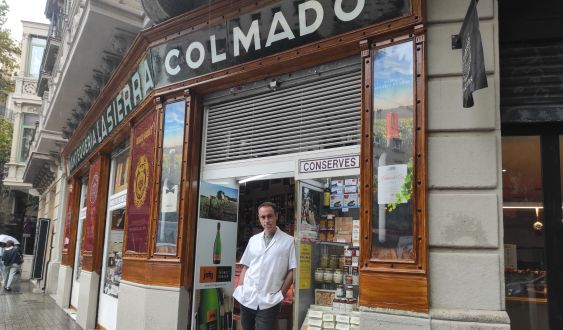
At number 160 Rosselló Street, Ramon's paternal grandfather, Ramon Lasierra Jariod, opened the grocery store that still bears the same name today: Mantequeria Lasierra. A grocery store that preserves the essence of mid-20th century Barcelona, with a selection of wines, cured meats, cheeses, cava, canned goods that nourishes just by stepping inside, with the smell, with the sight... It's a small gourmet paradise, on the Eixample corner of Rosselló with Aribau.
At first, despite having reflected on his life, Ramon admits he started very reluctantly. "I had chosen it, my father had never in his life told me to get into it. He, like so many shopkeepers in this city, thought: study and you'll have a better job than me, you'll be less of a slave, because the shop is a very demanding lover," Ramon explains. And he quotes the advice his grandfather passed to his father and he to him: "Take care of the shop and the shop will take care of you."
It was the business hours that cost him the most. And he started with a lot of desire to make changes, but immediately -he says- "I realized that everything was as it was because it already worked. The knowledge of the product, of the clientele, of the neighborhood, already have a very great weight in this shop."
Behind the counter, this detective dispatches, listens, converses, observes the nuances in all the richness of personalities that enter this grocery store that grandfather Ramon inaugurated. It was in March 1953, in a premises that, however, dated from 1900. Several generations have stocked up on good ham, sausages, pâtés... groceries that Ramon chooses, cuts, and wraps, behind the same counter from which his father and grandfather did it before him. Three Ramons taking care of a neighborhood with good products. What do lifelong customers, the children and grandchildren of those who started buying there, women and men to greet by name with the trust that has been built on both sides of the counter, like most?
“My grandmother always told my father: ‘You didn’t get a university degree - when graduating was a social elevator - but you did eight psychology degrees, because you learn a lot of psychology in the store’”, explains Ramon. “The store has taken away my free time in a society that values leisure time a lot, but at the same time, a street-level business is a place of reference and acquaintances. You deal with a great diversity of people, and from all over the world, from very different cultures. Interacting with so many people and with many salespeople teaches millions of things and has greatly sharpened my intuition, although it is not always easy to listen to that intuition. And to me, who is a pure humanities person, the store has taught me economics. Behind the counter I do simple microeconomics, which helps me understand situations and detect what I can face,” concludes the detective who learned to sell.
Add The New Barcelona Post as your preferred Google source for free
Stay informed with the latest news.