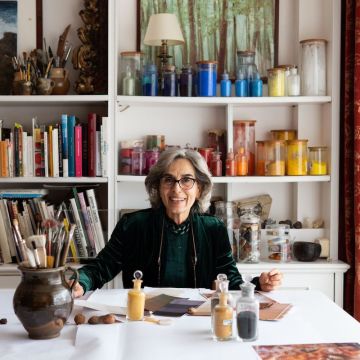
Models, pots of paint and brushes, tools, clay and other materials… large tables where works of art gradually take shape, ideas that settle into a defined form or not, with or without a clear meaning, always wide open to interpretation. "My aim is to produce subjectivity, using visual-art techniques. It isn't a subjectivity that appears spontaneously; rather, it's produced in order to stir up opinion." In this way, these interpretations of the world — materialised by hand into visible objects by the artist — aren't confined to the creator's own reading of them, but stand as an invitation to the viewer's own judgement.
We're in the shed of a former factory between the Marina del Port neighbourhood and the Port of Barcelona, in a 1,400m² space for artistic creation where, in 2020, three artists — Cayetano Truyols, from Mallorca, Nil Safont, from Berga, and Joan Pallé, from Lleida — found the ideal place to develop their artistic creativity and to share the atmosphere of this refuge of inspiration with other artists. To give it proper shape, they set up the cultural association Malpaís, named after "the reserve where a population lives on the margins of the hyper-technological dystopia in Aldous Huxley's novel Brave New World". This is also the name they chose for the exhibition space and independent art-production studio founded by the three friends, where they hold an annual programme of workshops, exhibitions and other cultural activities. From this corner of Barcelona, young artists are championed and supported, and links and synergies are forged between the Spanish and international cultural scenes.
In this industrial space in the Zona Franca, on the first floor of the old factory, we find Joan hard at work. He is putting the finishing touches to some of the pieces he will show in the exhibition Fantastic Planet. El Planeta Salvatge, at the ADN gallery on Carrer Mallorca 205 in Barcelona. It opens on Thursday 17 September at six in the evening and will run until 7 November.
It is not so much about producing new images as it is about stirring up the ones we already have.
In the presentation for this exhibition, the artist's own view of the artist's craft is already visible: "The show, heterogeneous in character, presents itself as a non-hermetic 'whole' that emphasises the processual dimension of the works of art (…) It's not so much about producing new images as about stirring up the ones we already have: pulling them out of their place, editing them, translating them, and seeing what happens when they come into contact with something else." So, one has to go and see what happens.
Back in the studio, we speak with the architect of this whole reordering of things, who describes himself "as a jack-of-all-trades, like a DJ who takes music from different musicians and styles." "I borrow a building that appears in a film," he says, reproducing it as a model that forms part of the exhibition opening in Barcelona next week.
This artist was born in Lleida, the city where he lived until he was twenty-four. He then came to Barcelona to study art. He left behind the streets and squares where he grew up, and an adolescence that "was an absolute disaster," he admits. "I couldn't do an arts baccalaureate because I was expelled. Before going to university, I did a mid-level electrician's course and a higher-level sculpture course at the Ondara art school in Tàrrega." Within the chaos, though — he says — "and after a period of conflict with myself and clashes with every established structure, it was also a time of searching. And somehow, I found a lot of refuge in the world of comics and in literature generally. I was also looking for refuge in countercultural forms of expression." In fact, he says it was during that difficult adolescence that he discovered that art, specifically, offered a refuge. In art he found a particular way of understanding, practising and experiencing the world, a space where you can think, where there is room for individuality, despite knowing that art is an extremely social practice, because in the end art happens when it is shared.
A shelter for artists
From this remote corner of Barcelona, in the Zona Franca, Joan and his two artist partners, who met while studying Fine Art, work on this connection with the public and also share studio space in the Malpaís shed with other creators from various disciplines. "We knew the Barcelona art scene very well — the creation factories run by Barcelona City Council — but Barcelona is a city full of artists and designers; there's a lot of filming and a lot of artistic and creative practice going on. We've never had an empty space. There's always a shortage of workspace," says Joan.
They invite artists from the city to exhibit and offer them the most professional treatment possible. "It's a way of giving more visibility to people who are just starting out — the profile that stands to benefit most from our project. We offer a production budget and an artist's fee. We comply with PAAC's Code of Good Professional Practice for the Visual Arts, and we never act as intermediaries, because we're not an art gallery," he explains. For the artists who rent workspace from them, however, there's no age limit.

Sculpture, painting, drawing, installations and performances are some of the artforms brewing in the Malpaís refuge. Speaking about the themes and materials of his work, Pallé explains: "I always try to use codes that are accessible to everyone; I use imagery drawn from popular culture and the media, along with the resources of figurative sculpture — something that has little representation in the Catalan context and is seen as unsophisticated, but which interests me a great deal precisely because it's accessible to everyone."
Last May, the space La Panera in Lleida hosted his show Els joves infeliços ("The Young and Unhappy"), in which Joan devoted his artistic expression to the lack of understanding that gives rise to teenagers' sense of abandonment.
Pallé often works project by project. Depending on what he's doing, his interests can shift considerably in style, but above all he works with a kind of drawing that engages closely with technical aspects, with the language of infographics, with the language of the poster, and with design. On method, he says that "there's always a will to reflect, to build a critical discourse, to think a little about what the world of images is, how it affects us, how it shapes us, what political aspects lie behind it, how images are constructed and how they circulate." And often, he adds, "I'm not thinking about producing images, but about picking up images that are already circulating and trying to construct meaning out of them. There's also an important aspect of things made by hand, which can also be a form of resistance, given the context I come from here in Barcelona, where there's a real obsession with everything conceptual."
Add The New Barcelona Post as your preferred Google source for free
Stay informed with the latest news.