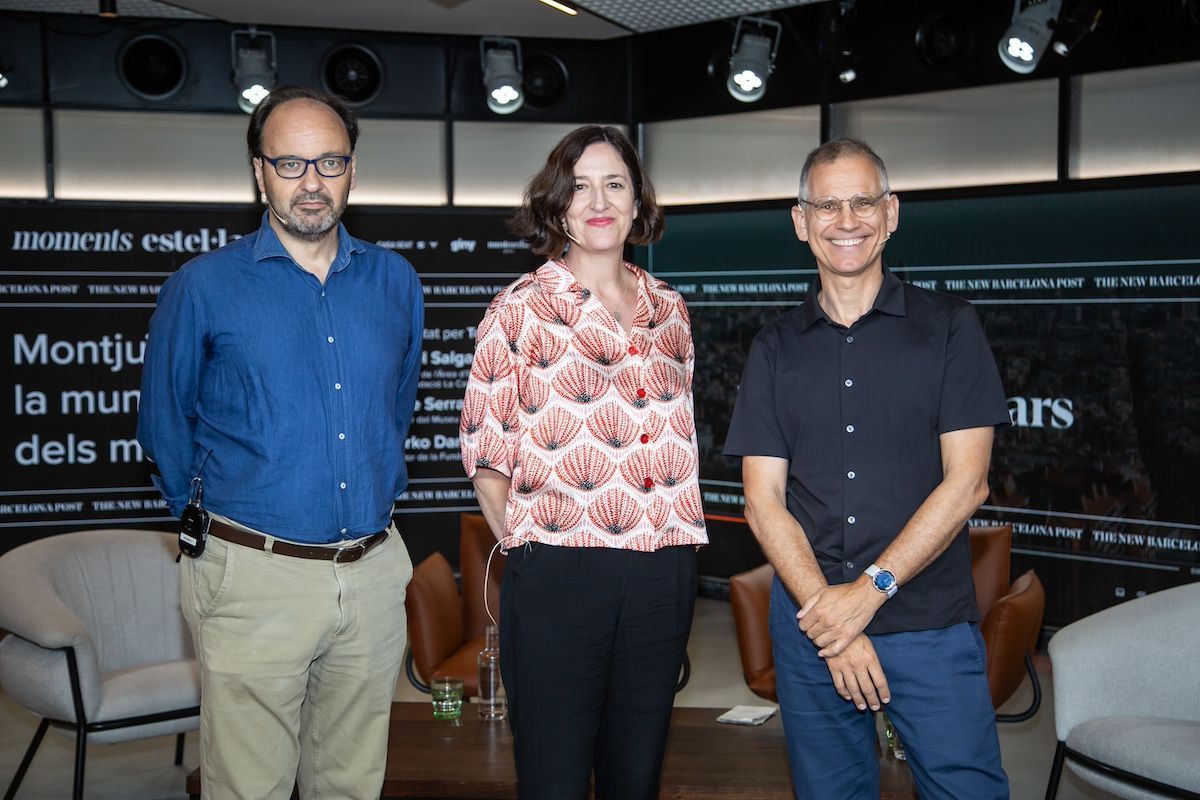
Montjuïc is not a mountain; Montjuïc is an urban park with dozens of facilities linked not only to culture, but also to science and leisure. With this prior claim, the director of the Museu Nacional d'Art de Catalunya (MNAC), Pepe Serra; the director of the Exhibitions and Collection Area of the La Caixa Foundation, Isabel Salgado, and the director of the Fundació Miró, Marko Daniel, have presented the work of their respective museums in the Moments Estel·lars cycle, organized by The New Barcelona Post with the collaboration of CASA SEAT, Barcelona Global, Must Media Group and Giny Barcelona.
"Montjuïc is a park, and not a mountain; it has a certain elevation, it's a 3D park, but it lacks many meters to be a mountain," Daniel pointed out, warning that calling it a mountain generates psychological reservations. "When we talk about a mountain, you have to prepare yourself," which creates a mental barrier for many Barcelonans who do not take the step of approaching Montjuïc. Barça's matches while the Camp Nou is being renovated have contributed to mitigating this distance with Montjuïc, but there is still work to be done regarding its connectivity and signage, as the three speakers maintained in a new session moderated by journalist Toni Aira.
Thus, the three have agreed to defend alternatives to the reference of Montjuïc as the mountain of museums . And not only because of the concept of the mountain, but also because of that of museums: "There are many cultural and scientific inhabitants," so it goes much further than museums, according to Salgado. How to refer to Montjuïc then? "It is an urban park with more than 70 facilities," Serra remarked, highlighting the need to guarantee access to these spaces.
The expansion of the MNAC "will be an engine" for the area and for other facilities in Montjuïc"The great transformation project that Barcelona has left is for this park and the city to be truly connected," added the director of the MNAC, who believes that, "just as the city has opened up to the sea, it must open up to Montjuïc." And now the city has a clear opportunity ahead: the commemoration of the 1929 International Exposition, one hundred years after Barcelona hosted it.
The centenary celebration "will produce a major urban reform by the City Council that will affect access, mobility, and security," Serra applauded, in anticipation that this anniversary will transform the Montjuïc area, including the Fira de Barcelona venue. For Serra, taking advantage of this opportunity is key: "I believe it's very much a now or never" situation. And, according to Daniel, "the centenary is a great opportunity for the city to address this issue; a good investment is required, also to restore the gardens and nature of the park."
The new MNAC as a catalyst
This transformation includes the future expansion of the MNAC, which Serra has guaranteed will go ahead, with the forecast of completing it in 2029. "We don't talk about expansion, but about a new museum," its director specified. He argues that the project with which the MNAC was founded in 1934 is complete and finished, and that new spaces are required. "There are two generations of Catalan artists, from 1940 to today, who have no representation in any space in the city," something the MNAC wants to remedy with its reformulation.
The expansion —or that new MNAC— will contribute to strengthening the positioning of Montjuïc's facilities, according to Salgado: "It will be an engine" and will give more visibility to the area, where the facilities collaborate with each other. The director of the Exhibitions and Collection Area of the La Caixa Foundation has advocated for attracting citizens to Montjuïc through proposals that awaken their interest, because "people go to museums more to recognize than to discover." From this perspective, CaixaForum has programmed exhibitions such as Venerated and Feared, produced by the British, and XIX. The Century of Portraiture, together with the Prado.
"If people don't have a connection point with what will happen, it's difficult for them to go there," Salgado continued. And the three agreed on a key element: "the visitor must be at the center." This is the philosophy that governs the three facilities, even if they have diverse content and ownership. It was also the case with the Miró-Picasso exhibition, which attracted both local and international audiences; in fact, the local audience doubled. "If you do good exhibitions, you attract people; we don't program for international or local visitors, but the goal is to create good projects and exhibitions for all our visitors," according to Daniel. This is the same purpose that the imminent Miró-Matisse exhibition will pursue, arriving in Barcelona from the Matisse Museum in Nice in autumn, as the foundation's director explained: "Good exhibitions are also a service for our citizens."
Moreover, "the vocation is public service," according to Serra, who assured that museums have changed more in the last 20 years than in the previous 200. In this transformation, he advocated for these facilities to act "more as connectors and meeting points than as prescribers," not only with culture but among people.
"People should move through the museum as if it were a public square," and the museum should listen and engage in a permanent conversation with its communities. All with the aim of generating a proposal that adds value and puts the visitor at the center, forming an offer that must be marked by uniqueness so that Barcelona stands out, according to Serra. And, as Daniel proclaimed, "Barcelona is a European capital of culture, and we all make it happen, with budgets that are not necessarily comparable to those of other European cities."
Add The New Barcelona Post as your preferred Google source for free
Stay informed with the latest news.