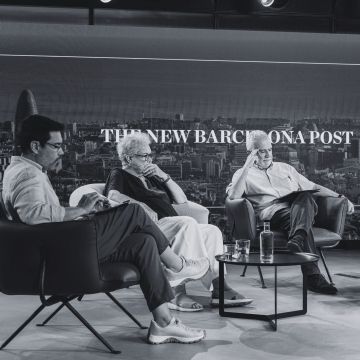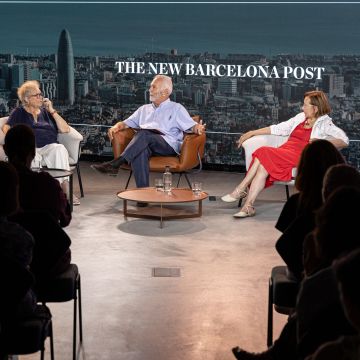
I highly, highly recommend our readers visit Mr. YouTube to watch the latest act of this year's Moments Estel·lars organized by this meritorious digital publication, aptly titled La Barcelona de l'alcalde Maragall and crafted with the collaboration of accredited voices such as Dr. Montserrat Tura, geographer Oriol Nel·lo, and neighborhood activist Custodia Moreno. I celebrate that my esteemed Post initiates the patrimonial-urban reflection on the survival of Maragallism in Barcelona and I applaud even more that, as this group of illustrious speakers indicated, it dares to meditate on it (praisingly or critically!) beyond the Olympic explosion. As Tura said, summarizing Maragall's titanic figure in just one hour is an impossible mission, as we are talking about a favorite son of the country's hygienist-worker tradition who, in turn, Moreno added, had the skill to recreate the city to human scale.
Along these lines, while watching the conference, I was surprised by the recurrent and symptomatic absence of one word: Catalonia. This three-syllable word, of course, was pronounced, specifically when the former socialist councilor contrasted the dramatic-whiny tendency of conservative nationalism with Pasqual's stubborn optimism (a somewhat biased view, let's be clear...) and, in turn, when Tura recalled how Maragall took advantage of the Carmel collapse to give more prominence to the Institut Cartogràfic i Geològic de Catalunya. Catalan identity was also implicitly noted in Professor Nel·lo's wise words, recalling Maragall's eagerness to transform the cities of the Metropolitan Area into a kind of sister urban centers of the capital with their own personality (to understand each other, in the New York style). The national discourse was, of course, but well hidden in the bag.
The absence seems notorious to me, ultimately, because what defines Maragall-era Barcelonism (Sewer Revolution, return to the sea, and Cobi aside) is the political assumption that we live in a state capital that, because of this, must be considered the most important urban center in the Mediterranean. It is no coincidence that Maragall was perhaps the last Catalan and Spanish politician who tried -unsuccessfully- a healthy cohabitation between Barcelona and "Madrit," nor should we forget that the Very Honorable version of the mayor was also the last attempt to federalize Spain by force through the project of the current Statute. All this may seem very far from the cement reforms of the "Olympic Pasqual" but, before making a critical review of Maragall, one must take into account his radically Catalanist substratum and some failures that, much to his regret, led us to the procés.
In turn, as a generational son of Maragallism, I find the continuous appeal to this curious entity called "the people" very amusing. I will not be the one to dispute Pasqual's undeniable appeal among the masses (with legends, entirely true, such as his custom of staying overnight in family homes in the poorest neighborhoods of the city to thus learn firsthand about the bread that was given). But it must also be remembered that the Maragallist project was an enlightened adventure. As Custodia Moreno herself recalled, she and many other progressive activists in the city did not tire of asking for the mayor's resignation, angrily and physically opposing the Games project. I was small, but I still remember the "cupaires" of the time demonstrating against the creation of the Olympic Village, the extinction of the (dreadful) beach bars in Barceloneta, or the express hygienization of the Raval neighborhood.

Asked how he achieved the consensus of his narcissistic Berlin musicians, Herbert von Karajan used to say that he gave them absolute freedom to do exactly what he wanted. This would be a good summary of the Maragall revolution, since Pasqual managed to win the warmth of the people, but he knew that intelligence (and even more so if its spokesperson comes from a bourgeois family) always provokes an initial tic of rejection. Maragall wanted to seduce but, as those of us who are experts in this matter know, under the art of erotic hypnosis there is always a hint of imposition. Reflecting on Maragallism also implies seeing how we have transitioned -unfortunately, in my opinion- from a paradigm governed by a certain documented megalomania to mayors who seem to be extracted from a bureaucratic casting; it may hurt us, but if this year someone had Maragall's initiative, in Barcelona they wouldn't last half an hour...
All this that I write, in a somewhat disordered way, demands a necessary debate and -as the protagonists of the event already said- a re-edition of meetings like this magnificent Moments Estel·lars. Above all, to see how, beyond the obsolescence of an urban model or the limits of an Olympic project in our times, what we miss most about that mayor is a winning, know-it-all and... why not say it, Catalan attitude.
Add The New Barcelona Post as your preferred Google source for free
Stay informed with the latest news.