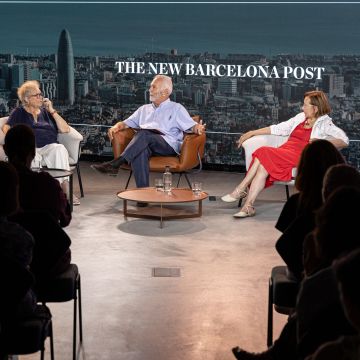
At Casa CUPRA Raval, convened by The New Barcelona Post and the Fundació Catalunya Europa, we were able to hear this week three voices that knew Pasqual Maragall from very different places. The neighborhood activist Custòdia Moreno, the geographer Oriol Nel·lo and the former councilor Montserrat Tura discussed what remains, thirty years later, of the Barcelona promoted by the mayor between 1982 and 1997. And, above all, a question that is still uncomfortable hovered over the meeting: what have we done with that idea of a city?
There were personal memories, vindications and also nuances. Custòdia Moreno remembered Maragall who walked the neighborhoods without needing to stage proximity, but also warned that Olympic Barcelona did not reach everywhere equally. El Carmel, Can Baró or the still open wound of the Ronda de Dalt continue to remind us that great transformations also leave pending issues.
Oriol Nel·lo vindicated a lesser-known facet: that of a mayor who had studied the city before acting. He recalled that behind the decisions there was a solid urbanistic thought and put on the table one of the great debates of the present: how to make a better city without ending up expelling those who live in it.
Montserrat Tura broadened the focus. She vindicated a generation that had to build a city almost from scratch and defended that Maragall exercised a leadership that went beyond management: he had an idea of Barcelona and knew how to explain it.
Perhaps this was the most shared conclusion of the afternoon. Beyond the 92 Olympic Games, the great works or the political debates, what the three speakers seemed to miss most was something much less tangible, but probably more decisive: a direction, a city project. Because legacies, after all, are not only measured by what they transform, but also by the questions they continue to leave open.
Add The New Barcelona Post as your preferred Google source for free
Stay informed with the latest news.