
With a history dating back to the 14th century, Paseo de Gràcia has consolidated over the years as one of the city's main arteries and has become the most luxurious. Its recent past, a period in which it has catapulted among the most recognized commercial hubs worldwide, would not be understood without the work carried out by the Associació del Passeig de Gràcia, known as Amics del Passeig de Gràcia, which this 2022 celebrates its 70th anniversary with almost 200 members.
Since the early fifties, the Associació del Passeig de Gràcia, formed by shops, restaurants, hotels, and cultural facilities, has worked to achieve improvements in the street that hosts them. Some of the campaigns they have led have demanded the elimination of tram traffic, the widening of sidewalks, or the creation of underground parking lots. "Without these actions, today Paseo de Gràcia would not be the best street in Barcelona and one of the most prominent worldwide," says its president, Luis Sans, also owner of one of its historic stores, Santa Eulalia.
Such has been their insistence that, at times, they have been labeled "the Enemies of Paseo de Gràcia," recalls Sans, "but at all times the association was clear that one of its main roles should be that of a counterweight: to ask the municipal power to rectify when it made decisions contrary to the interest of the promenade." "Political power is temporary, but the interests of Paseo de Gràcia and the city endure over time," Sans defended this Tuesday at a commemorative dinner held at Casa Seat.
With a commercial tradition that began in 1930, it was in the 1940s when shops and restaurants took root in this artery of the city. To make them shine more, the association began by demanding better cleaning and lighting. Then came the construction of underground parking lots and the widening of sidewalks, a request made for almost 20 years. It was also the defender of the hexagon designed by Gaudí, in the face of the municipal will to equip all the streets of the Eixample with the panot. "We managed to make the municipal government understand that Paseo de Gràcia predated even the Eixample itself and deserved special treatment," explains Sans. More recently, the entity has promoted the removal of garbage containers and has participated in the last reform, which culminated in the mid-last decade.
70 years later, the demands continue and, although adapted to new times, have not changed much. Sans, third generation in the service of the association, asks to focus on issues such as greater security and easy access by private vehicle. "It is as important that our clients and neighbors are not robbed as it is that they can come to see us," Sans explained, very critical of the laws that allow a group of 200 repeat offenders to act with impunity in the city. "They are few, but they do us a lot of harm; the system does not work," he lamented. "We are not local commerce, we are central commerce and, therefore, we need the demand generated by the city as a whole, the metropolitan region, the rest of Spain and international tourism," he stressed after criticizing the traffic jams caused by the Glòries tunnel and restrictions on private vehicles.
The entity also does not look favorably on tactical urbanism or the Barcelona City Council's project to promote green axes in the Eixample and the new plan of uses that it will entail, since they consider that it will mean "a blow to the economy of the city center". "The Eixample is not just any neighborhood, it is the economic, financial and service center of the city and of Catalonia and needs mobility," he warned.
"It is as important that our clients and neighbors are not robbed as it is that they can come to see us"Not everything is criticism and the association applauds measures such as the future installation of security cameras on urban roads, as well as the opening of a joint police station for Mossos d'Esquadra and Guardia Urbana near Paseo de Gràcia. The extension of commercial hours, which will allow opening on Sundays and holidays from May to September, is another of the municipal policies highlighted by the entity.
The Associació del Passeig de Gràcia also advocates continuing to project the city to the world and, therefore, to the commercial hub it represents. "We do not want to be a provincial capital, but to continue being a global, open and inclusive city, that leaves no one behind, but that has the ambition to play in the league of the best cities in the world," defends its president. In that sense, Barcelona's election as host of the America's Cup in 2024 is "an injection of pride and self-esteem", but there are still subjects to resolve, Sans stresses, such as the expansion of Barcelona Airport and the bid to host the Winter Olympic Games in 2030. "We need more consensus," he concluded.
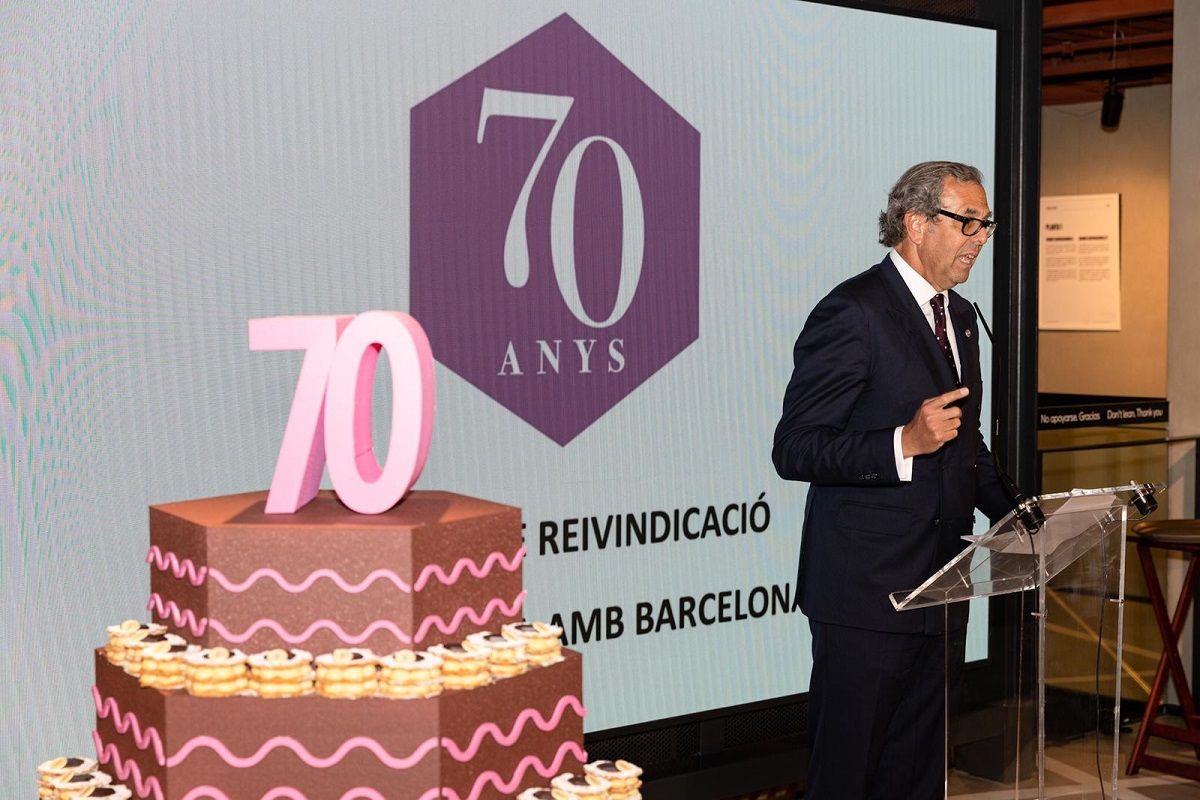
Commemorative dinner at Casa Seat
The mayor of Barcelona, Ada Colau, was not present at the dinner organized by the Associació del Passeig de Gràcia, but the first deputy mayor, Jaume Collboni, was, who stressed that "Barcelona is beating again" and that tourism "has returned". Collboni called the agreement to extend the number of commercial Sundays "historic", in addition to asserting that local commerce "is a jewel for the city" that must be taken care of.
Also present at the event were the president of the Parliament, Laura Borràs; the secretary of Business and Competitiveness of the Generalitat, Albert Castellanos; the Government delegate in Catalonia, Maria Eugenia Gay; the president of the Barcelona Chamber of Commerce, Mònica Roca; and the president of Foment del Treball, Josep Sánchez Llibre, and two former mayors of Barcelona: Jordi Hereu and Xavier Trias.
Among the numerous attendees at the dinner were Gabriele Palma (Casa Seat), Damià Calvet (Port of Barcelona), Rafael and Andreu Soldevila (Majestic), Malco Par (Majestic), Ramon Agenjo (Damm), Marian Muro (Turisme de Barcelona), Marga Farga (Farga), Jordi Rabat (Rabat), Juan Juvé (Juvé & Camps), Josep Martínez Vila (Saba), Rosa Maria Esteva (Mordisco), Javier Cottet (Cottet Óptica), Gabriel Jené (La Mallorquina), Fermin Villar (Amics de la Rambla), Llucià Homs (Hänsel i Gretel) and other political representatives such as Ernest Maragall, Albert Batlle, Montserrat Ballarín, Assumpta Escarp, Nacho Martin Blanco and Ignacio Garriga.
Add The New Barcelona Post as your preferred Google source for free
Stay informed with the latest news.
