
The sea represents a source of resources connected with hundreds of activities ranging from commerce to obtaining energy and food. Due to the not always predictable characteristics of the sea, any of these activities gains security and efficiency if it has an element that stands out as crucial: data. Faced with this reality and the lack of affordable and secure solutions, in 2019 the Catalan company Seabots was promoted, which develops robots and digital tools to analyze and preserve the marine environment.
After selling about forty autonomous and sensorized aquatic robots, the company expects to invoice 650,000 euros this year, 20% more than the previous year, which will be complemented by 500,000 euros in public funds. Now, Seabots aims to deploy a constellation of its robots along the Catalan coast, so that it can offer continuous data and analysis to multiple clients.
"Any activity carried out at sea needs to be very well documented before being carried out," remarks the CEO of Seabots, Pau Guasch. In this context, Seabots was launched in 2019, stemming from the GPA Innova group, created in 2013 by Guasch and three partners to act as a technological platform to promote innovative projects in the industrial field. The good results of the group "helped generate enough muscle to be able to carry out other projects," such as Seabots. "The means that existed in 2019 to obtain data from the sea were very rudimentary and did not meet the expectations and needs for efficiency and safety required by an environment as complicated as the maritime one," according to Guasch, who came from the maritime sector.
Despite the fact that other areas of the world have shown interest in having a similar constellation on their coast, Seabots considers that the ideal place to install the first one is the Catalan coast"Collecting data represents a repetitive task and the optimal thing is that there is no one at sea to do it, since it is dangerous.The robots fit perfectly", Guasch narrates. In this way, they decided to launch Seabots, with another objective in mind: to develop affordable robots and not at exorbitant prices.
To materialize this, they opted to base themselves on a technology that was already consolidated and apply it to the sea: aerial drones. Thus, they implemented their technology in the maritime sector, and obtained a product "enormously versatile and with a practically derisory price for a robot," of about 40,000 euros for a standard model. All of them are characterized by versatility, and they admit the installation of all types of sensors, depending on the client's needs: "It is not a closed platform, but an open one that is highly customizable."
Seabots, which has a staff of ten people focused on R&D, has produced 40 of its robots so far, which have been sold in 20 countries worldwide, with the first of them exported to China in 2020. "Our initial business model was to sell the robots; now we maintain that business line, but we have pivoted to a service company," operating for specific missions on demand using a fleet of eight robots. Thus, they are responsible for collecting the data required by clients, adapting the robots and operating them at sea, and then delivering the information. For this, Seabots incorporated specialized robot operators: "The best talent in this field is precisely in Barcelona, and we have two world-class operators, who have even helped find sunken treasures."

In this mission-as-a-service business model, Seabots' main clients belong to the scientific field: "Universities, technology and research centers are our main clients, although we also have private sector companies linked to various areas of the blue economy". An example of these missions as a service is the one the company recently provided at the request of the Generalitat in the Sau reservoir to study the state of its waters due to the drought.
Now, Seabots plans for the next five years to expand its business model again, and go from deploying robots on a one-off basis for specific missions, to creating this permanent constellation of robots on the coast that can be continuously operating to offer data collected in a personalized way for different clients. Seabots' intention is to locate robots in the first two miles of the coast, "where practically all activity takes place."
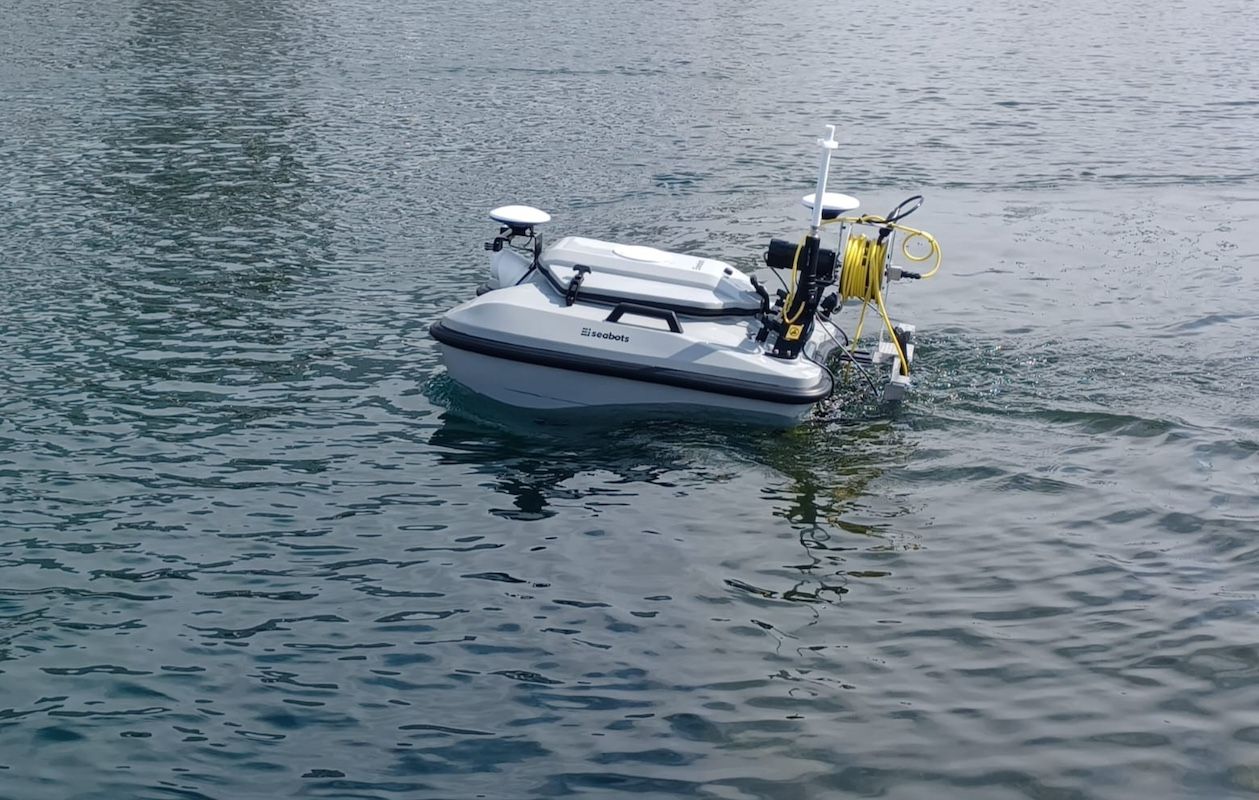
"We will end up moving from a mission as a service model to a data as a service model: a data platform that clients can connect to and download the information they need," explains Guasch. This multi-client model, unique internationally, will begin to materialize over the next few years. "The intention is to strengthen ourselves technologically and commercially over the next two years, and dedicate the following three to operatively deploy this first global constellation of robots on the coast," through a fleet that will also include its new Oasis robots, the smallest hybrid robot in the world. "It fits in the trunk of a car and can be operated by two people, something that is unique in the world for a hybrid robot" and that facilitates tasks such as inspection, rescue, and scientific research. Seabots' product portfolio includes autonomous robots for cleaning microplastics and spills and filtration buoys, in addition to autonomous vehicles equipped with sensors, capable of reaching spaces inaccessible to people.
Although other areas of the world have shown interest in having a similar constellation on their coast, such as Monaco and Costa Rica, Seabots believes that the ideal place to install the first one is precisely the Catalan coast: "The time is here and now." This is because "the potential market and the ecosystem linked to the blue economy that operates from Barcelona and the rest of Catalonia and the Spanish Mediterranean is spectacular."
Seabots' commitment also comes at a time when the blue economy is receiving a boost in Barcelona and its surroundings, partly driven by the America's Cup, and with projects such as the new SSShub of startupsSSS from the sheds of the Sant Bertran dock in the Port of Barcelona, and the spaces for these emerging companies linked to the sea at the renovated Olympic Port.
"The variety is impressive: all the activities of the blue economy are represented," from aquaculture to ports and other infrastructures, energy facilities, industry of all kinds, freight transport, and research, according to Guasch: "We have much to do here."
Add The New Barcelona Post as your preferred Google source for free
Stay informed with the latest news.
