"There is not enough bread for so much chorizo," warns one of the signs hidden in Antoni Miralda's Barcelona workshop. The phrase could pass for a popular saying if it weren't for the fact that, in this artist's universe, almost nothing is as innocent as it seems. A chair bears the words "grease and desire." In another corner, a monumental crown of the Statue of Liberty, crossed by corn cobs and peppers, lights up again for a few hours.
For decades, Miralda has used food to talk about almost everything that remains off the plate. About power, identity, migrations, religion, consumption, and the contradictions of a society that has turned one of the most elemental needs into a territory increasingly loaded with meanings.
The Sant Stomak 2026 found in his Barcelona workshop a setting worthy of its particular sanctity. Born from the universe of FoodCultura, the foundation dedicated to exploring the relationships between food, art, and anthropology, this gastronomic saint summoned his faithful with an apparently simple mission: to enter a supermarket, choose a product, and bring it to the workshop with a single condition. The label had to contain some statement headed by the words "without" or "with." Two seemingly insignificant prepositions, but capable of revealing a good part of our fears, desires, and contradictions.
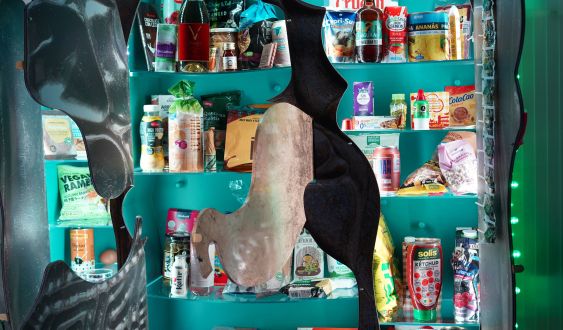
The result was a very curious inventory. Cereals without artificial flavors, corn nuts without palm oil, and alcohol-free or unfiltered beers. Juices with vitamins A, C, and E, but without added sugars. Protein powder with Cacaolat flavor, perfect for gym millennials. Olives with pits and without pits, sugar-free cookies and others enriched with iron, as well as drinks with collagen, a trend that, strange as it may seem, is also starting to find a place in bars. My favorite? A drink that proudly announced the presence of 100,000 live microorganisms. Yes, 100,000.
The food industry seems determined to offer us a world in which everything is improved, enriched, purified, reduced, or corrected.
But the most interesting thing was not any of those products separately, but seeing them all together. As if food had ceased to be sufficient by itself and had to constantly justify what they contain or what has been taken out of them. The food industry seems determined to offer us a world where everything is improved, enriched, purified, reduced or corrected. And, amidst that inventory of virtues and absences, someone had left a box of Ozempic. Is Ozempic a product "with" or "without"?

The question took that same logic one step further. After all, whoever doesn't have a good dose of collagen, impeccable iron levels or a slim body is because they don't want to. And I wouldn't rule out that we'll soon find "GLP-1 friendly" labels on supermarket shelves.
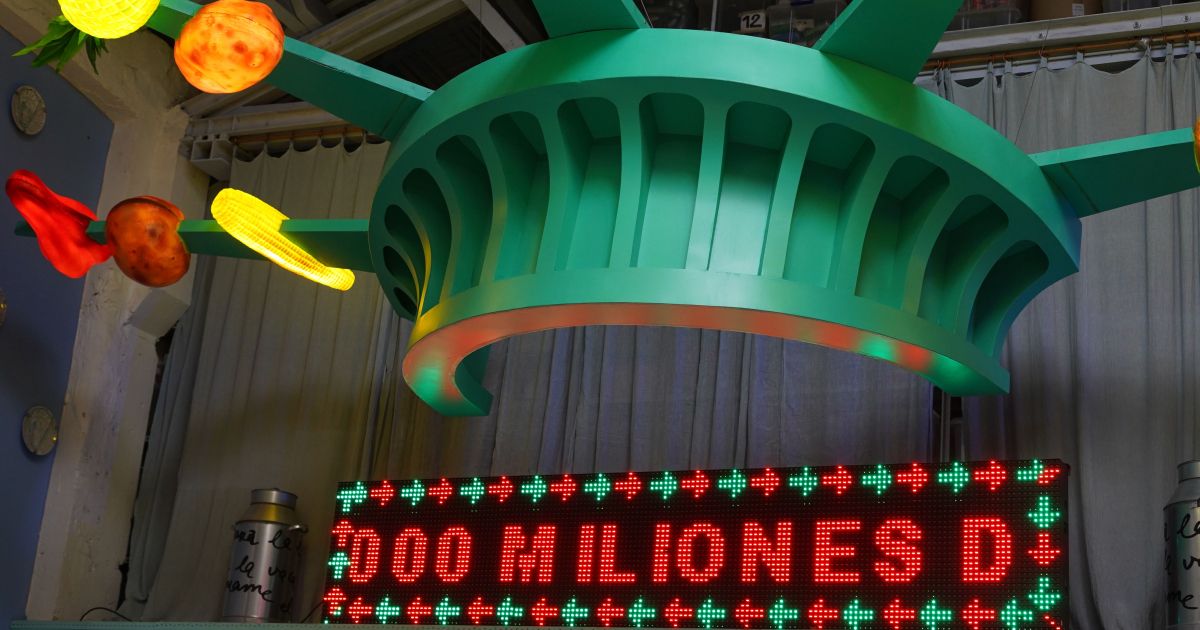
But the food offerings were only part of the celebration. There were also the electronic mantras of Ramón Faura/Cuerno and a rather unusual appetizer: a 500-milligram activated charcoal pill, free of genetically modified organisms, gluten and solvents.
The artist Alicia Ríos, for her part, ended up covered in labels that read "with taste", "without pleasure", "with air" or "without fear". The same words that in the supermarket serve to sell food became here declarations about life, the body and emotions.
The same words that in the supermarket serve to sell food became here declarations about life, the body and emotions.
Meanwhile, the traces of other celebrations and artistic adventures remain present in the workshop. Among the 100,000 documents - here yes - that fill the space, one can reconstruct a trajectory difficult to classify, with creations as unique as the Honeymoon Project, in which Miralda imagined a love story between the Statue of Liberty and the monument to Christopher Columbus, or El Internacional, the restaurant he promoted together with Montse Guillén in New York in the eighties.
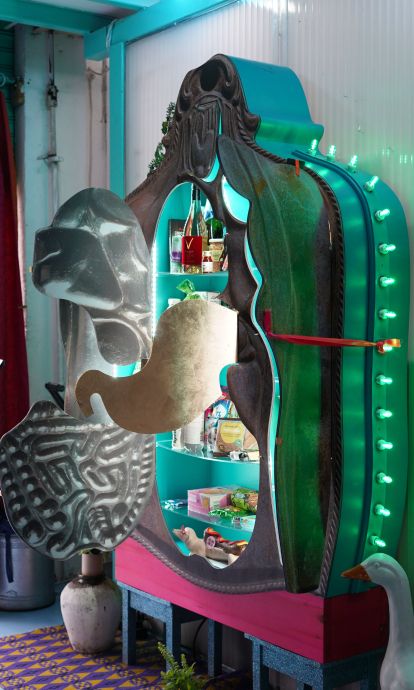
Among all these initiatives, the Sant Stomak occupies a particular place. It travels, stars in processions, receives offerings, and adopts new forms in each place it arrives. More than offering answers, it seems willing to multiply questions. After an afternoon with it, it's hard to look at labels the same way again. After all, perhaps they explain less about food than about ourselves.
Add The New Barcelona Post as your preferred Google source for free
Stay informed with the latest news.