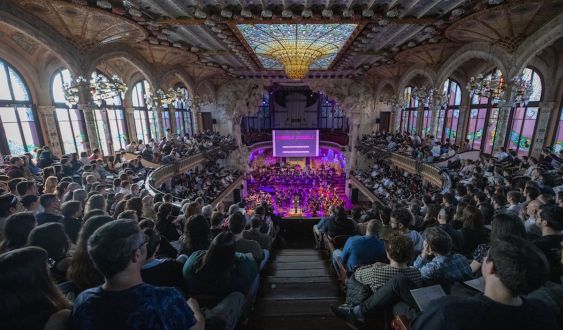
A society without culture is almost a society without a soul. For this reason, the powerful Catalan cultural fabric fights to configure and preserve the soul of this society. An unstoppable work that, especially in recent years, seems to be bearing fruit, with record figures that revalidate the good health of culture in Catalonia: theater halls with record audiences, Catalan films that triumph on the small and big screen, and an energetic literary industry that consolidates itself as the great engine of the sector on a Spanish scale. An unstoppable work that, however, often encounters barriers to continue growing, such as the lack of economic resources for cultural projects.
In this search for funding, public administrations —from the City Councils to the Generalitat— play a fundamental role, through different subsidies and aid for cultural projects. Even so, at a time when the cultural sector demands that the Department of Culture have, at least, 2% of the budgets during this legislature, public aid and subsidies are not always sufficient.
In times of crisis, in fact, culture seems to be relegated to a secondary plan, becoming one of the first areas to suffer cuts, both by public administrations and on a personal level. "While in times of political and economic instability in Catalonia it is decided to cut the budget in culture, in 2008 —coinciding with the real estate crisis— France opted for the opposite strategy: eliminating VAT for cultural products, since it was considered that, in times of instability, the population still needed culture more to connect and disconnect from problems," reflected Ainhoa Grandes, president of the MACBA Foundation in the session Patronage and impact: beyond financing of the Stellar Moments cycle organized by The New Barcelona Post and the Catalunya Cultura Foundation.
It is at this moment, when public aid is minimal or insufficient, that another way of financing and supporting culture comes into play: private funding. Spectators, readers, and consumers of cultural products are, ultimately, the reason for being, but also one of the main engines that allow culture to subsist. Even so, consuming culture is not the only way to finance it: individuals themselves can also become patrons, that is, people who, altruistically, decide to promote a certain activity, either through money, material donations, or even by investing their time.
Patronage is, in fact, a form of financing that is not only possible thanks to private initiative, but also to public collaboration, since, although it is individuals or companies who provide these economic resources, public administrations return a part of these expenses through income tax deductions or in corporate tax.
This form of financing cultural projects, that of patronage, is responsible for the magnificence of cities like Florence, which would not be the same without wealthy families like the Medici, who decided to support art and finance the work of artists who would end up becoming geniuses, such as Michelangelo or Da Vinci. Even so, one does not have to resort to this Italian city to find examples of how patronage has shaped and impacted society: the city of Barcelona itself, as well as other places in Catalonia, would have a very different configuration without the contributions of small and large patrons.
 The Liceu would not be a reality today without the involvement of wealthy families who financed its construction. © Sergi Panizo
In fact, buildings such as the Palau de la Música Catalana or the Gran Teatre del Liceu —two of the great reference cultural institutions— could not have been erected without the commitment of a committed civil society, as well as renowned personalities or businessmen who helped finance their constructions. "A civil society and personalities who, especially in times when Catalan society observed that indigenous culture was suffering a setback —such as the Renaixença or the years after the Civil War—, have contributed money to finance important cultural projects," recounts Marta Grassot, head of the Documentation Center of the Orfeón Catalán project.
Grassot has also been the curator of the exhibition Mecenatge i cultura. Una història compartida (Patronage and culture. A shared history), which reviews the rise of patronage especially in Catalonia in the late 19th and early 20th centuries, a time when names of personalities who acted as cultural patrons stand out, such as Francesc Cambó —very linked to the Orfeó Català—, Eusebi Güell or Josep Bartomeu —who organized free concerts at his home, in what was known as the Garden of Oranges—, but also the involvement of artists such as Pau Casals himself and even women like Isabel Llorach. These personalities join the strength of civil society, thanks to which the Palau de la Música Catalana could be built. A force that manifested itself through associations and entities such as the Orfeó Català, which came to concentrate 9,500 members in 1969, in the midst of the Franco era.

In 21st century Catalonia, it seems that, with the death of these personalities, a way of investing in and preserving culture has also been dying. "In a moment of geopolitical instability like the current one, in society it seems that a generalized discouragement reigns in many aspects: political, social, and even cultural and artistic. This instability, added to a generational change, causes the figure of patrons to have been diluted and even disappeared," laments Bernat Puigdollers, art director of the Vila Casas Foundation.
The entity was founded in 1986 by pharmaceutical entrepreneur Antoni Vila Casas, owner of Prodesfarma —which at the end of the 90s merged with Almirante laboratories—, with the aim of promoting research and, later, also Catalan contemporary art. Today, the entity manages five spaces spread across the territory from which they keep alive the spirit and legacy of Antoni Vila Casas, considered by some as the last great Catalan patron, contributing to the dissemination of Catalan contemporary art. For this reason, Puigdollers believes that individuals or entities like the Vila Casas Foundation have almost become a "rara avis" within the Catalan landscape, since they see that there are fewer and fewer entities or individuals who play this role of patron and facilitator of culture.
Currently, in fact, the entity is in a moment of internal redefinition to try to establish bridges or dialogues between this commitment to emerging art and Catalan tradition, in addition to trying to merge in a clearer way the areas of health and art, the two great pillars of the foundation. During this process of redefinition and adaptation to new times, the Foundation wants to take the opportunity to highlight the figure of entrepreneurs like Vila Casas and the impact of these patrons on Catalan society.
An altruistic and discreet contribution
Although the widespread perception is that, with the turn of the century, the commitment to cultural patronage has diluted, the reality is that patrons who invest in culture continue to exist, even if they do so discreetly. Patrons like Sergi Ferrer-Salat, president of Grupo Ferrer and promoter of the Finestres bookstores as well as a music foundation that subsidizes the careers and concerts of young artists; TatxoBenet, who has recovered and exhibited works censored for decades; or Joan-Artur Roura y Comas, who, over the years, has gathered an eclectic art collection, works that have been lent in various exhibitions.
Likewise, there are also Catalan companies that are committed to patronage as one of their main objectives. Companies such as Llet Nostra, a dairy cooperative that every year organizes El Nostre Festival, a cultural event aimed at a family audience and donates its profits to the Catalunya Cultura Foundation. Even so, Llet Nostra is not an exceptional case.
In addition to the IMPULSA seal, an extensive list of companies committed to culture is among the eighty companies that are part of the Patronage Council of the Palau de la Música, where names such as Fundación Damm, Havas Media Group, Agbar, Fundación Puig, Agrolimen, or even The New Barcelona Post.

Among the agents committed to financing culture in Catalonia, the strength of associations and foundations that are committed to culture at all levels and in all disciplines also stands out. In fact, according to the Observatory of Foundations published this October by the Catalan Coordinator of Foundations, in Catalonia there are more than 2,000 active entities, 49% of which are dedicated to providing services in the field of culture.
Thus, in addition to the Vila Casas Foundation, there are also other entities that are committed to the cultural sector, such as the Catalunya-La Pedrera Foundation, the Setba Foundation or the Carulla Foundation. These entities, although often concentrated in the metropolitan area, are spread throughout the Catalan territory, such as the Iluro Foundation or the Itinera Festival.

Thus, patrons and companies committed to culture have not disappeared with the turn of the century, but it is true that the work of these personalities and companies often goes unnoticed. It is the patrons and companies themselves who invest in culture, in fact, who choose for these to be discreet contributions, partly also for fear that the population perceives these donations as an attempt at advertising or a facelift.
Towards a more collective patronage model
Even so, especially in recent years, in Cataluny civil society has dismantled the false idea that patronage is only the responsibility of great fortunes and wealthy families.Thus, in recent years, a new funding model stands out: crowdfunding from individuals or businesses that, perhaps on a very small scale, contribute to the proliferation of cultural projects. From the neighborhood store that sponsors acollaof popular culture to the culture lover who decides to subscribe to a theater venue.To channel and promote all these anonymous patrons, Verkami was born fifteen years ago, a pioneering crowdfunding —or micro-patronage— platform that allowed connecting artists with small patrons. It was the idea of biologist Joan Sala and his two sons Adrià Sala and Jonàs Sala, an art historian and a doctor of physics, who, despite their professions, shared a passion for culture. Replicating a model that was beginning to succeed in the United States, they launched the platform that allowed connecting creators with anonymous patrons who could help finance their creations.

Thus, as a token of gratitude to their patrons, creators offer a reward system according to the product they are working on: from an exclusive preview of a film to a dedicated book or a series of limited edition cards in the case of a board game. The platform allows, therefore, that anyone can become a patron of cultural projects with contributions as minimal as 20 euros, although the average usually stands at around 45 euros per project. Since 2010, the platform has brought 13,000 projects to fruition, raising 66.5 million euros, with an 80% success rate compared to the total number of projects initiated through the platform.
Even so, for Jonàs Sala, the key lies not only in the success figures, but also in the community of small patrons that Verkami has managed to mobilize, with people who have contributed money to up to 200 projects that, otherwise, would not have gone ahead. "Patronage is not just about contributing money, it is also a commitment and a bond between the two parties involved," a bond that is fostered through platforms like Verkami, where there are even cases of people who act as patrons of a specific project also talk to the creator to help them refocus certain strategies or messages.

In fact, the Palau de la Música, for a couple of years now, has also been working along these lines, trying to promote micromecenazgo so that a greater number of people can become benefactors of the institution. Remembering, furthermore, that donating money is not the only way to become a patron, as donations of archival or historical material can also be made to the institution or a part of the testamentary legacy can be left to the institution.
For Jonàs Sala, the proliferation of these more collective micromecenazgos, which come to fruition thanks to the collaboration of multiple people, have allowed for the democratization of both the figure of the patron, who has ceased to belong to an affluent social class, but also cultural creation. "A few years ago, for artists and creators, it was much more difficult to find economic resources because either they knew they were signing with a powerful record label or publishing house or their projects would end up in a drawer. Now, creators have these platforms that allow them to bring their ideas forward despite not having the support of any large company," Sala defends.

This new form of collective micromecenazgo, then, adds to the tireless work of large Catalan entrepreneurs and companies that, even today, are committed to the preservation of Catalan culture. All in all, thanks to this ecosystem made up of multiple and varied agents, the Catalan cultural fabric can find in these different forms of patronage an ally and an impulse to preserve itself, especially to cover projects where subsidies or public aid do not reach.
An ecosystem, however, that, according to the general director of Llet Nostra, Gabriel de Mariscal, could still be further favored if there were a Catalan patronage law that not only did not fiscally penalize companies that invest in cultural, social, or scientific projects, but even supported and projected them. For Mariscal, it is essential that this future regulation, on which the Generalitat is now working with the aim that it can see the light during this same legislature, explains and multiplies the positive impact of patronage both for private organizations and for individuals.
"Only a cultured and educated society can be considered a free and just society, with individuals capable of discerning what suits them and what does not." And only a society with culture, and with projects promoted and financed both by public administrations and by the actions of small and large patrons, can come to be considered a society with a soul.
Add The New Barcelona Post as your preferred Google source for free
Stay informed with the latest news.
