"The home has come to be considered an active piece of daily life, leaving aside the role of bedroom-capsule that isolated and hindered integration. Neighborhoods are dynamic and promote the concept of community. The same block or contiguous buildings share services such as laundry, cleaning, food purchasing center, restaurant, workspace, and leisure area for reading, cinema, and other activities. They cooperate in areas such as time saving, work-life balance for couples, for families."
Utopian Barcelona is the result of conversations held with 5 municipal architects. Each of the conversations has revolved around a specific theme, although the result, a consequence of an integral vision of the city, incorporates transversal ideas. The idea for this series of 5 articles about a utopian Barcelona was born to give wings to these architects who maintain close contact with the city, some for many years and, moreover, daily. The creative scope of municipal architects is often limited by budget allocations, by execution deadlines, by the policies of the government in power… So, without entering into partisanship, they have ventured into the exercise of speculating about a Barcelona that will never exist, but that we can imagine.
The articles have a futuristic slant. However, not all of them delve into science fiction. The readings invite imagined locations and corners. To invented forms of the city. To projections of a Barcelona society far removed from the current one and, above all, they seek to give the reader a good time. With the exception of the text in italics, which is a transcription of part of the conversation or a research process, the rest is the fruit of imagination.
*Guest architect: Xavier Soler i Benito, municipal architect of the Barcelona City Council.
Xavier meets me at the beach bar in Ciutadella Park, one of the remnants of the 1888 Universal Exposition that has not only withstood the test of time but has also known how to adapt. Nearby, in Sonia's roundabout, a music quartet plays. Xavier has a coffee and I have sparkling water. "I am skeptical about what is said about the future," Xavier says. "If we were to pay attention to predictions, today Barcelona would be an urbanistically unrecognizable city. And, certainly, the city is unrecognizable in some aspects of daily life. One only needs to compare it with Barcelona of one or two decades ago. In contrast, the urban transformation has not kept pace. In reality, more than a transformation, it has been an adaptation. If the Cerdà Plan had been respected point by point, we would probably be in the projected garden city, where two of the four sides of the blocks should have been green spaces. But interests guided it in another direction and going back now is difficult, if not impossible. Whatever wants to be renewed, amended, or corrected, must be confined to the city limits."
Housing is an example of adaptability. Helsinki has been the model that has guided a good part of European cities towards a paradigm shift. Since 2016, the Finnish capital owns more than 70% of the urbanized area. This gives it autonomy when developing its own policy in housing supply and promotion. It is a model that intervenes in the housing market to stabilize its price balance, making housing accessible to all social and economic conditions. "Currently, around 75,000 public housing units ---which represents 80% of the total portfolio--- are rental housing subsidized by the government through a system of participations." The measures establish quality minimums and limit production costs. Consequently, profits for builders are lower, but on the other hand, they have assured sales.
The adaptation of the Helsinki model in Barcelona allowed the neighborhoods of the Catalan capital to break the trend set until then. Now they are neighborhoods where diversity predominates. The way the city is lived now, more relaxed, is a consequence of having reduced access to private cars and having established a green axis with Plaza Catalunya as a neuralgic space and La Rambla, connecting with the sea on one side and with Paseo de Gràcia on the other, acting as a link with Gràcia and Horta-Guinardó as a corridor that connects with Collserola.
Since the implementation of this pattern we have witnessed a progressive transformation of the way of inhabiting the city. The home has come to be considered an active part of daily life, leaving aside the role of a bedroom-capsule that isolated and hindered integration. Neighborhoods are dynamic and promote the concept of community. The same block or contiguous buildings share services such as laundry, cleaning, food purchasing center, restaurant, workspace, and leisure area for reading, cinema, and other activities. They cooperate in areas such as time saving, work-life balance for couples and families. Also in schooling, general training, or parenting support. They take part in recreational activities and stimulate lines of creativity for young people.
The city is full of functional spaces because it has ceased to be a space limited to mobility as it had been until now. The streets and avenues of Barcelona favor the return to the quality of life of the Mediterranean spirit, to harmony and affinity between people, abandoning the rhythm imposed by the agenda-driven life, necessary for productivity, because it has ceased to provide value. The streets are clear and compartmentalized spaces that invite one to observe their detail. Everything moves within a routine exactitude. On the benches there are books. Between the trees, clothes hanging. Children have ceased to be machines and play without architectural confines. In the squares, repose prevails, watered vegetation, and in the sky, a cloud. The contemplative character is imposed. Silence favors inner dialogue. Quite the opposite of the Barcelona that dazed, that opposed the spontaneity of chromatic changes, that imposed neon advertisements, that distanced people from the radiant midday or from sunsets of pure blue and intense reds. This return to the natural sensibility of being, reconnecting with intimacy and the naive heartbeat is, in Mediterranean culture ---where the scenery is balm--- something vital. And it is permanently so.
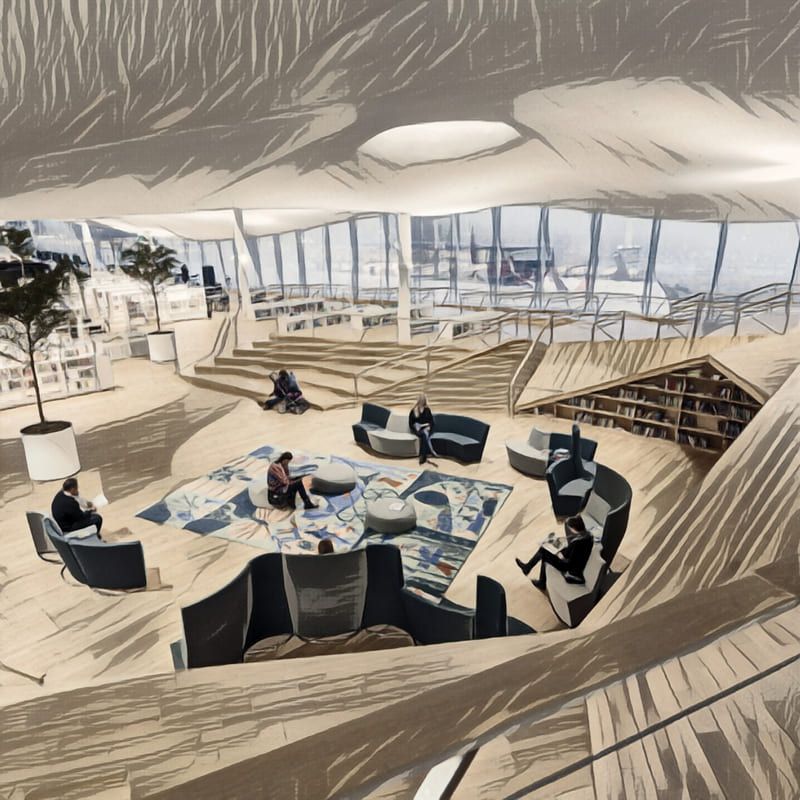
Xavier has to leave. He has a medical appointment. And we take advantage of a last note on the transformation of the waiting rooms in primary care centers and hospitals, which have ceased to be spaces where time passes reluctantly to transform into rooms where it is possible to engage in respectful conversations or join open meditation sessions. As well as accessing consultation points on preventive nutrition, Ayurvedic cooking recipes, botany or, simply, having a good coffee. The interior design of these areas has also changed from the coldness of plastic seats to the comfort of warm-colored sofas, lush vegetation and live musical performances; sometimes on the piano, sometimes on the cello… This ending brings back the memory of a conversation with Víctor Torres at the foot of the Sant Quirze Safaja cemetery, where his brother Màrius is buried. --- It's so beautiful [the cemetery] that it makes you want to die, said Víctor. Immediately after, we laughed, of course. And now I think these waiting rooms make you want to wait.
Chapter 1. The mobility of the future. Guest architect Joan Sansa.
Chapter 2. The landscape and the ecological footprint. Guest architect Sara Udina.
Chapter 3. Turning heritage into part of life. Guest architect: Armand Fernández Prat.
Add The New Barcelona Post as your preferred Google source for free
Stay informed with the latest news.