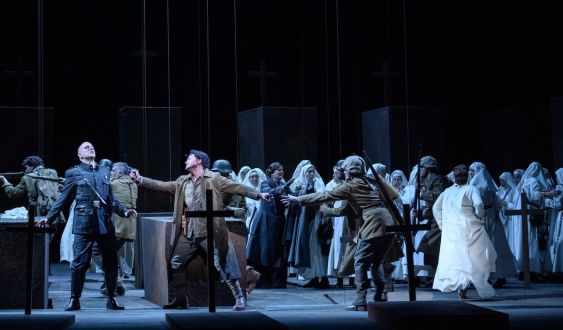
Despite being one of Giuseppe Verdi's most performed and beloved operas, Il trovatore (1853) presents conflicts that are hardly credible to today's eyes, too irrational, as when one of its protagonists, Azucena, makes a mistake in her revenge and ends up killing her newborn son. "It's a soap opera," summarizes stage director Àlex Ollé, who had to imagine how to make a plot, conceived in the midst of Romanticism when epic and unleashed passions found a fervent audience, more plausible.
War, already present in the original work, emerged as the only possible answer, sustaining extreme situations amidst chaos, hatred, and death, making reflection that would weaken some actions impossible. And reinforcing the conflicts that drive the four main characters, pursued by a love triangle between Manrico, Leonora, and Conte di Luna, even more lost with Azucena's constant revenge and the wounds she opens.
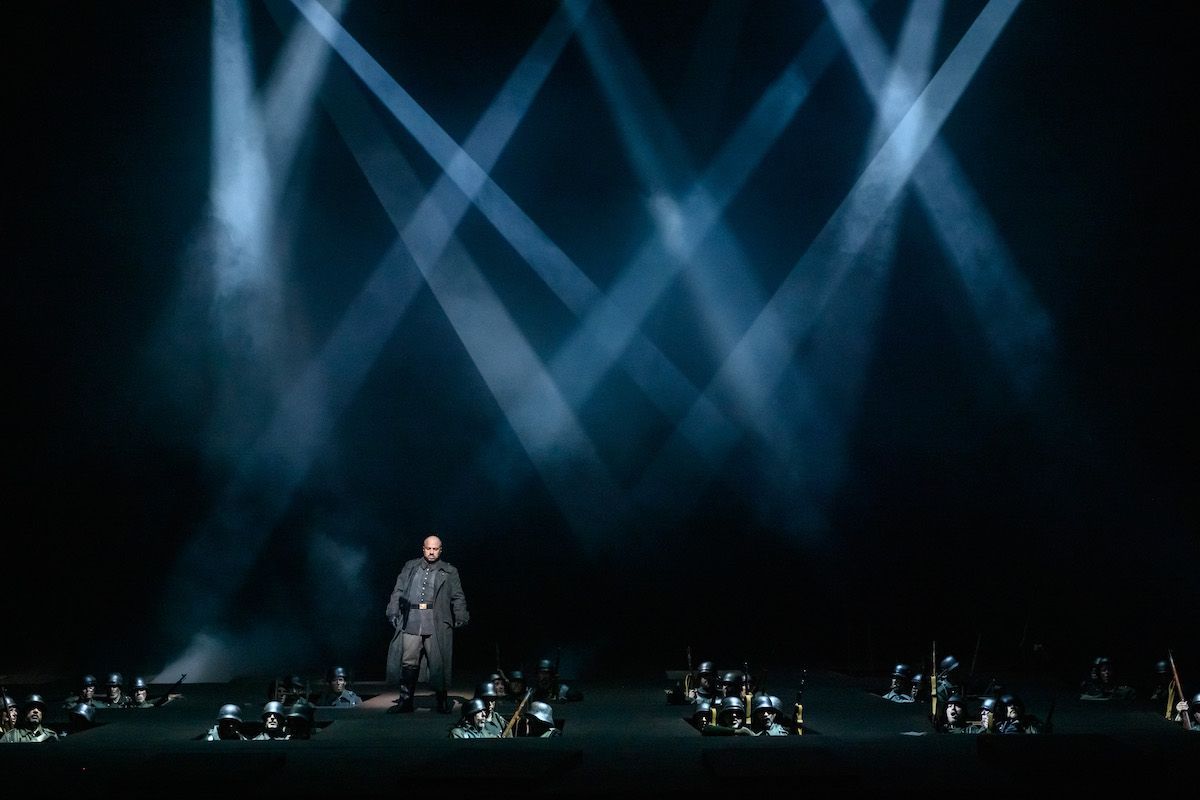
Once the storyline was chosen, it had to be concretized. The work is originally set in the 15th century, in medieval Aragon and Biscay, through a war conflict between brothers, even more visceral and unjust, with two sides that are closer than they think and who don't realize it until they fatally discover it. For Ollé, the Middle Ages could not awaken any interest in the current spectator, too alien and dark. Being aware that opera, moreover, "generates distance," and following his style, he chose to update the story and set it in World War I. He did so because he could thus play with "an anachronistic and, at the same time, futuristic appearance," mixing cavalry and sabers with gas masks, which further increased the sense of proximity.
The staging conceived by Ollé for Verdi's classic was designed for the Dutch National Opera in Amsterdam (2014) and the Opéra National de Paris (2016). After traveling to Rome and repeating in Paris, the proposal arrives at the Liceu, where the work has already been performed almost 290 times. The last time, recently, in 2020, with Gustavo Dudamel conducting the Choir and Symphony of the Barcelona theater. Il trovatore as conceived by Ollé can be seen from this Thursday until Tuesday, November 8. The audience under 35 was the first to see it on Wednesday, in one of the sessions of the new cultural initiative Vibe35.
Verdi's melodrama will be the only chance to see Ollé in action this year, after taking to the stage of La Rambla last season with Norma and Pelléas et Mélisande, and two years ago with La Bohème. The next production by the Barcelona artist will not arrive until the 2024-2025 season, with Lady Macbeth. The wait will be worth it because it will be the first premiere in these years in which Ollé has become artist-in-residence and artistic advisor of Barcelona's great theater.
Trenches on a changing stage
With Il trovatore, the Liceu is invaded by the trenches of the First World War under the baton of maestro Riccardo Frizza. A minimalist, yet spectacular, set design by Alfons Flores allows the stage to be transformed in a few seconds with about twenty boxes that go up and down throughout the four acts that make up the work, with the capacity to outline different spaces, from a military camp and a cemetery to a convent and a palace. At some point, it recalls the Holocaust Memorial in Berlin, an analogy that takes the work to the Second World War, a scenario discarded by Ollé for the production, since he wanted to avoid the simile between the gypsies who star in Verdi's libretto and the Jews.
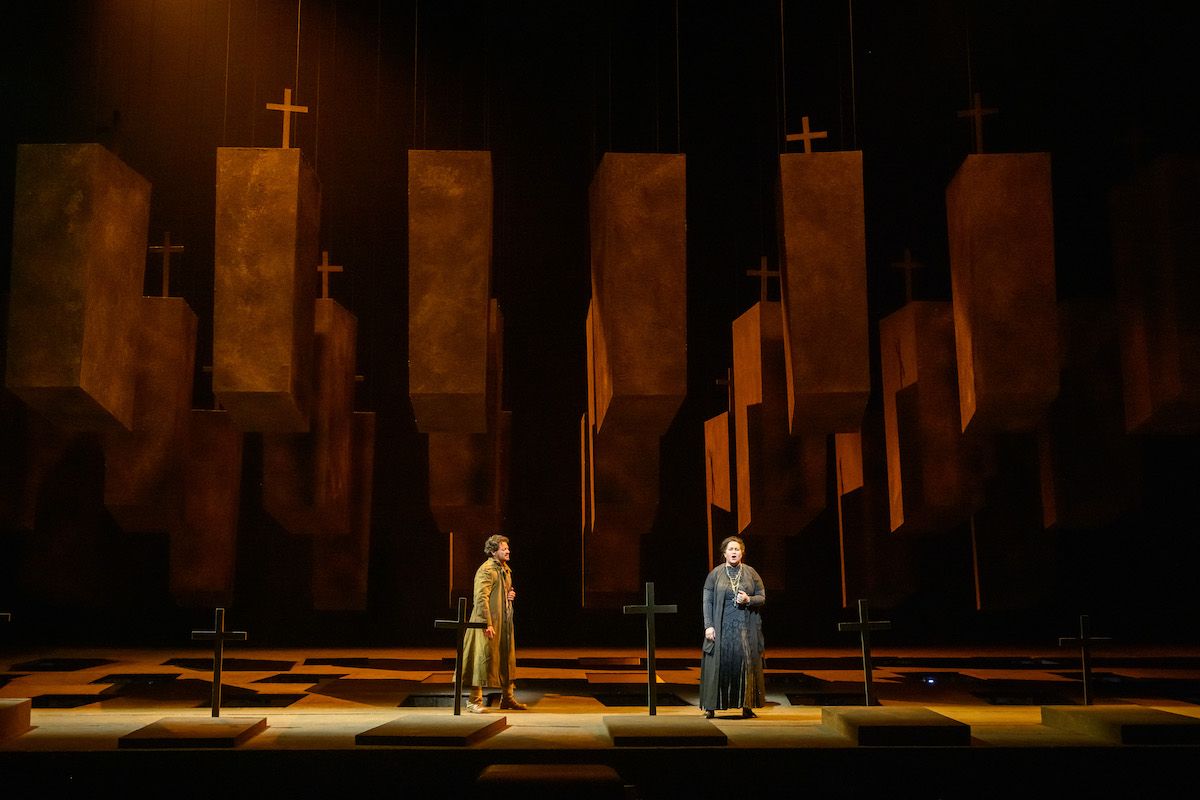
Urs Schönebaum's lighting completes an approach in which the action almost always takes place at night, with darkness and fire creating tense atmospheres. The staging reaches its maximum expression in moments such as when Leonora is about to enter the convent but Manrico appears and time stops. The theater becomes a living painting of a thousand expressions, with the nuns accompanied by gas masks and soldiers from both sides raising their weapons.
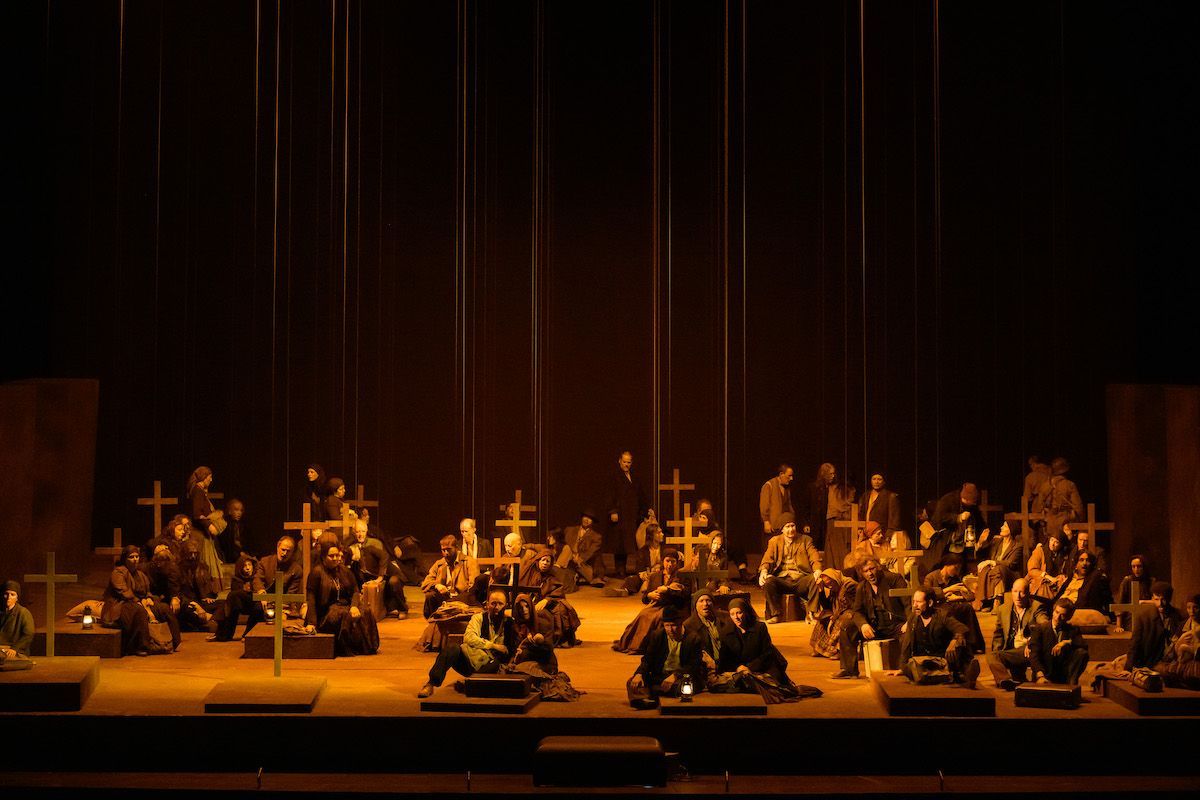
All this, with a cast formed by the Madrid soprano Saioa Hernández (Leonora), with pharyngitis the days prior to this Thursday's premiere, in which she is expected to be able to sing; the Italian tenor Vittorio Grigolo (Manrico), who debuts at the Liceu representing the most charismatic character with the most opportunities to leave the audience breathless; the Russian mezzo-soprano Ksenia Dudnikova (Azucena), the most elusive protagonist, but also the most appreciated; and the Andalusian baritone Juan Jesús Rodríguez (Conte di Luna), interpreting, along with Leonora, the less realistic plots. Throughout the performances, the roles will be alternated with Hibla Gerzmava, Yonghoon Lee, Judit Kutasi and Àngel Òdena, respectively. Without forgetting the impressive choir directed by Pablo Assante, with hypnotic moments such as the one starring the gypsy camp and its "Who beautifies the days of the gypsy?", or by the army before entering another battle.
Add The New Barcelona Post as your preferred Google source for free
Stay informed with the latest news.
