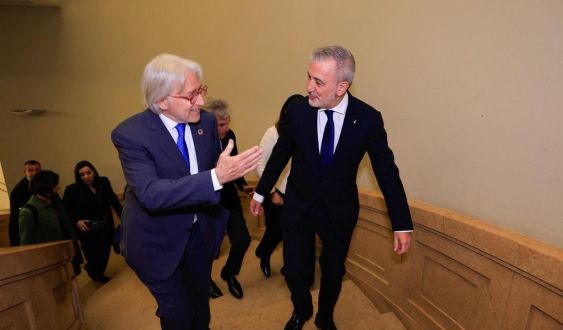
"In the first conversation I had with Salvador Illa, I said that in the short term the city needed security; in the medium term, housing, and in the long term, more metro." This was explained by the mayor, Jaume Collboni, in the dialogue of Rethink BCN and the Societat Barcelonesa d'Estudis Econòmics i Socials (SBEES) of Foment del Treball. To start, the president of the employers' association, Josep Sánchez Llibre, focused on public-private collaboration and the need for more cranes to build housing in the city, and more dialogue in decision-making such as that of the tourist tax.
From the global dimension to the most human and local scale, the mayor has outlined his vision for Barcelona in 2035, which involves the metropolitan scale, with affordable housing, sustainable mobility, and opportunities. We summarize in six notes Collboni's keys for the city of the future.
The right to stay
The mayor has insisted on defending what he describes as the right to stay and live in Barcelona. And that requires two elements, according to him: accessible housing, and opportunities. At the same time, these opportunities must translate into economic prosperity that must also be directed at reducing inequalities, and "avoiding two speeds in the city," according to the mayor. "The city is its people," he summarized in the dialogue, led by journalist Glòria Marin.Transformation of the city
La Sagrera, the reform of Montjuïc, cranes for new homes in La Marina or Zona Franca, the new Clínic… The city is in a moment of transformation that Collboni considers comparable to what Barcelona experienced for the Olympic Games. Furthermore, in this transformation also emerge new cultural projects, like theThyssen,and extensions such as those of theMNACand that of theMacba"We are generating new audiences."This transformation advances at the same time that the most everyday Barcelona is managed, according to the mayor. "I do not conceive of a city that does not take care of the human scale and at the same time is not capable of imagining a future project." Felipe Campos, CEO of Aigües de Barcelona and Director of Social Action at Veolia, also highlighted this when presenting the dialogue: "Barcelona is at a turning point." At this point, "the future does not depend only on the challenges, but on the ability to address them," he pointed out.
Housing and the pending task of 30%
Housing continues to be one of the main challenges for the city and, according to Collboni, it can be faced in two ways: leaving it at the mercy of the market law, or intervening. "I do not resign myself to the fact that families cannot live in the city center or in the Eixample, and that is why we have to intervene." The cap on rental prices goes in this direction, while it remains pending the reform of the 30% protected housing reservein the new promotions. "It's an obstacle that I recognize we haven't been able to overcome" due to lack of a sufficient majority in the City Council ("for now").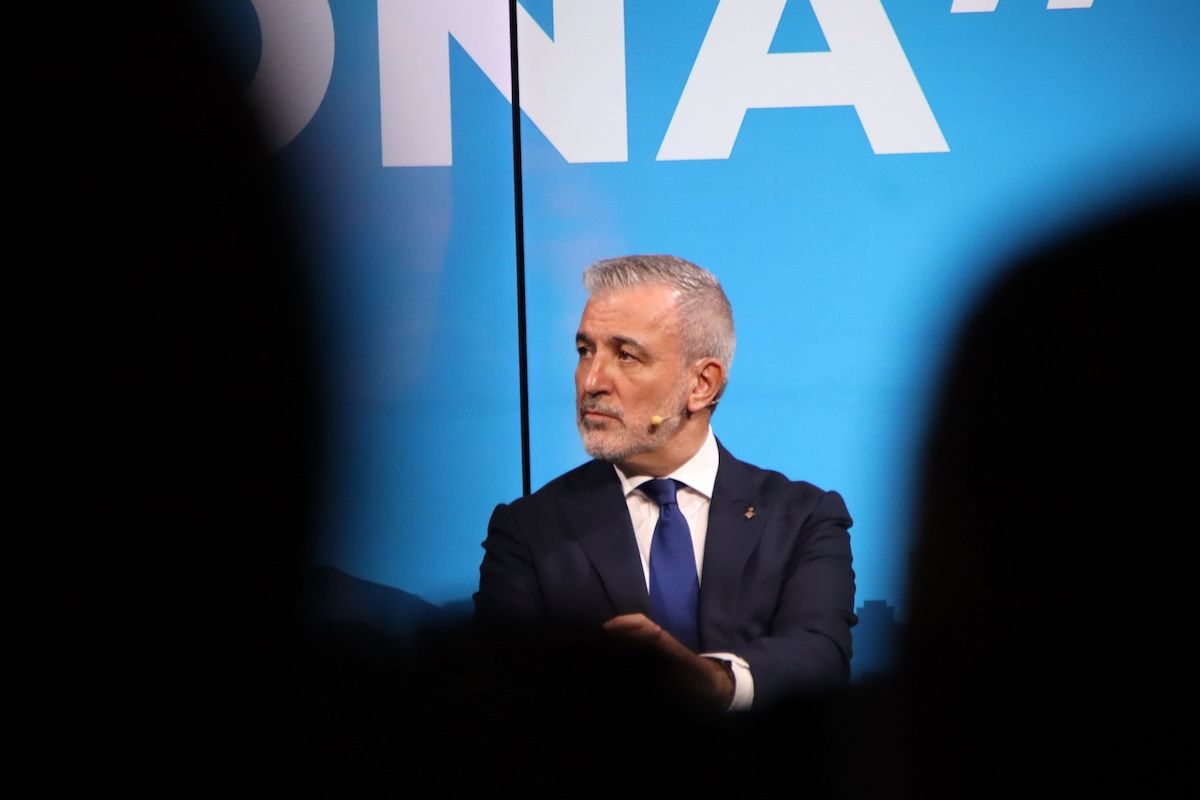
In fact, the reform of that 30% has been one of the clearest demands made by the president of Foment del Treball and SBEES: it will be a "negative point" of the mandate if an agreement is not reached on a reform that facilitates private promotion, according to Sánchez Llibre.
Barcelona in a metropolitan key
For Collboni, Barcelona must be understood in its metropolitan dimension of five million inhabitants, with shared challenges and opportunities that must be addressed jointly. To this end, the also president of the Barcelona Metropolitan Area (AMB) recalled that work is underway on the new metropolitan plan, to rethink the metropolis of the mid-21st century.The vice-president of Foment, Mar Alarcón, has precisely emphasized this direction, through areas such as housing, which "is not a global challenge, but a deeply metropolitan, and also European, structural challenge." And she went further: "Not only must the new scale of governance be addressed, but also public-private collaboration."

The metro, to Mataró and Castelldefels
To advance towards this connected metropolis, mobility is key. "Public transport is very well regarded in the city; the problem is the metropolitan area." Every day 400,000 vehicles enter and leave the city, and alternatives in efficient, fast and economical public transport must be promoted. "The metro should reach Mataró, and Castelldefels. It's the way to truly link a metropolitan area," he proclaimed. And he expressed his conviction that, one day, it will arrive: "I don't know if we will see it, but it will arrive."The rule of three thirds in tourism
In that Barcelona of the future that the mayor draws, tourism also plays a key role, in an economy that must be diverse and in which sectors such as creative industries and culture must gain strength. However, not everything goes in that tourism: "Mass tourism does not suit us and we do not want it, and tourism does not want it either." Thus, the city must move towards the rule of three thirds: one third family tourism, one third cultural tourism, and one third business tourism, according to Collboni.With all this, where is the Barcelona of the future going? "Towards a more livable city, with more green spaces, with more sustainable mobility, a city that guarantees that whoever wants to can stay, and a city of enjoyment from the point of view of sport and culture," as a horizon for 2035.
Add The New Barcelona Post as your preferred Google source for free
Stay informed with the latest news.
