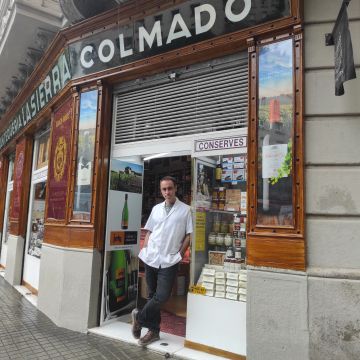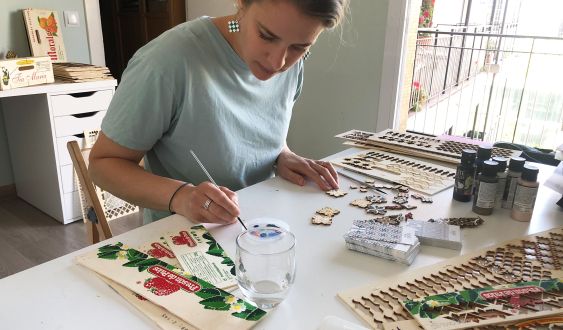
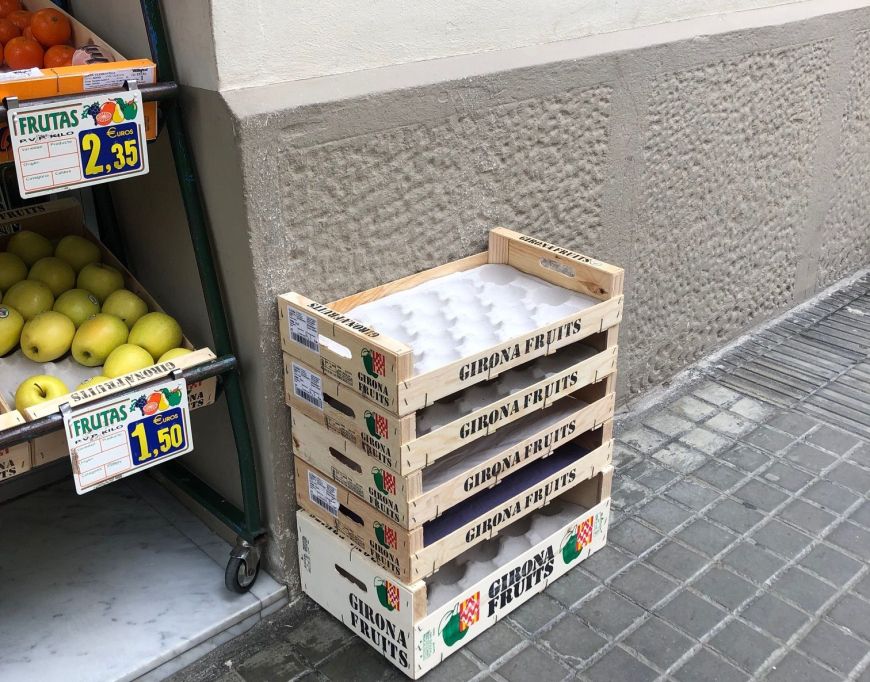
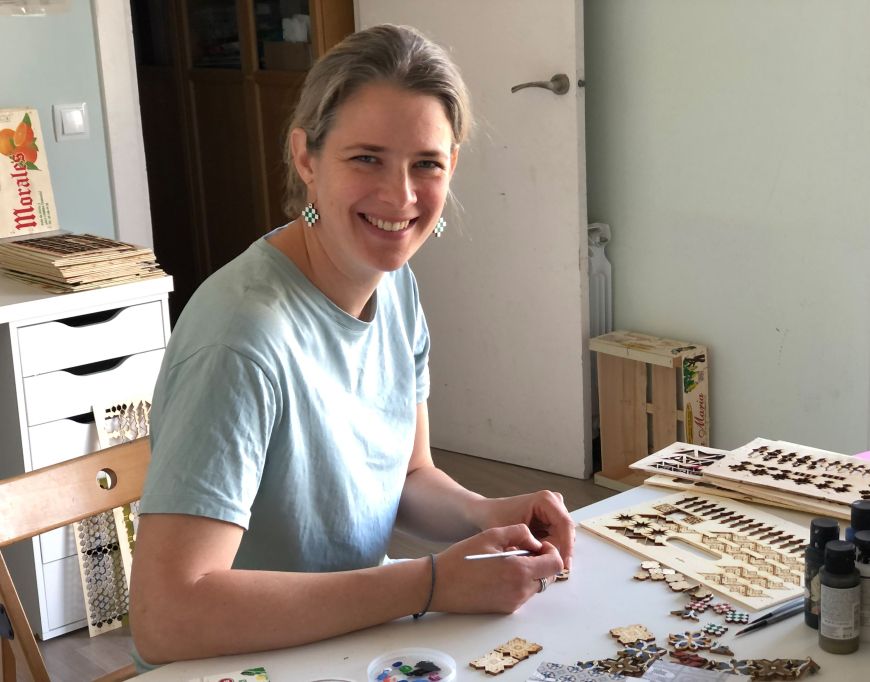
Stacks of wooden fruit crates piled beside the neighbourhood greengrocer await collection by municipal street cleaners. Yet before the refuse truck arrives, a local resident passes by and rescues them. It is Laura, ever on the hunt for the handsome crate. In the hands of this architect, boxes initially destined for the bin are transformed into the raw material for striking jewellery designs: earrings and pins that recreate the patterns and palettes of interior floor tiles found in entrance halls, apartments, and the pavement stones of the city’s streets and squares.
Laura Martinell is an architect who conducts property appraisals for flats and commercial spaces. It is a profession that grants her access to numerous singular buildings and private homes across Barcelona. Particularly in historic, regal, and Modernista properties, she frequently encounters the encaustic cement floor tiles – the baldosa hidráulica – that spread across so many interiors at the turn of the twentieth century and have recently made a resurgence in domestic spaces, reviving the very designs that spark her creativity.
Her venture began in 2018. Motherhood had afforded her quiet moments to reflect on the relationship between creativity, consumerism, and sustainability. “Back then, I was already making products using discarded materials,” she recalls. Gathering the yellow plastic capsules found inside Kinder Surprise chocolate eggs – which were beginning to accumulate at home – she designed miniature cacti, turning each half of the capsule into a plant pot for a “baby cactus”, as she called them.
While fashioning small wooden hangers for these mini pots from offcuts of fruit crates, she noticed she was using only a tiny fraction of the wood. Having mastered handling the material, she realised she could use it to shape an entirely new creation. That was when her thoughts turned to the mosaic floors she had always cherished: the encaustic cement tiles paving private residences, palatial reception rooms, grand entranceways, and countless apartments across Barcelona’s Eixample district.
Thus the tile motifs were reborn as earrings and pins. Once the crates are stripped of staples, cleaned, and sanded down, each piece is laser-cut to Martinell’s designs and hand-painted individually. “I create the drawings using AutoCAD, the standard architecture software,” she explains. Her eye is now finely trained to spot promising crates discarded in the street, already envisioning what they could become. “The moment I see them, I pounce. I take them home and salvage them. I have a wonderful time doing it; it’s fantastic.”
Sustainable creation
She finds deep satisfaction in bridging creativity with recycling. “I have reclaimed a material that had lost all commercial value and given it a new lease of life, a new purpose, and a new meaning. It is a way of creating added value from what already exists. It isn’t merely about reusing a material, but about uncovering its potential and turning it into something meaningful for someone once again.”
I have reclaimed a material that had lost all commercial value and given it a new lease of life, a new purpose, and a new meaning.
She arrived at this philosophy after asking herself: “If we already inhabit a world saturated with goods and materials, what is the point of making more using virgin raw materials?” Consequently, she notes, “it brings me great joy to have designed a product that captures people’s interest and inspires a purchase, while doing so in an environmentally responsible way that aligns closely with my values.”
During her architectural training, Martinell recalls how heavily sustainability was emphasised. “Throughout university, particularly around 2005, lecturers placed immense focus on the energy efficiency and sustainability of buildings. They taught us that our decisions as architects carry a profound impact on resource consumption and environmental footprint. That instilled in me an awareness of the responsibility we shoulder whenever we design and build.”
When reflecting on her upcycled wooden jewellery line, Martinell sees it as far more than an exercise in creating earrings and accessories. It embodies a whole creative outlook: “observing what surrounds us, uncovering the latent potential in disused materials, and turning them into pieces people can appreciate and cherish.”
Every incoming order, she says, “suggests that awareness is steadily growing around the importance of reusing, reclaiming, and giving materials a second life. I feel that, even on a modest scale, I am playing a small part in encouraging more mindful production and consumption that benefits the planet.”
I feel that, even on a modest scale, I am playing a small part in encouraging more mindful production and consumption that benefits the planet
“It gives me a real thrill and brings a smile to my face knowing so many people wear my jewellery,” says Martinell. She notices two distinct profiles among her clientele: “On the one hand, there are those who buy the earrings purely because they love the aesthetic, because the colours catch their eye, or because they evoke memories of Barcelona, without necessarily knowing the back-story. But there are also customers who know the project well, understand how the pieces are made, and value the ethos of working with reclaimed materials. In those instances, it feels like a truly conscious purchase,” she remarks. Circular reuse is woven directly into Martinell’s working method: the offcuts from large earrings are turned into smaller studs.
From Casa Batlló to the home of poet Joan Maragall
Historic floors had long captured her fascination. “When I began making the earrings, there was growing discussion around salvaging hydraulic tiles from flats undergoing renovation, which all too often ended up in rubble heaps. I had gathered several pieces myself from builders’ rubbish sacks in the street, and I began experimenting with them to design earrings inspired by their patterns.”

Once her first samples were finished, she took them to BdeBarcelona, a boutique on Avinguda de Gaudí dedicated to goods produced in the small workshops of local artists. The shop’s owner, Maite Guillem, was already an admirer of Martinell’s baby cacti. The new jewellery line won her over immediately: an emblem so quintessentially Barcelonan was bound to be a hit. And so it proved.
Guillem encouraged her to pursue the venture, which today spans several themed collections. “I focused on earrings because they frame the face, draw the eye, and occupy a strategic vantage point for wearing jewellery. A smaller piece is also far more practical to wear,” she reasons.
An emblem so quintessentially Barcelonan was bound to be a hit. And so it proved.
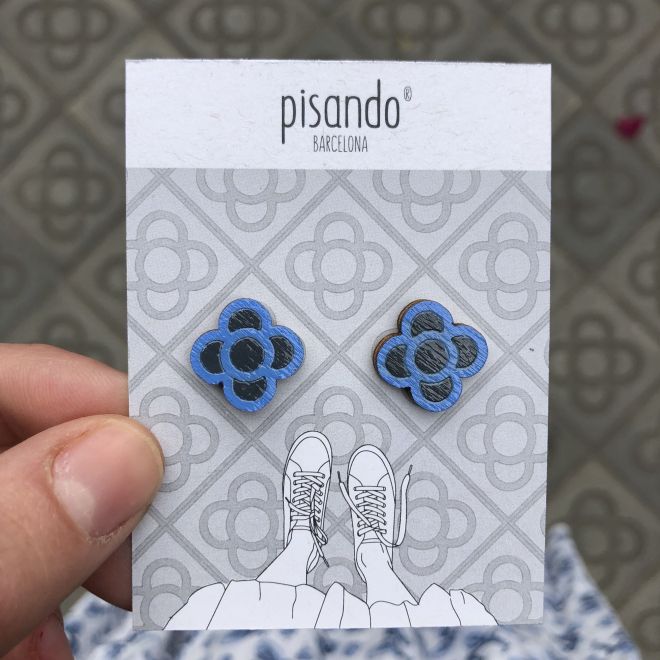
Wherever she walks, Martinell’s eyes are drawn instinctively to the floral patterns, geometric lines, and ornamental details decorating the city’s interiors and public spaces. She has her personal favourites: “I adore the tiles at Casa Vicens, and up in the attic of Casa Batlló there is a tile with a floral motif that I find enchanting.” Before the Covid-19 pandemic, she launched the Gaudí collection, drawing on motifs from the master architect’s landmark buildings.
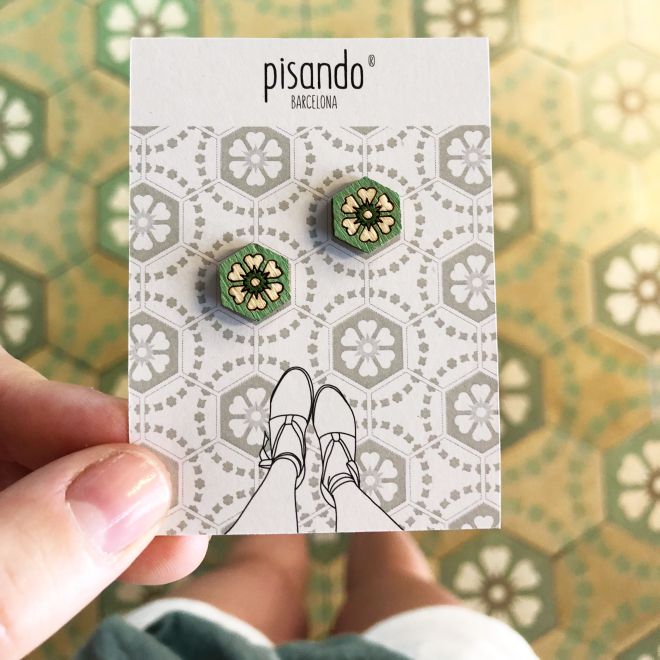
Tucked on the back of each earring card is a miniature map marking the exact location of the original tile that inspired the design. Her collection maps out diverse corners across the city. She has even uncovered gems in waiting rooms, such as her chiropractor’s clinic: “a floor I find utterly wonderful,” she remarks.
From her trained gaze, the patterns pass into her camera lens, and from the camera to her workbench. The packaging features a full illustration of the tile as seen in the street: Verdi, Pau Claris, Enric Granados, Mallorca, Alfons XII, inside Casa Batlló, and at the eco-boutique Hotel Yök on Carrer de Trafalgar. “I love floors, and one highlight is at the Joan Maragall Archive and House-Museum on Carrer d’Alfons XII, right by Plaça de Molina. The tiles there were made by Miquel Nolla, a Valencian industrialist who imported them from England.”
These floors are a piece of our built heritage that remains underappreciated, and they are truly gorgeous.
Martinell’s creative practice salvages and upcycles materials while offering wearers a daily connection to Barcelona, sporting brooches and earrings inspired by the city’s paved history. “These floors are a piece of our built heritage that remains underappreciated, and they are truly gorgeous.”
Whenever we eat strawberries, apples, oranges, or fresh produce, we might remember that they arrived in wooden crates that could one day showcase the decorative beauty of floor tiles, framing someone’s face. Perhaps even someone who once ate fruit from those very crates – carried along the virtuous cycle of recycling that benefits us all.
Add The New Barcelona Post as your preferred Google source for free
Stay informed with the latest news.