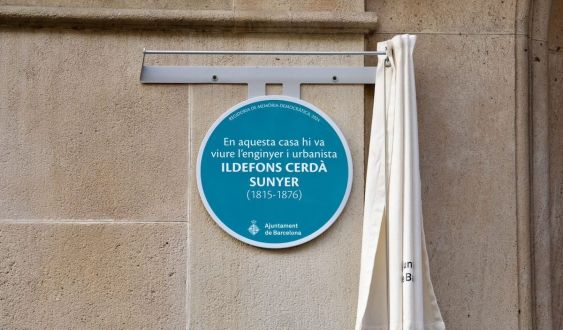
Reading my dear The New Barcelona Post, I learned that, about a month ago, our city (authorities included) paid tribute to Ildefons Cerdà by embedding a plaque at number 49 Bruc Street, where he resided for years. We must applaud fellow citizen Pere Calvet ---dean of the College of Civil Engineers of Catalonia (it must be remembered that Cerdà was an engineer, not an architect, as the common tribe still thinks)--- for being the icebreaker of this laudable initiative. Upon learning of it, I rushed to the place to see the object in question, a blatant copy of the London blue plaques; the sphere is somewhat difficult to spot, given the new and appalling custom of tinting Eixample buildings with truly nauseating establishment signs and other decorative junk like salads, but Cerdà enthusiasts appreciate this gesture, of course.
I agree with Mayor Collboni when, at the inauguration of the thing, he stated that this is still a "small gesture" of meager dimensions if one pays attention to all that our city owes to its demiurge. Perhaps the task of restitution would begin by removing the good name of Ildefons Cerdà from his current square, one of the most sordid nooks of Barcelona, which not only moves away from the Eixample to Sants-Montjuïc, but represents all the chaos and disarray that our protagonist would have hated in life.
I agree with Barcelonologists like Lluís Permanyer in proposing that Plaça Cerdà be in the middle of the Grid and, more specifically, at the intersection of Passeig de Gràcia and Gran Via, a roundabout that could be expanded to build a monument. Because, alas, unlike some of his competitors (like Rovira i Trias), Cerdà still awaits his statue.
The transformation of Barcelona into a modern city, through the Grid, was cemented on an authentically titanic philosophical baseRecently, coinciding with the bicentenary of Paseo de Gràcia, the City Council ephemerally installeda sculpture(quite mediocre, if its author, Lluís Lleó, will excuse me) inspired by the original plan of the neighborhood, where Diagonal and Palau Robert converge. Again, the attempt is appreciated, but nothing would be more opportune to pardon Cerdà (as he expressed itXavi Casinos here in the Post) than returning him to his neighborhood and to dedicate a monument to himthat is authentically differential.
All of this is relative to the visual aspect; but we still have to study Cerdà properly. Those of us who have read his mythical General Theory of Urbanization and Application of its Principles and Doctrines to the Reform and Expansion of Barcelona of 1867 have had to devour reissues made during the seventies (fortunately, the Institute for Advanced Architecture of Catalonia (IAAC) translated it into English in an exemplary edition).
If we read Cerdà, we will enjoy it more and, after doing so, we will surely not allow our founder's square to be a dumpIt would be appropriate for the General TheoryCerdanescait had a critical and updated version in Catalan, so that most readers could understand that the transformation of Barcelona into a modern city ---through the Grid--- was based on an authentically titanic philosophical foundation.One would have to reread Cerdà, not only to allow us to resurrect or pardon him, but to begin to enjoy him beyond his condition as a sacralized figure. Symbolic recognitions like the Bruc street plaque are things of a normalized city, and I celebrate them, but this tribe of ours specializes in saving aesthetics and forgetting the foundations kept in libraries. If we read Cerdà, we will enjoy it more and, believe me, after doing so, we will surely not allow our founder's square to be a dump, and we will also give him the pantheon he deserves. Let it be done soon, I beg.
Add The New Barcelona Post as your preferred Google source for free
Stay informed with the latest news.
