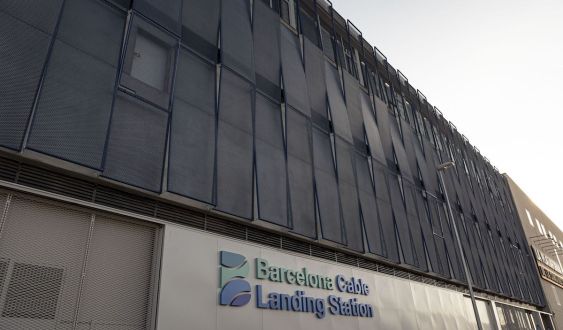
The Barcelona Cable Landing Station, a fiber optic submarine cable landing station located in Sant Adrià de Besòs, is taking its first steps after its commissioning. The announcement of the first cable, driven by Meta, and the agreement with the operator DE-CIX, is joined by the arrival of the station's first terrestrial client, the British multinational Colt Technology Services, specialized in terrestrial fiber optic routes and in high-bandwidth network and voice services for businesses.
The company will set up in Sant Adrià to connect the Barcelona Cable Landing Station with the main digital hubs in Europe, such as Paris, London, and Frankfurt, reaching more than 1,000 data centers and 31,000 buildings, located in 220 cities in about thirty countries in Europe, as well as Asia and North America. It will also serve to provide an express terrestrial route to other cable landing stations such as Lisbon, Bilbao, and Marseille.
Colt Technology was already present in the Iberian Peninsula, where it has deployed a fiber optic network, nodes, and connections with data centers in cities such as Barcelona, but also Madrid, Bilbao, and Lisbon. In the Catalan capital, the company has 13 connection points to data centers that will now add one more. The London-based company has also previously worked with the owner of the submarine cable station, the Catalan company AFR-IX Telecom, an infrastructure and telecommunications operator that provides Internet access in more than 50 African countries.
"With the arrival of Colt, we are sure that other operators will come. Synergies are very important in this sector," defends Norman Albi, CEO of AFR-IX. In addition to terrestrial clients like Colt, the Barcelona Cable Landing Station has the capacity to host up to eight cables coming from Africa, the Mediterranean, and Asia. The third one planned is Medusa, built by AFR-IX itself and Alcatel Submarine Networks (ASN), from the Nokia group. It is expected to be the longest in the Mediterranean, with 8,700 kilometers. The Barcelona Cable Landing Station is expected to reach full capacity by 2027.
The Barcelona digital port is the second of its kind in Spain, after another one located in Bilbao. With an investment of 10 million euros, AFR-IX has developed facilities that can be used by any telecommunications company, operating as an independent manager that grants the concession of use to third parties on a rental basis.
Add The New Barcelona Post as your preferred Google source for free
Stay informed with the latest news.
