
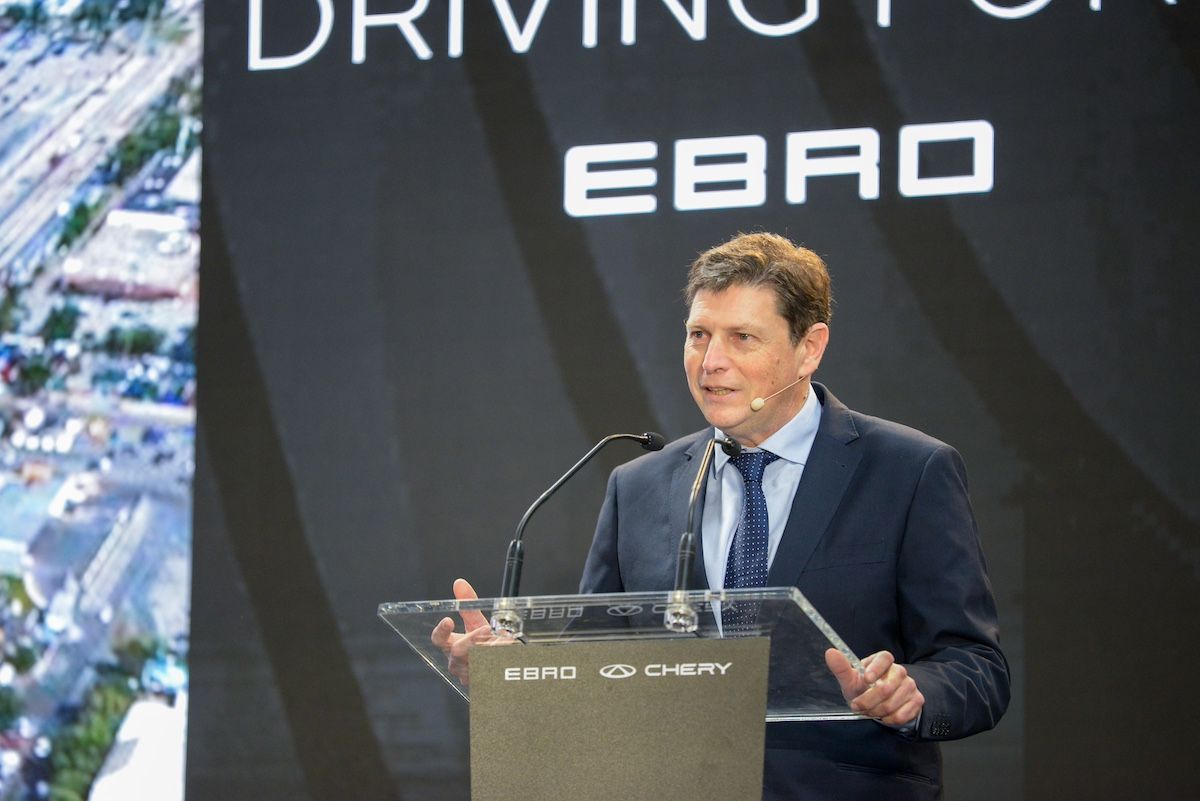
The road has been long and very hard, but this Friday was a day of joy at the former Nissan plant in Barcelona. A hundred former workers of the Japanese car manufacturer took thousands of photos and excitedly recorded the signing of the agreement that ensures, once and for all, their future and that of their former colleagues. The unexpected companion that the valuable facilities of the Zona Franca have found has been the Chinese company Chery, a leader in vehicle exports. "Spain has been of great interest to Chery," said Chery Automobile Executive Vice President Zhang Guibing at the event, accompanied by the President of the Government, Pedro Sánchez, the Minister of Industry, Jordi Hereu, and the President of the Generalitat, Pere Aragonès.
Hand in hand with the reborn historic brand Ebro, state-owned Chery, based in Wuhu, will become the first Chinese manufacturer to produce cars in Spain and throughout Europe, a milestone for the Spanish automotive industry, the second European producer and eighth world exporter. "It is not often that we witness the rebirth of an emblematic brand. Ebro is part of the collective memory of many Catalans and of Spanish society as a whole; many worked with its trucks and tractors," explained the President of the Government, who celebrated the agreement that made it possible: "United we are unstoppable. We have demonstrated this by working hand in hand with the Barcelona City Council, the Barcelona Provincial Council, the Generalitat and the Government." Even Estopa slipped into his speech, recalling how the Muñoz brothers, former Seat workers in Martorell before dedicating themselves to music, showed solidarity with Nissan employees.
WhatsApp groups were buzzing this Friday, even more so when selfies began circulating of those who had managed to get close to Sánchez and Hereu, and even their new bosses, the Chery executives. Among those who kept sending videos was Jaume, nervous and moved, remembering how much they had suffered in these almost four years since Nissan announced the closure of the factory at the end of May 2020, in the midst of the pandemic and leaving the future of many workers who had spent their entire lives there up in the air. "It has been very difficult, everything has happened," he explains. He had been at Nissan for 30 years and spent two years unemployed after the definitive closure of the plant at the end of 2021, until just a week ago he was called to return and prepare to train those who were coming in welding, reuniting with colleagues he hadn't seen in a long time like Andrés, Víctor, and Paqui. In Jaume's case, an even more special return, since his father worked in those same facilities with Ebro, which will now occupy them again.
About 120 former Nissan workers have already returned to the factory to adapt the assembly lines to their new use, to which more than a thousand employees who are waiting their turn to be relocated will have to be added, with about 600 on training contracts after having exhausted two years of unemployment. For now, according to Ebro CEO Pedro Calef, about 150 workers will be reincorporated in the coming months. The forecast is to reach a total workforce of about 1,250 workers in the rebranded Ebro Factory, which includes the former Nissan facilities in the Zona Franca and Montcada i Reixac, dedicated to the stamping and welding of metal parts. The investment to launch the EV Motor project, Ebro's parent company, and Chery stands at 400 million euros, a budget that includes both public aid such as the PERTEs and the outlay that both companies will make. "Investments like this tell us that we are on the right track. Catalonia inspires confidence as a land of opportunities," Aragonès remarked.
Through a joint venture, majority-owned by Ebro (with 60% of the capital), the Chinese group will begin production at the end of this summer, with the forecast of reaching 50,000 vehicles in 2027 and 150,000 in 2029. Globally, Chery has a presence in 80 countries and boasts sales of 41.7 billion euros and a workforce of 80,000 employees.
In the coming months, about 150 former Nissan employees will rejoin the factory, where a hundred workers are already employed.In the Zona Franca, in an initial phase, the gasoline version of the Omoda 5 will be assembled, with parts arriving by ship from China. Later, its electric version will be produced, and the Jaecco 7, a higher-end Chery vehicle, will also be made. From the end of this year, the assembly of the first Ebro vehicles will continue, with two SUV models, combustion and hybrid, one in the mid-segment and another in the mid-high segment. Later, in a second phase, welding, painting, and assembly processes will be carried out in Barcelona, and components will be localized with local suppliers.
In addition to the joint venture for manufacturing, Ebro and Chery have established another joint-venture for the commercialization and after-sales of the vehicles that will come out of the Zona Franca, Ebro SUV, also with a majority stake held by the Catalan company. It will start in the Spanish and Andorran markets, with its own network of dealerships, and later will continue to grow in Europe. "It will be one of Chery's main bases worldwide," emphasized the executive vice president of Chery Automobile. Furthermore, the Asian manufacturer will study installing a research and development (R&D) center in Barcelona. The group has five R&D centers spread across the world, with a workforce of 5,500 employees. One of them is in Frankfurt.
Almost four years of agony
Reaching this Friday's agreement has not been easy. Chery had been eyeing Barcelona for some time, first in 2010, with the then president of the Generalitat, José Montilla, traveling to China to learn about the company. More recently, in 2022, the state-owned company became interested in the Zona Franca land, with a company delegation traveling to the Catalan capital to see them and meeting with Aragonès.
However, the reindustrialization of Nissan ended up falling to what was called the D-hub mobility hub, formed by QEV Technologies and Btech, owned by EV Motors. They were accompanied by the Australian logistics group Goodman, who will be in charge of managing the facilities for the next 50 years and will invest 100 million euros in the industrial complex. QEV Technologies has ended up jumping out of the formula, recently selling 40% of its share of the hub to Btech, which has served to smooth the arrival of Chery.
"Despite the setbacks, today Ebro and Chery have found common opportunities," summarized Zhang Guibing. Their joint venture will keep 300,000 square meters of the 500,000 square meter plot that Nissan previously occupied, where they will also coexist with Silence, which kept 70,000 square meters, and with Nissan, which maintained about 40,000 square meters for its technical center. About 10,000 more square meters will be allocated to logistics.
Add The New Barcelona Post as your preferred Google source for free
Stay informed with the latest news.
