At the end of the 19th century, the smell of chocolate was intense on the corner where Passeig de Gràcia turns into Gran de Gràcia. Oleguer Juncosa's factory was there. It had 500 workers, a 25-horsepower steam engine, and was capable of producing five million bars annually under the La Chocolatera brand. Mariano Fuster set his sights on that location and made an offer to the Juncosa family in 1905. The aroma of cocoa products and the factory walls disappeared from the area in 1907. A few months later, the scaffolding for what is now Casa Fuster was erected, the protagonist of the 19th chapter of Hotels with History and Hotel Stories, the series we publish every 15 days in The New Barcelona Post.
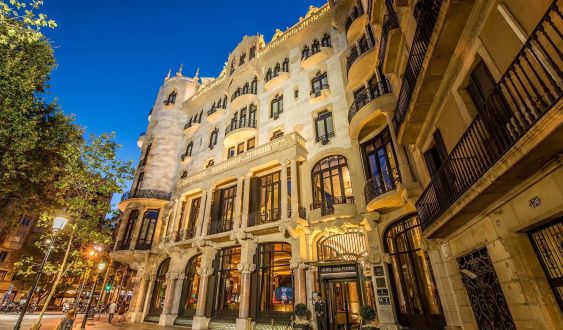
The architect of the building commissioned by the Mallorcan lawyer Mariano Fuster i Fuster was none other than Lluís Domènech i Montaner. The lawyer wanted to impress his wife (and her family) by dedicating the building to her as a wedding gift. He placed no budgetary limits, which is a dream for an architect, making it the most expensive house ever built in the city. Not because of its size, which was not small either, with 1,697 square meters distributed over a basement, ground floor, four floors, and a theater-lounge, but because of the materials used to build it.
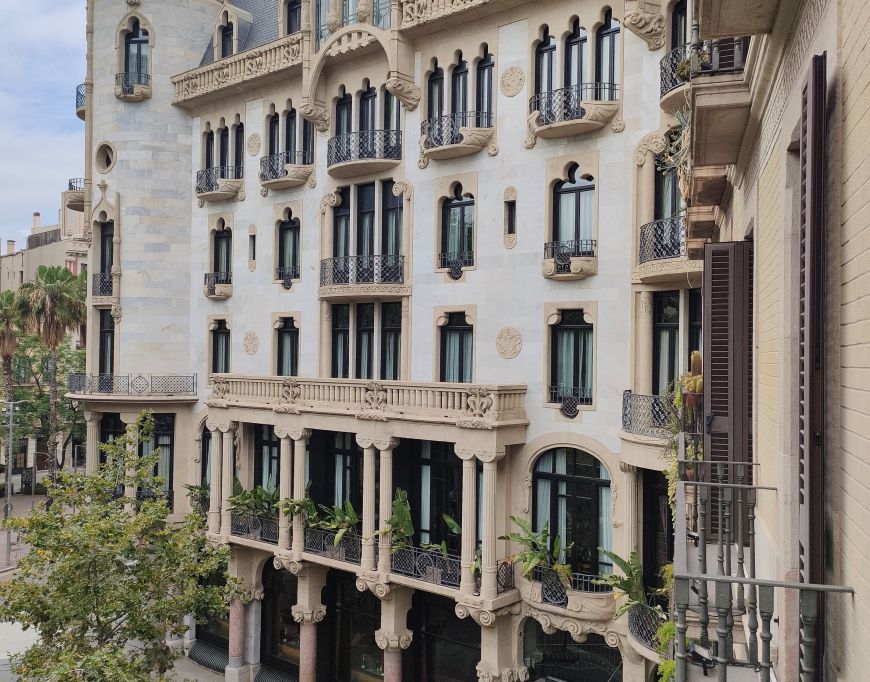
The facade was made of white marble, the first of its kind in Barcelona. The stone came from Montjuïc. Added to that were the stained glass windows and artistic wrought iron: everything was chosen with the ease of putting a blank check on the table. Fuster wanted the house he would give his wife to be the most beautiful in the city.
The regular reader of this series will immediately recognize the surname of Mariano's wife: Consol Fabra i Puig. Daughter of the first Marquis of Alella, Camil Fabra i Fontanills, and of the family that would give its name to Fabra i Coats, the Barcelona textile empire that built, among other things, the large factory in Sant Andreu. The Fabras were, at the beginning of the 20th century, one of the most powerful families in Catalonia. Marrying Consol Fabra was not, therefore, a neutral act. It was an alliance, and one had to live up to it.
The architect and the last commission
Domènech i Montaner had behind him, at that moment, the Palau de la Música Catalana and the Hospital de la Santa Creu i Sant Pau, works that UNESCO would recognize decades later as World Heritage Sites. Casa Fuster is not his most exuberant work, but quite the opposite: it is inspired by Venetian palazzi, with neo-Gothic and floral elements, though with more restrained ornamentation than in previous works.
The works finished in 1911, the same year Gaudí completed Casa Milà, La Pedrera, three blocks further down the same promenade. Two monuments of Barcelona Modernism completed in the same year, a few hundred meters apart. The Fuster-Fabra family settled on the main floor. The rest of the apartments were rented to wealthy families and exclusive businesses, including the Salón de la Moda de Anita Monrós. But the maintenance cost was astronomical. In 1922, eleven years after moving in, and nine years after the premature death of Consol Fabra, who could only enjoy it briefly, the family sold the property and left.
Up to here, a story of love and architecture. Although now the other story begins.
A Nazi consulate, the POUM and Salvador Espriu
During the following decades, Casa Fuster was, in turns and often simultaneously, all the things Barcelona was in those tumultuous years. In the 1930s, the consulate of Nazi Germany occupied one of the floors. The Italian Institute of Mussolini's era also had its headquarters there. On the ground floor, what is today the Cafè Vienès had become an intellectual meeting point, and in 1922 it had debuted its Austrian name with that certain aroma of Central European melancholy that the bourgeois Barcelona of the interwar period so enjoyed.
The year 1936 changed everything. When the Civil War broke out, the POUM or Workers' Party of Marxist Unification seized the building and converted it into a revolutionary headquarters. In May 1937, when Barcelona experienced the episodes that Ken Loach would reconstruct decades later in the film Land and Freedom, the defense committee of the revolution met there with the participation of the CNT, the FAI, the Libertarian Youth, and the Iberian Communist Youth. It has been written that among the attendees was a young German socialist militant: Herbert Ernst Karl Frahm. He called himself Willy Brandt and years later became Chancellor of the Federal Republic of Germany and Nobel Peace Prize winner. Barcelona, as always, was a handkerchief.
In 1939, the Falange arrived, occupying the building for its social services. Casa Fuster has another surprise: for thirty years, one of its apartments was the home of the poet Salvador Espriu. The author of La pell de brau refused for decades to leave the building. They say he did not leave until a serious leg injury made it impossible for him to climb the stairs, as the building, with all its magnificence of marble and wrought iron, had no elevator. The neighborhood is the reason why the Jardinets are officially called de Salvador Espriu.
The threat of ENHER and the citizen victory
In 1962, the worst threat to Casa Fuster arrived. The state-owned ENHER (Empresa Nacional Hidroeléctrica del Ribagorzana) bought the property for eleven million pesetas. The intention was clear: to demolish the building and construct an office skyscraper that would have been called Torre Barcelona. They published an advertisement in La Vanguardia on June 12 of that same year, inviting all Spanish architects to submit projects for the new building, with prizes of 150,000, 75,000, and 35,000 pesetas for the best-positioned in the competition.
Barcelona's response was forceful. The residents of Gràcia rebelled and architects like Oriol Bohigas raised their voices against the project. Print media such as Destino and Diario de Barcelona published articles of denunciation at a time when there was not as much architectural sensitivity or as many opportunities to complain publicly. The pressure worked: ENHER not only gave up on the demolition but also committed to carrying out conservation works between 1962 and 1974, with a final restoration in 1995.
Here stops the misfortune of a Barcelona that, in those decades of mayor Porcioles, lost too many things it should never have lost.
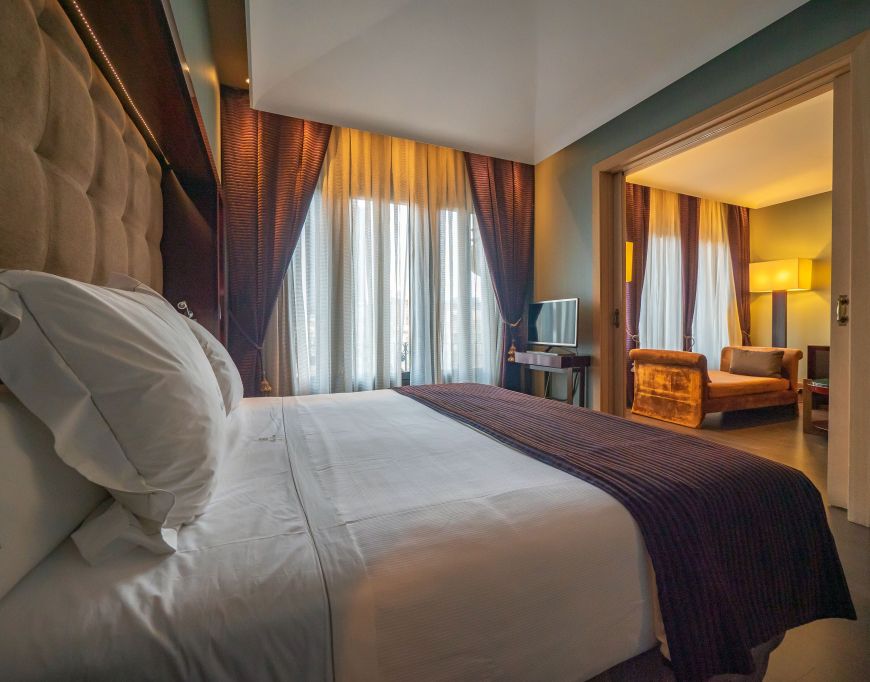
In 1999, the property went up for sale. In 2000, the Andalusian chain Hoteles Center acquired it and began a four-year renovation that faithfully respected the original architecture. In 2004, Casa Fuster opened as a five-star monument hotel.
Aleia: two stars for the marchioness
The hotel that occupies Consol Fabra's house has, since December 2021, a gastronomic restaurant on its main floor: Aleia. The name is not casual. It is a veiled tribute to Consol herself: her father was the first Marquis of Alella. The most expensive house in Barcelona has been guarding its owner's surname among its stones for over a century (finding the rosette with the CF on the facade is entertaining), and now also on the menu of a two-Michelin-star restaurant.
Aleia is a four-hand project: the strategic direction of the Italo-Argentine chef Paulo Airaudo, who has accumulated eight Michelin stars among his restaurants in San Sebastián, Hong Kong, Florence, and Bangkok, and the daily cooking of Jerez-born Rafa de Bedoya, trained in the Basque Country and at the Celler de Can Roca. A first star arrived in November 2022. The second, in 2025. The dining room where the tasting menus are served is the same one that a century ago was the noble area of the Fuster-Fabra family. The ceilings, stained glass, and wrought iron of Domènech i Montaner continue to be the best pairing for the table.
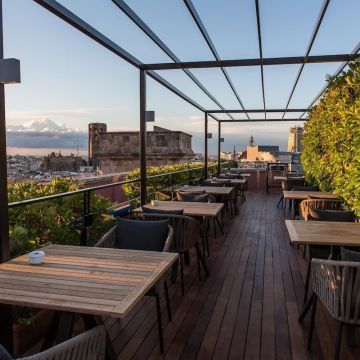
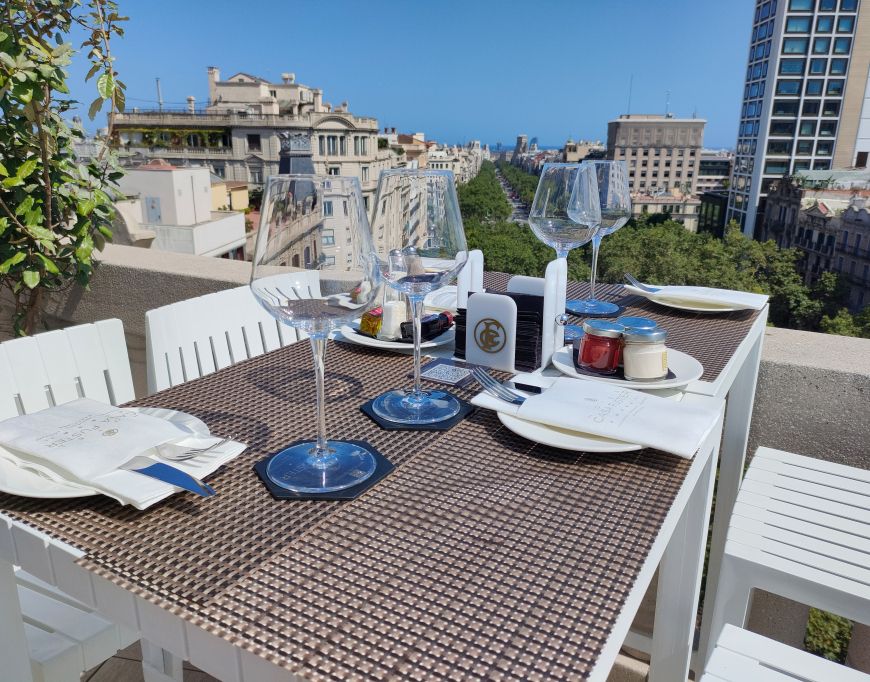
The hotel terrace, for its part, has become one of the most sought-after settings in Barcelona for photo shoots, interviews, and recordings of cultural programs. The reason is evident to anyone who has gone up: from up there, with Passeig de Gràcia spread out at its feet in its entire length, the city shines.
The closing of the Paseo
There is something that no photograph of Passeig de Gràcia captures entirely well and that, on the other hand, is immediately understood when walking up: Casa Fuster is not a building on Passeig de Gràcia. It is the closing of the promenade. The building that puts the final touch to the great bourgeois avenue and that, in doing so, looks at the entire promenade from the privileged perspective of someone who has seen everything pass by.
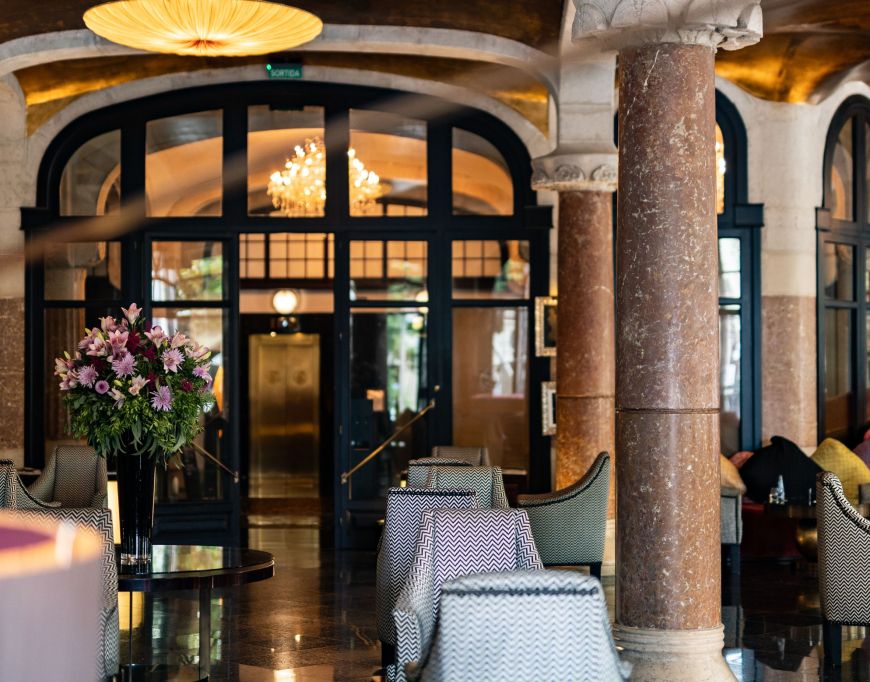
At the Cafè Vienès some nights live jazz plays. In the hall that was once a ballroom (El Danubi Blau, in the fifties) and a revolutionary headquarters (the POUM, in 1936) and offices (ENHER, in 1962), today cava is served and jazz is listened to. There may be no better summary of all that Barcelona has been in a hundred years than this white marble building at the end of Passeig de Gràcia: the place where a Mallorcan wanted to give his wife the most expensive house in the city, where the most important architect of Modernism put all his lessons, and where the citizenry, when necessary, stood up to an electric company and won the game.
Add The New Barcelona Post as your preferred Google source for free
Stay informed with the latest news.