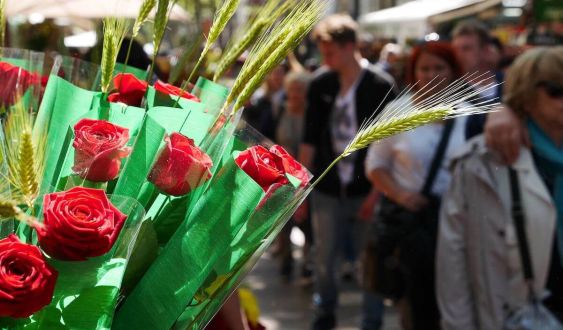
The arrival of Sant Jordi always brings excitement. But this year, everything indicates that expectations will be exceeded. Not only will restrictions be left behind and the pandemic be slammed shut, but record figures will be reached and new spaces will be inaugurated, with a special prominence given to the literary super-block that will emerge in the heart of the Eixample. Furthermore, this year, April 23 falls on a Saturday. "We have ahead of us one of the most relevant Sant Jordi in history," defends the president of the Cambra del Llibre, Patrici Tixis.
The desire to enjoy this Sant Jordi has allowed reaching 300 book and rose stalls in Barcelona, the highest figure ever achieved, surpassing even those of the last pre-pandemic celebration, in an already distant 2019, when there were 240. According to the secretary of the Gremi de Llibreters de Catalunya, Marià Marín, the offer achieved this year will be equivalent to occupying four kilometers in a straight line of book and rose stalls. The number of stalls with author signings will also be high, leaving behind last year's shared spaces and reaching 170 points. About fifty stalls will be dedicated to the sale of roses.
A good part of the 300 stalls in the city will be concentrated in the new super-block, which will go from Diagonal to Gran Via and will be nestled between Balmes and Pau Claris. A total of 140,000 square meters where cars will be replaced by books and roses, highlights the Deputy Mayor for Culture, Jordi Martí. From 9 in the morning until 9 at night, this new formula will encourage a calm and safe stroll while moving from one stall to another, also avoiding the crowds that have always characterized this festivity. Without the need to respect maximum capacities, the entire area will be freely accessible, avoiding last year's controls and queues.
The literary super-block will leave the area between Diagonal, Pau Claris, Gran Via, and Balmes traffic-freeOn Passeig de Gràcia, there will be the stands of bookstores and flower shops, while on Rambla Catalunya there will be those of associations and entities that could not participate in 2021.There will also be roses and books in the cross streets that will connect Paseo de Gràcia with Rambla Catalunya, with the exception of València and Aragó, where vehicle circulation will be permitted. If the new model proves successful, both the book sector and the city council hope to revalidate it in future editions.
This formula of spaces reserved for book and rose professionals will be replicated in other parts of the city, with 11 more zones distributed across seven districts. In the Eixample, stalls will also be set up in Plaza Universitat and Paseo de Sant Joan, which will recover its focus on comics, graphic novels, and children's and young adult literature after two years of absence. In Ciutat Vella, the main attraction will be in Plaza Reial and Paseo Lluís Companys, while on La Rambla there will only be a few stalls from entities and bookstores. There will also be stalls in the Plaça de la Vila and Nicolás Salmerón in Gràcia, Plaza Valdívia in Les Corts, Rambla del Poblenou, Plaza Orfila in Sant Andreu, and Plaza de Sarrià. To all these spaces must be added the hundred stalls that bookstores will set up in front of their establishments on Friday 22 and Saturday 23.
All this optimism leads the sector to trust that, at a minimum, the figures from 2019 will be matched. Three years ago, 1.6 million books were sold and 22 million euros were invoiced. Last year, on the first April 23rd in the pandemic, more than a million books were sold, 75% of the 2019 figure, exceeding initial forecasts. For Tixis, this Sant Jordi could mean a consolidation of the increase in reading rates brought by the coronavirus, making 2021 the best year for books in the last decade. It should be noted that some publishers achieve 20% of their annual turnover on this day.
Add The New Barcelona Post as your preferred Google source for free
Stay informed with the latest news.
