
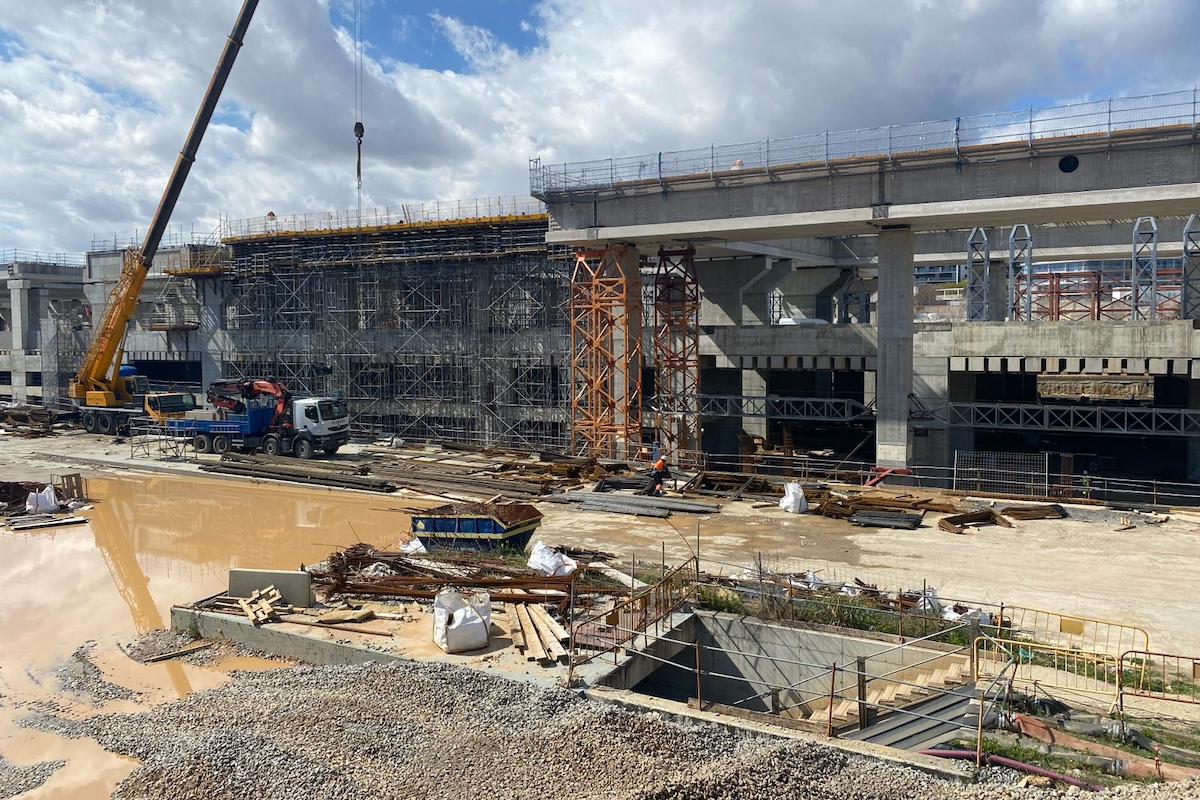
As residents who come in the morning to see the works of La Sagrera can confirm, the future station of the city is meeting objectives, after accumulating years of delays and unfulfilled deadlines, opening a large urban wound between the districts of Sant Andreu and Sant Martí. From an improvised viewpoint, they can see the operators placing the new high-speed tracks, which will run on the highest floor of the infrastructure, covered in a few years by a large urban park.
Adif foresees that AVE trains will begin to circulate through La Sagrera at the end of this year, achieving a new milestone in the execution of a pharaonic work. The convoys that leave Sants heading to Girona and France will pass through the interior of the station, although there is still a long way to go before seeing them stop and drop off passengers on the platform. The same happens with Rodalies trains, located on the lowest level of the station, where they have been running since the end of 2020 but still do not stop. On the intermediate floor, there will be the station lobby and the parking lot.
First, the AVE line on the sea side will come into operation, which has been cut for some time to move it to its new location, running on a single track on the mountain side. When it is operational, the circulation of the one on the mountain side will be cut, so trains will no longer be seen circulating outside the station. The second international gauge track is expected to be finished between the end of 2025 and the beginning of 2026. At this time, all works related to the railway infrastructure ---civil work--- of La Sagrera will be considered completed. The station will have six high-speed tracks, two more than the Sants station.
"It is the largest civil engineering project being carried out in Spain," remarks Adif's Deputy Director of Construction, José Vicente Romero. It is made up of 25 different projects, integrated and coordinated "as if it were a puzzle," according to the technical coordinator of the work, Luís Ubalde, encompassing the multimodal station, with Rodalies and AVE trains, but also buses and metro, and a logistics area where wagons can be prepared before their operation. In this technical area, vehicles can be cleaned and maintained, as well as catering loaded, services that in stations like Sants are done on the same track where the train arrives, occupying too much time in a very valuable space given the growing liberalization of railway transport. Currently, 11 different works are underway along a one-kilometer length, which will form the longest building in the Catalan capital, with dimensions comparable to Barcelona Airport, but with the difference that La Sagrera will be embedded in the urban fabric.
The works have picked up cruising speed since 2018, when a new team arrived due to the change in government color, which came to be led by President Pedro Sánchez. At that time, many projects had not yet been drafted. "Here there was an empty plot, only the excavation of the station had been done, but not even the foundations were laid," emphasizes Romero. The first milestone came with the circulation of the Rodalies Mataró line inside the station in 2020, followed two years later by the other line, the Granollers line, accompanied by the commissioning of the new Sant Andreu station.
With the different advances that have occurred in the last six years, the civil engineering works are now at 70% completion, with about 900 million euros disbursed from the global budget, valued at about 1,250 million euros. The execution rate is 90 million euros per year. To this figure will have to be added the architectural and urbanization project, increasing the investment to more than 2,000 million euros. It will be carried out by Fermín Vázquez's studio, b720 Arquitectura, responsible for other buildings in the city such as the new Mercat dels Encants or the Torre Agbar, in collaboration with Jean Nouvel. It is expected that the future station will have a wooden canopy as an emblematic element.
La Sagrera gets covered
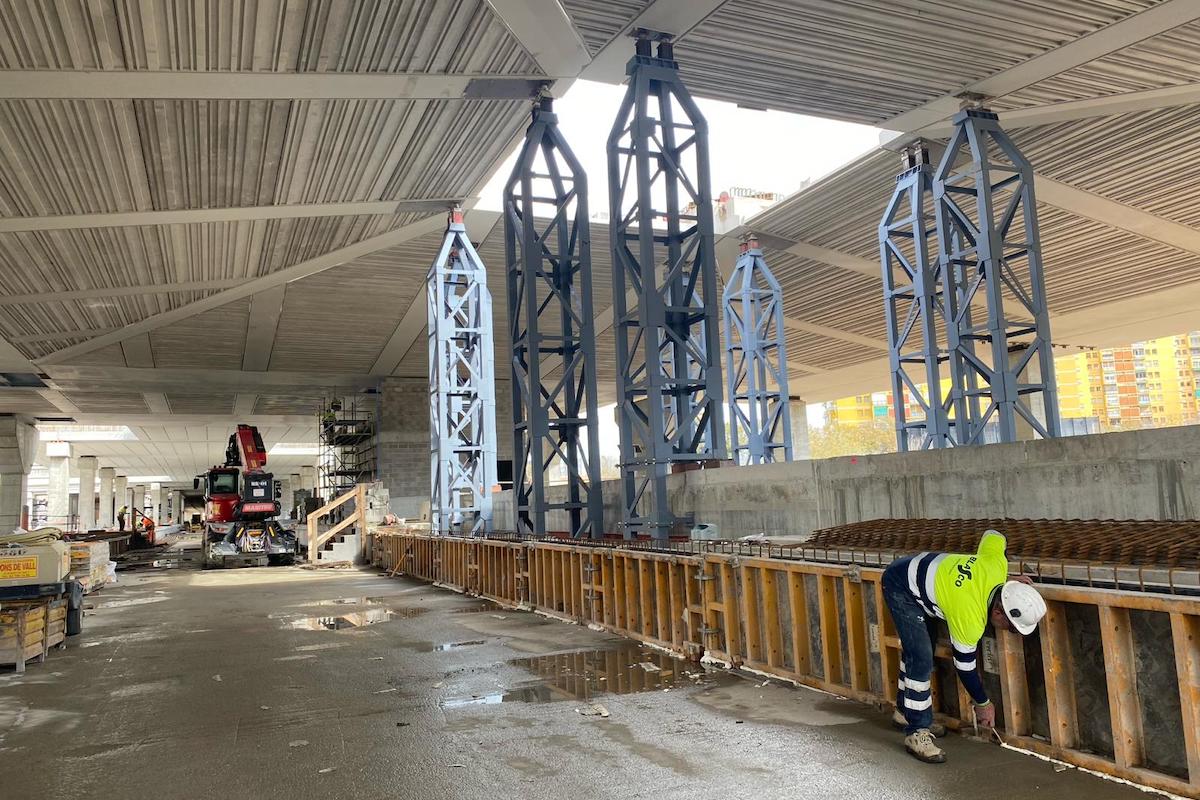
As the new international gauge tracks take shape, the station is building its roof, with 25% of the structure already completed. In the central part, it will consist of an innovative inverted pyramid-shaped roof. Composed of eight modules, with almost 300 beams, it will feature skylights that will allow natural light to enter the tracks and platforms. A unique proposal that requires specialized machinery to achieve maximum precision, in addition to the use of new technologies such as BIM methodology and augmented reality. Beyond the central part, the roof will extend with a flat shape towards the ends of the building.
The roof will have a total area of more than 50,000 square meters, equivalent to five blocks of the Eixample. Once the roof assembly is completed, a concrete slab will be built on top. This structure will house the future park, which will stretch from Bac de la Roda to the Nus de la Trinitat and will have an area of 40 hectares, making it the largest in the city. It will be surrounded by a new neighborhood, as denoted by the multiple cranes that are building modern apartments, very close to old blocks that have been waiting for years for the works to finish.
Add The New Barcelona Post as your preferred Google source for free
Stay informed with the latest news.
