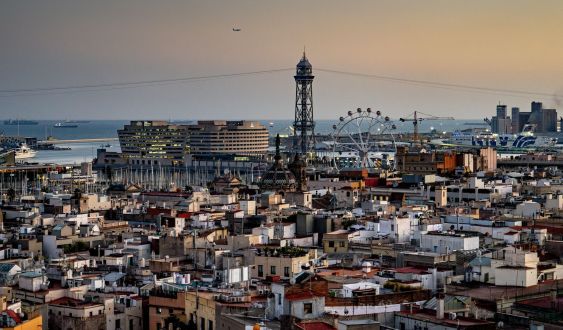
Since the winter of 1958, the company Teleféricos de Barcelona Sociedad Anónima has been in charge of the day-to-day operations of an element that is difficult not to see from many points of the city, and especially from the seafront: the port cable car. Two large metal towers and a station on a Montjuïc hillside that have been part of Barcelona's skyline for almost 100 years, because this cable car was conceived as a complement to the second great exhibition held by the city: that of 1929, the one that opened Montjuïc to Barcelona. A part of that project was going to be a spectacle for visitors: to be able to fly over the port from Miramar, in Montjuïc, to the very sand of Sant Sebastià beach, in Barceloneta. A journey that continues to be a magnet in both directions for visitors to Barcelona in 2026.
This story needs a little more context, and a surname: Buïgas. The same author of the Font Màgica de Montjuïc.
A project conceived for the Expo that arrived late to the Expo
Carles Buïgas conceived the aerial tramway in 1926, with the collaboration of Ramon Calçada and Josep M. Roda, with the idea of linking the Montjuïc venues with the Maritime Section of the 1929 International Exhibition. The plan was ambitious and, on paper, perfect: the city was interested in the sea just as it was also opening up to interwar Europe.
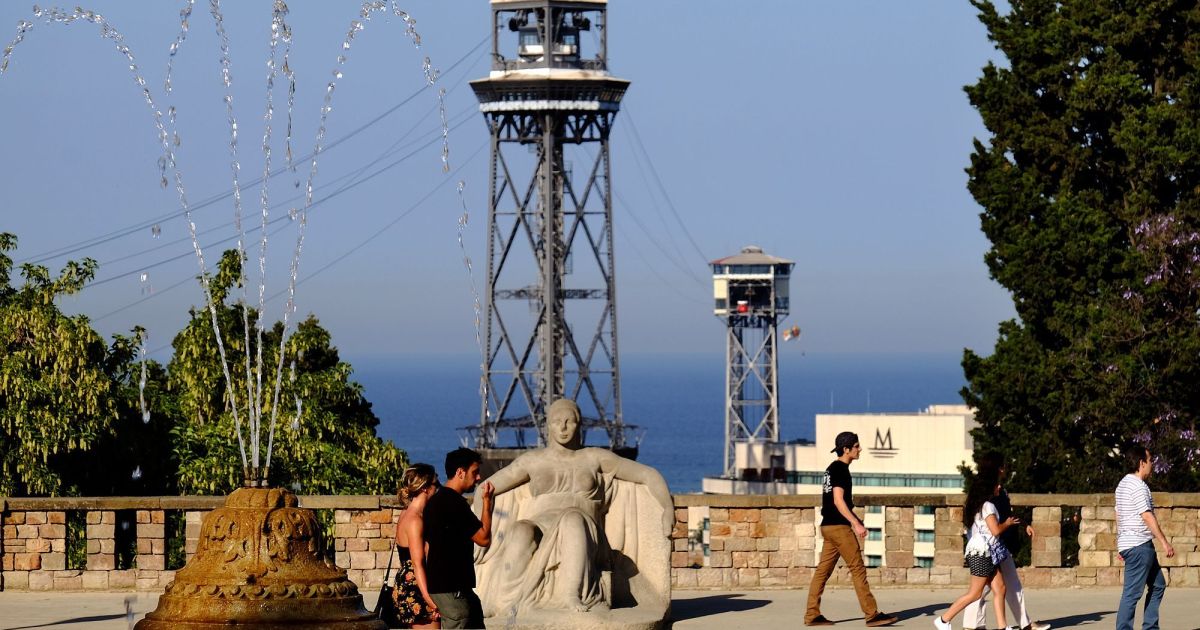
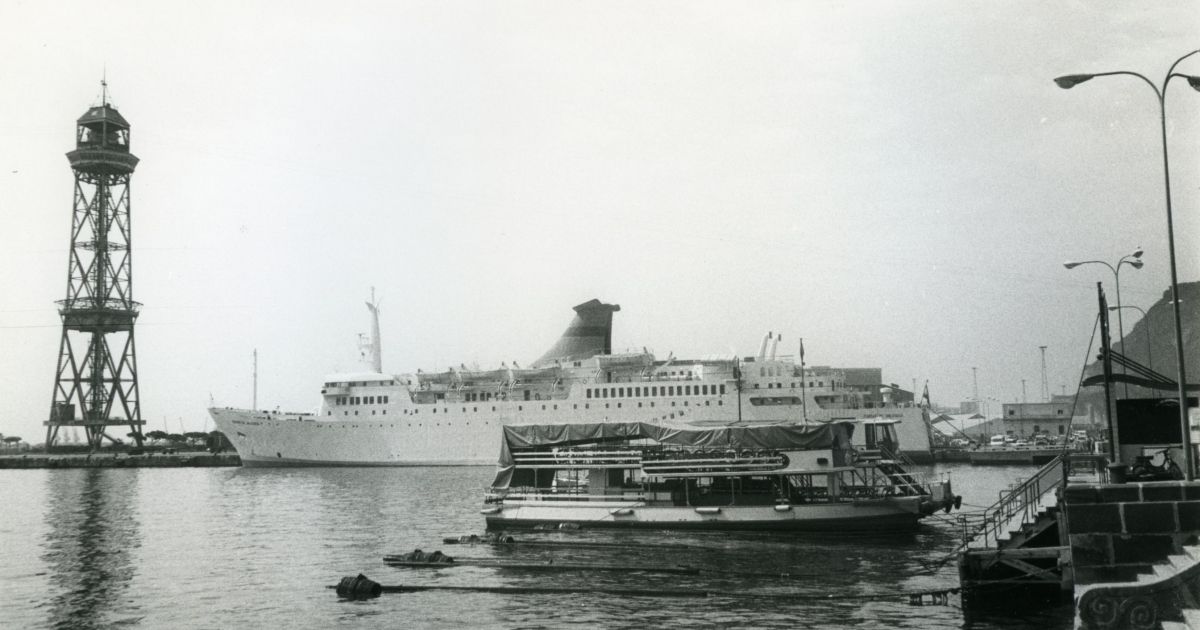
The problem was money. Buïgas did not get enough capital for his project until 1928, too late to finish the works in time to coincide with the Expo the following year. He ended up selling his stake to Roda, who took over the execution of the project. And here appears one of those details that change the geography of a city without almost anyone noticing: in the original project, the central tower (the one we know today as Torre Jaume I) was not intended for the Moll de Barcelona, in front of the current World Trade Center, but for the Moll d'Espanya, in what is today the Maremàgnum. A pier then fully commercial. The change of location came with Roda's replacement at the head of the project, and thus the route we know was fixed: Sant Sebastià, south of Barceloneta beach; Jaume I, in the Moll de Barcelona; and Miramar, on Montjuïc mountain.
The cable car finally opened on September 13, 1931, two years after the Expo that was supposed to premiere it. And even so, it was an immediate success. The three stations had restaurants, bars, and entertainment: it was, in every sense, a place to see and be seen, part of the new profile of Republican Barcelona of the 1930s that was inventing itself.
The war, the silent towers, and an American helicopter
The Civil War stopped the service and the two towers became strategic points for the anti-aircraft defense of the coast. Both witnessed a city savagely bombed from the sky and the sea. After the war, the cable car did not operate again. The towers remained standing, rusting, year after year, while authorities debated whether to demolish them or reactivate them, never deciding on either. Almost two decades passed like this.
On August 15, 1957, something happened that forced a decision. A United States Navy helicopter from the aircraft carrier USS Franklin D. Roosevelt, anchored in front of the port, was flying over the area on a purely recreational flight for its crew when it collided with the abandoned cables of the cable car. The aircraft broke apart in the air and fell into the water; its two crew members died. The Jaume I tower visibly swayed with the impact, and for minutes, rust and metallic debris rained down on the pier.
An American air tragedy was, paradoxically, what saved the towers. The accident forced authorities to act: either they were definitively demolished, or the concession was reactivated. A study led by engineer Joaquín Planell concluded that despite everything, both structures were in good health. In 1958, the concession was awarded to Serafín Masó Cantal, who transferred it to the newly created and already mentioned Teleféricos de Barcelona S.A. Cables, cabins, and electrical installation were renewed. And in 1963, thirty-two years after its inauguration and twenty-seven after its closure, the cable car once again crossed the port.
Sant Sebastià: from station to restaurant with views
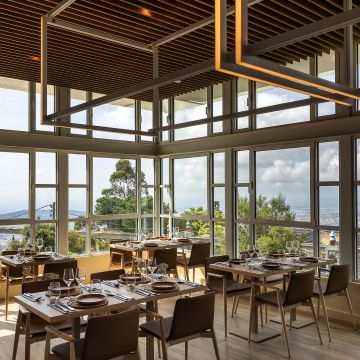
With the reopening also came a new life for the Sant Sebastià tower, in Barceloneta: in addition to functioning as a final station, it became a viewpoint and high-altitude restaurant, one of the most unique gastronomic experiences in the city, suspended over the Port Vell. Today, La Torre d'Alta Mar, by chef Óscar Manresa, operates at its summit, a direct inheritance of that panoramic vocation that the cable car always had, since its golden years of the 30s.
This silent aerial has not only been transport: it has also been a film set. The most famous image is perhaps from 1975, when Michelangelo Antonioni filmed part of The Passenger in Barcelona, with Jack Nicholson in the role of journalist David Locke. In one of the scenes, Locke crosses the port in the cable car and recklessly leans out the cabin window, extending his arms as if he wanted to fly. A gesture that, forty years later, continues to be one of the most reproduced shots of cinema filmed in Barcelona, and which made the aerial part of the city's cinematographic imaginary, long before the W Hotel, the Arts or the Mapfre tower existed.
The nineties parenthesis
In 1995, the cable car stopped again, although this time by its own decision: the Sant Sebastià and Jaume I towers needed a comprehensive restoration after more than three decades of uninterrupted service. The works lasted until 1997, when the aerial regained its usual use. It returned modernized although faithful to its usual layout and image: the characteristic red and white cabins, lined with aluminum, that cross the port at about 70 meters high in a journey of almost 1,300 meters.
In Barcelona there are symbols so integrated into the daily landscape that we stop seeing them as the icons they are. The port cable car, with its red and white cabins silently gliding over the water, is one of them: it has been there all its life.
The symbol that no one draws
Here is the paradox that makes this story more than an archival curiosity. When someone draws the profile of Barcelona (that exercise so common in postcards, logos, or tourist guide covers) almost always the same protagonists appear: the Sagrada Família, the Mapfre Tower and the Hotel Arts twins by the sea, the Vela pointing towards the sky and Collserola crowning the city from afar. They are, without a doubt, part of the skyline. However, the port cable car towers almost never appear, despite having been part of that same profile since the 1930s: ninety-five years watching the city grow around them, surviving a war, an American helicopter, two decades of abandonment, and a comprehensive restoration.
Perhaps it is precisely that discretion, that of being a transport infrastructure and not an icon designed to impress, that has left them out of the drawings. Or perhaps it is, simply, that in Barcelona there are symbols so integrated into the daily landscape that we stop seeing them as the icons they are. The port cable car, with its red and white cabins silently gliding over the water, is one of them: it has been there all its life.
Add The New Barcelona Post as your preferred Google source for free
Stay informed with the latest news.