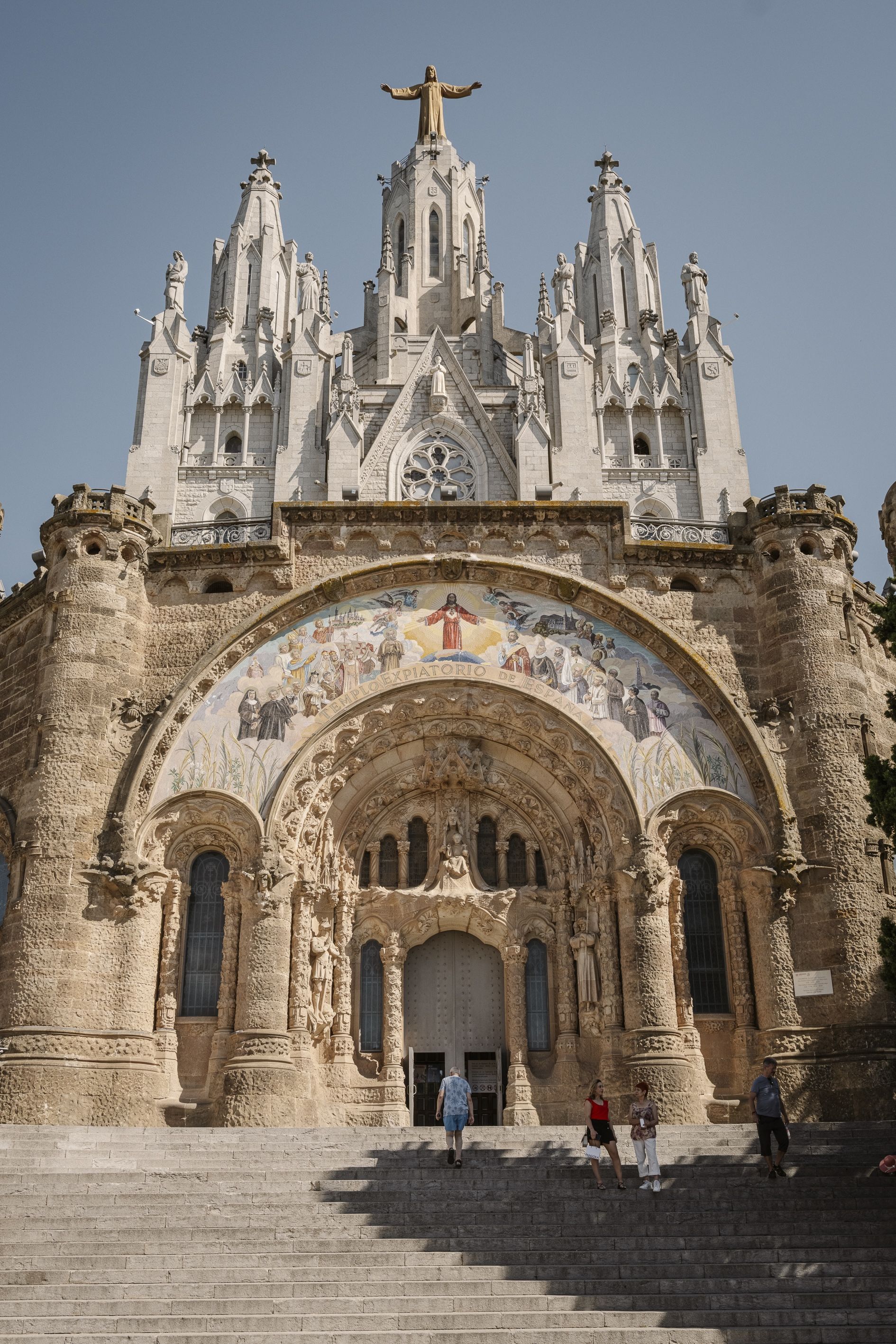
"All these things will I give thee, if thou wilt fall down and worship me.” That Barcelona has two expiatory temples is already a rarity, as if we were the most sinful city in the world, but it is even more curious that the name of its highest peak responds to this temptation of Satan. The Tibidabo has been called that since approximately the 15th century, they say by decision of the monks of the Monestir de Sant Jeroni, but the fact is that, as much as we have grown tired of hearing that the Sagrada Familia could not be taller than Montjuïc (a theory about Gaudí that is still to be proven), meanwhile the city's other expiatory temple crowns its heights pointing, probably, to the fact that we never get high enough to try to expiate our temptations. Furthermore, if you look at the city from Tibidabo, the doubt about whether the city is really ours appears increasingly large. Perhaps it is that we have not prostrated ourselves enough before the Devil.
The Expiatory Temple of the Sacred Heart of Tibidabo is our particular Christ the Redeemer of Rio, an icon that visitors immediately locate on the horizon and want to visit almost before the Barri Gòtic and everything. And it has an amusement park... temptation, in effect, almost always ends up overcoming them. Another thing is whether that bronze figure with open arms, suspended over the mountain, represents something more than a tourist attraction. The first stone of the temple was not laid until December 28, 1902 (as if it wanted to imitate the Sagrada Familia, which laid its first stone in 1882), but the works were not considered finished... until 1961! Almost sixty years to build a temple seems few compared to Gaudí's basilica, but frankly the dimensions invited more haste. The project was by Enric Sagnier, an architect much less popular than Gaudí but extraordinarily prolific, and it was finished by his son, Josep Maria Sagnier. In a work that began with a father and ended with a son, we only need to locate the Holy Spirit.
It should be said that, already in 1886, during the visit of Saint John Bosco to Barcelona, a group of Catholics ceded the land on the summit to him with the intention that he build a temple dedicated to the Sacred Heart there. Behind this was also a much more earthly concern: there was a rumor that a Protestant temple, and even a hotel-casino (which, by the way, ended up being built), was to be constructed on the summit of Tibidabo. The Catholics, so efficient, decided to get there first. The mountain that today we associate with the amusement park, the funicular, the suspended train, and panoramic photographs began, in part, as an operation to prevent other unspeakable activities from taking place there.
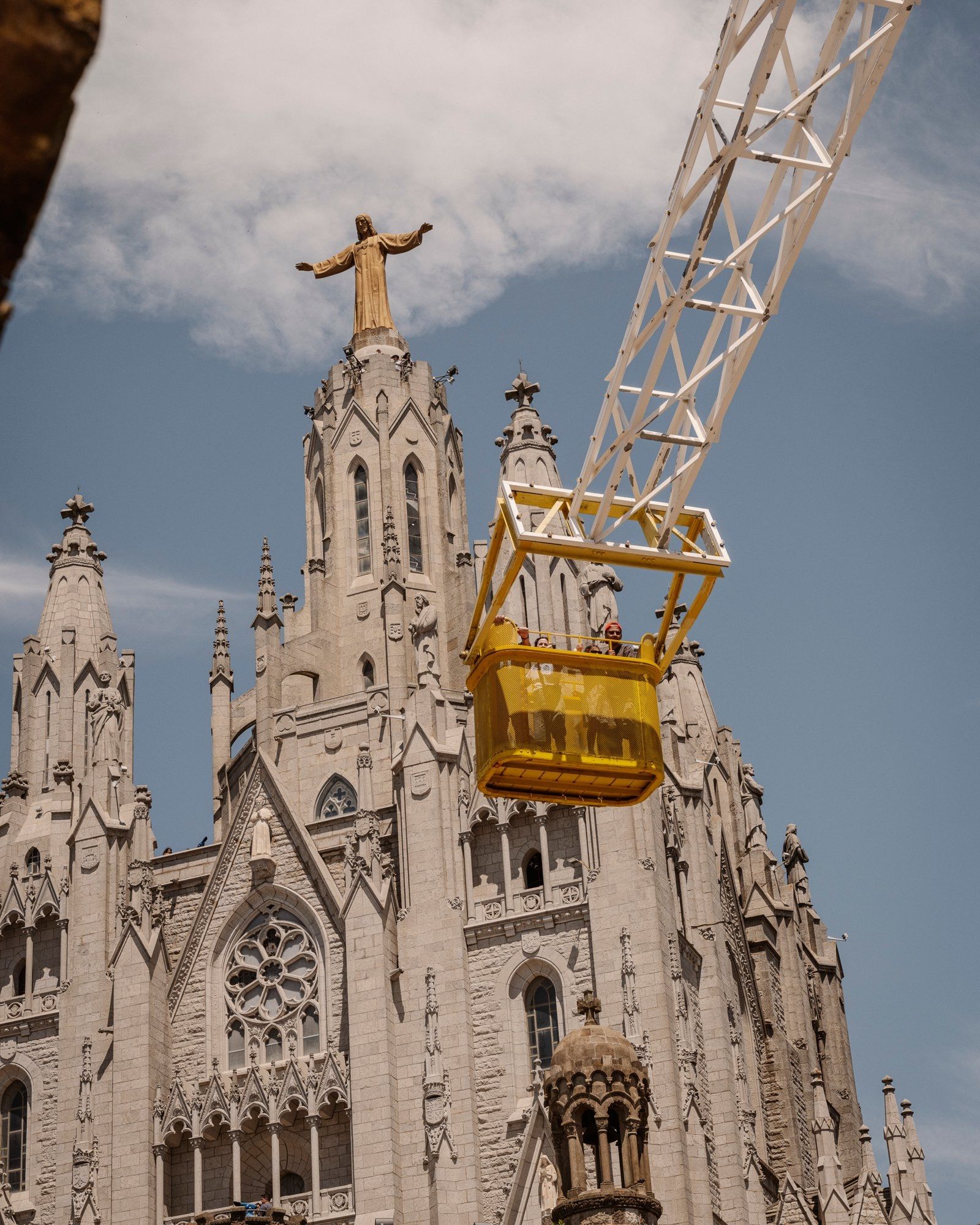
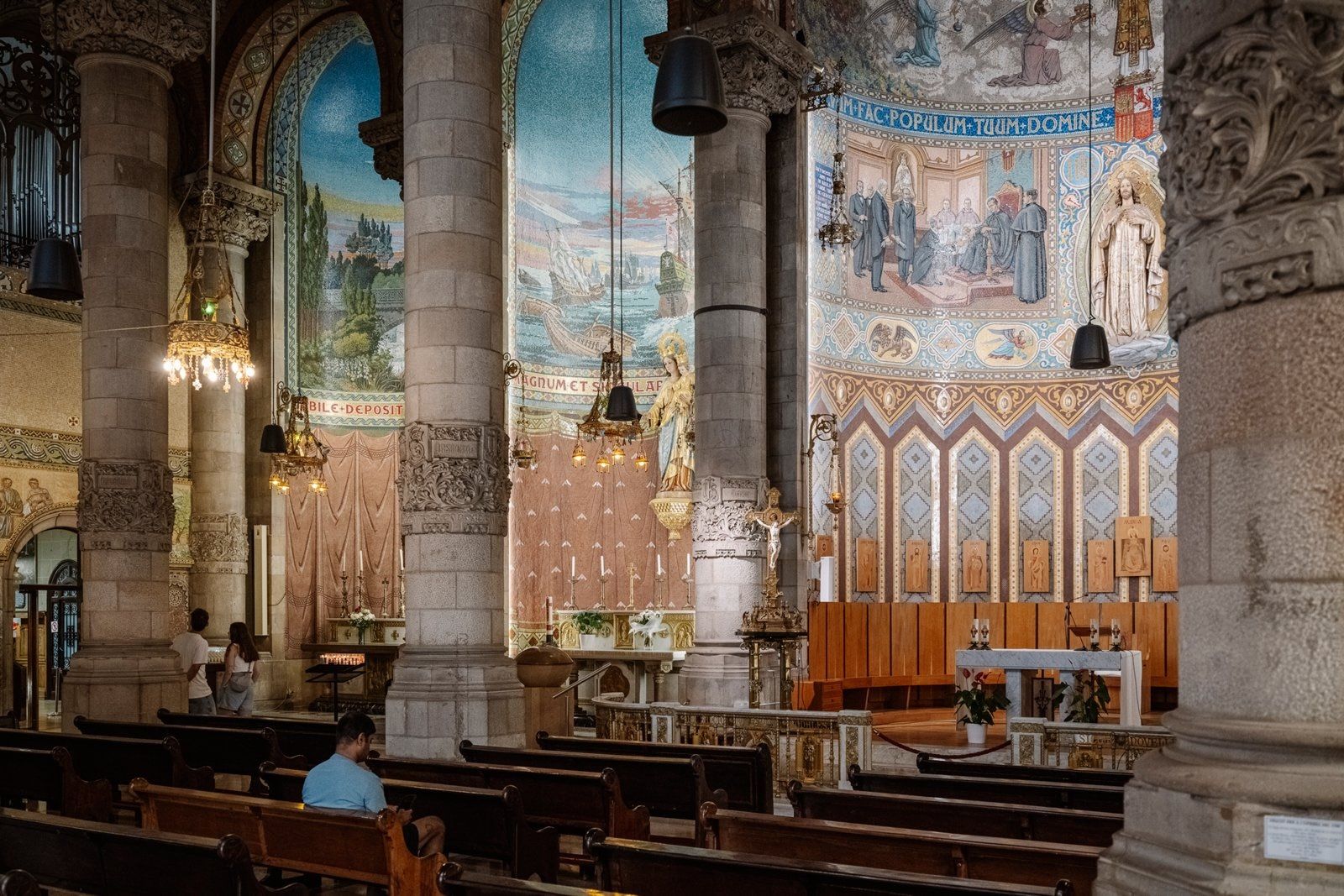
The first construction was a small neo-Gothic hermitage, inaugurated that same year, 1886, and still existing next to the temple. The promoter was Dorotea de Chopitea, a patroness of Barcelona and benefactor of the Salesians. Two years later, on the occasion of the Universal Exhibition, a wooden pavilion of Mudejar inspiration was built next to the hermitage from which, apparently, Queen Maria Cristina contemplated Barcelona. That is to say: in reality, the resulting temple of Tibidabo consists of several stacked buildings. Below is the crypt, heavy, dark, built with brownish stone and decorated with mosaics, arches, and forms that evoke Romanesque and Byzantine styles. Above it rises the temple, lighter, vertical, and neo-Gothic. And at the very top, almost as if it were the last piece of a Lego with instructions, is the Christ.
The history of the sculpture is even more eventful: the first image of the Sacred Heart, a work by Frederic Marès, was destroyed in 1936. The one we see today is a work by Josep Miret and was installed in 1950. In 1961, the temple received the title of minor basilica from John XXIII. For decades, then, Barcelona has had a Christ up there that is not exactly the same one seen by Barcelonians at the beginning of the century, but which has ended up forming part of everyone's visual memory. We must also mention the sculptures representing the Virgin of Mercy, Saint George, and Saint James (patrons of Catalonia and Spain respectively, just in case), made by Alfons Juyol following a design by Eusebi Arnau. After the war, as is known: in 1955 a new mosaic was made showing an allegory of Spain's devotion to the Sacred Heart, in which the inscription "Expiatory Temple of Spain" stands out, with all the national-Catholic and Columbian iconography typical of those years of saving expiation.
"And the amusement park?" the intrepid tourist will ask. Well, it was built as a private leisure park in 1899 by the pharmacist Salvador Andreu (Dr. Andreu of the cough drops) and was inaugurated in 1901 along with the Tramvia Blau and the Funicular. Roller coasters, carousels, arcade machines, and screaming children: almost as a provocation, the leisure and revelry of children transformed into Pinocchio's donkeys tickle Jesus' feet, as if transcendence and fun were condemned to share the summit. Without ever fully resolving, yet, which of the two has the last word.
Add The New Barcelona Post as your preferred Google source for free
Stay informed with the latest news.