"My dear Miró Foundation is not for sale," said Robert Lubar, professor at the Institute of Fine Arts of New York University, as he resigned from the board of trustees of the Miró Foundation in protest of the appointment of the new director (Maribel López, director of ARCO). The crux of the matter has been the "evident" transfer of art market interests to the management of an internationally prestigious artistic institution. And, outside of institutions and museums, a city that sometimes also seems for sale. With Miró's works embedded in its streets, with the artist's explicit will to link his name to the city, one might ask if this urban museum has also been given away (or sold very cheaply) to market interests. That's what happens, at least, to a city everyone calls "beautiful": ending up believing it or becoming only that.
Miró awaits us when we land at the airport, observes us as we cross the Rambla, and stands, monumental, between the old Escorxador park. If Gaudí or Domènech have turned the city into a promise of imagination in homes, palaces, and facilities (and temples), Miró has transformed it into a kind of open-air gallery. And, beyond that, he has created places that we already feel are our own: nobody says "let's go see Miró's mosaic," we say "see you at the Pla de l'Ós." Nobody visits Dona i Ocell as one visits a foreign monument, and the airport mural is an almost daily welcome and farewell mural. For that alone, among many other reasons, the airport should be called Joan Miró and not that ridiculous name that no one uses.
Miró knew well the power of symbols. Despite having developed a good part of his career away from Catalonia, he never lost his connection with the Catalan capital. When he agreed to create these works, he was not seeking to monumentalize himself: he wanted art to leave specialized (or elitist) spaces and coexist with people. So that the child going to school, the tired tourist arriving after a flight, or the retiree strolling through the park (if this enormous sandy dog park that is Parc Joan Miró can be called a park) could encounter, unintentionally and yet always wanting to, a work of art.
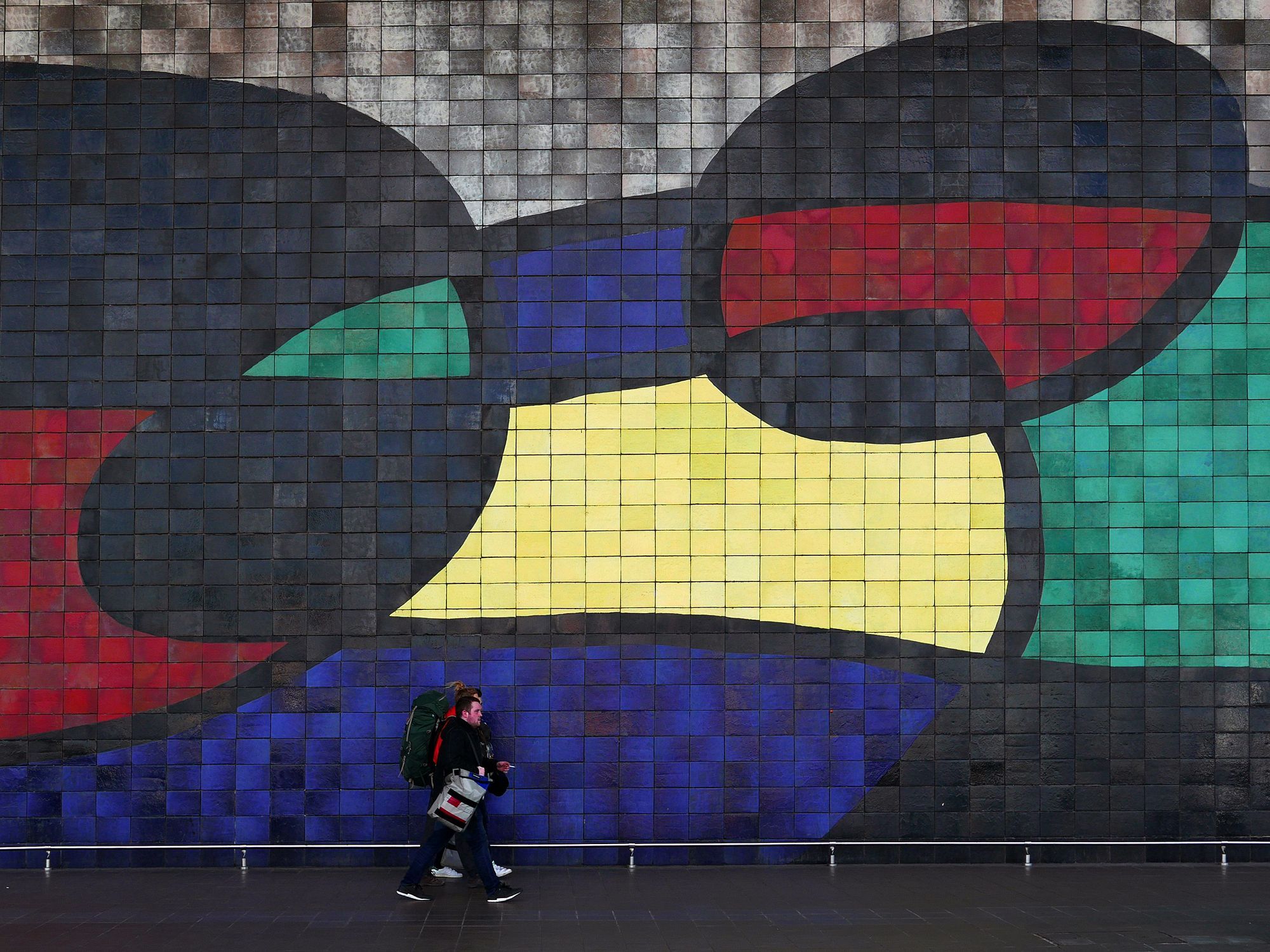
The first contact, as we said, is usually the ceramic mural at Terminal 2 of the airport. Inaugurated in 1970, it was made jointly with the ceramist Joan Gardy Artigas, an essential collaborator so that Miró's forms and colors could withstand the elements. The mural is enormous, almost impossible to embrace with a single glance (or a single Instagram photo). The red, blue, yellow, and black stains bask under the Prat sky while seeming to give it a dress, an accessory, a signature: here the sky and earth bleed, cry, tear their clothes just because the sky is blue or because the Earth revolves through the Universe. You are at the center of the world (with permission from Perpignan station): you are in the Mediterranean. And no, it is not just a geographical place. Neither an airport with planes, nor a skyline, nor a genre scene, but a different and passionate hospitality: color as a celebration, organic forms as a universal alphabet, vital vertigo as a way of understanding the world. A kind of flag of the human condition.
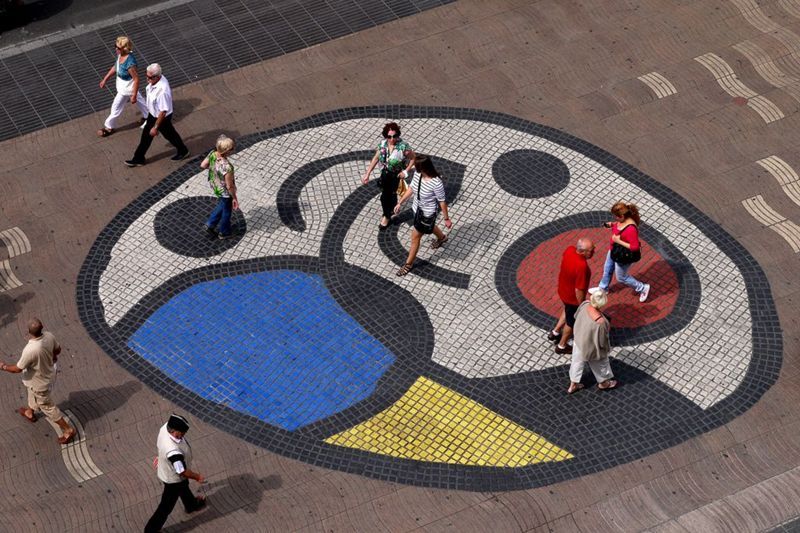
A few years later, Miró left another mark in one of the most transited spaces in the country: el Pla de l'Ós, in the center of La Rambla. The circular mosaic was conceived to be stepped on, adopted as urban parquet, carpet, and indelible tattoo even when an Islamist van attack occurs. Art ceases to be contemplated from a distance to become a physical experience: the mosaic changes with the rain, with the shadows, with the street vendors, with the demonstrations, with the hurried tourists, and with the hustle and bustle of the subway. Barcelona passes every day, and it is Miró who remains.
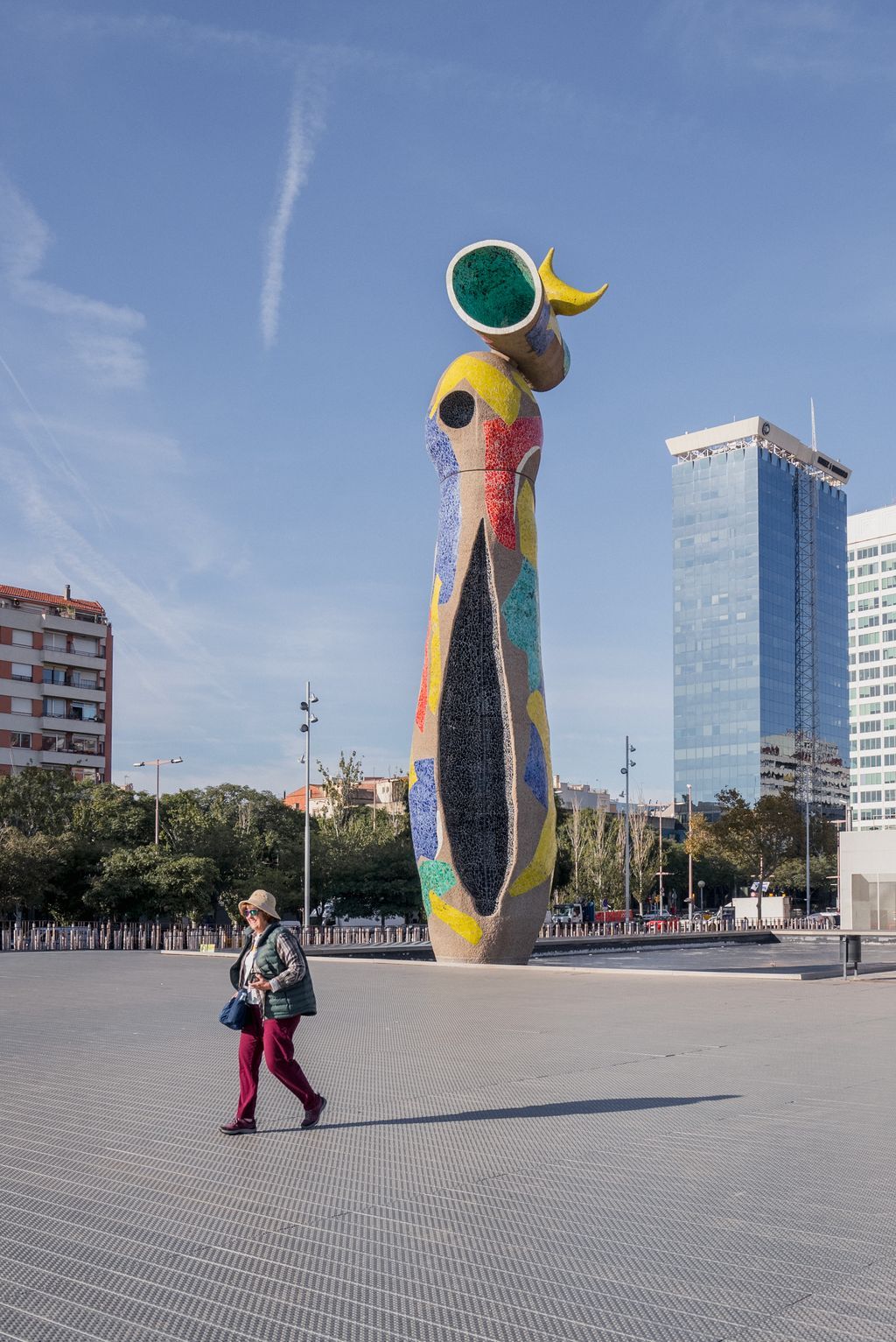
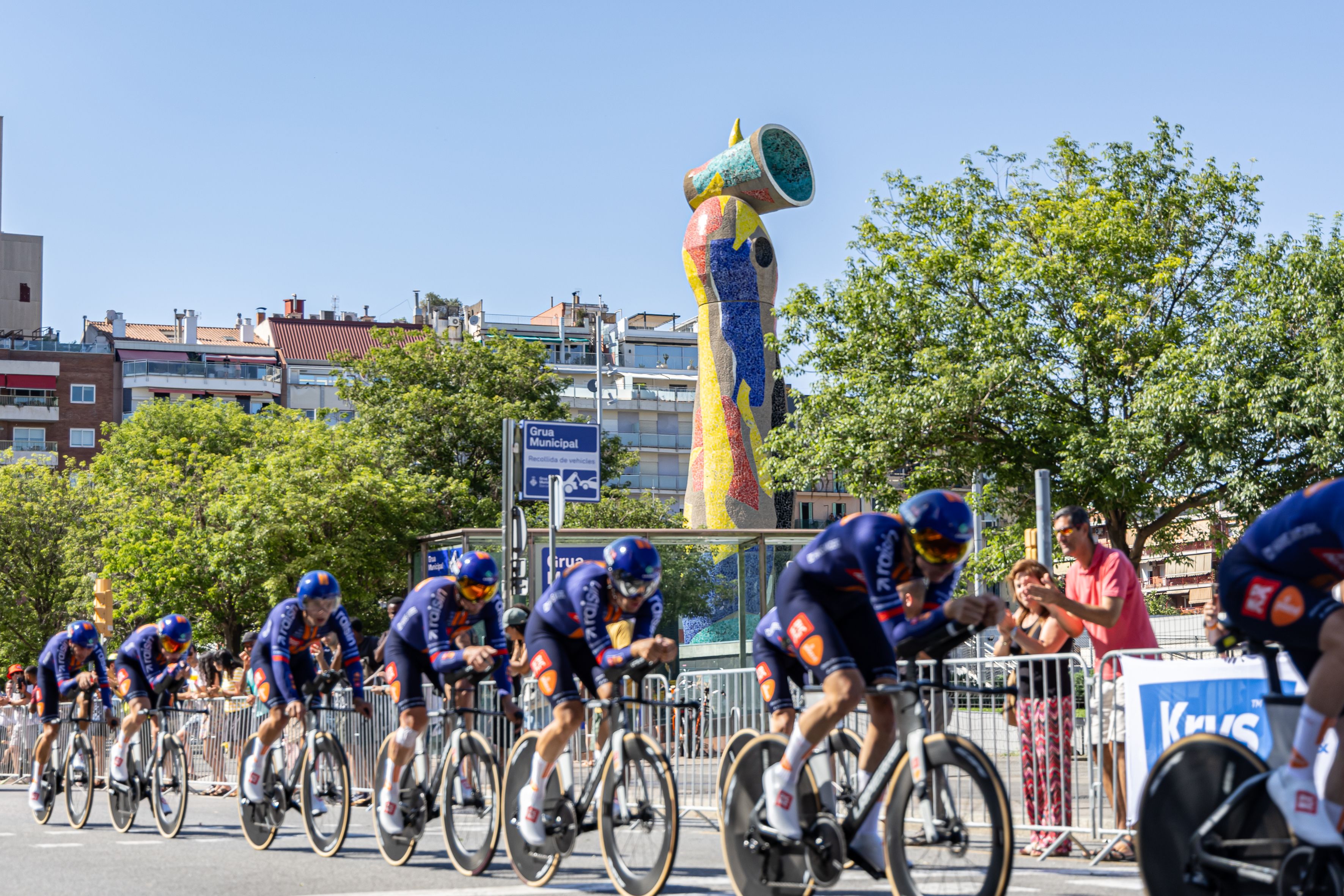
Finally, there is the city's great sculpture: Dona i Ocell. Erected in 1983, shortly before the artist's death, it seems like a trophy hard-won by the residents of this end of the Eixample. The female figure and the bird, two recurring symbols in his iconography, climb one on top of the other as a single vertical presence, covered by ceramic shards also designed with Joan Gardy Artigas. The ensemble has something of an ancient totem and at the same time of a futuristic, Martian, hieroglyphic creature.
Miró: a circle, a star, an eye, a bird. This economy of resources explains (in part) why his works are contemporary more than half a century later. They work because they appeal to a primitive, shared, spontaneous, and perfectly intelligible language. You don't need to fully understand it to feel it familiar, close, and crystal clear. Miró shouts, very clearly, and that's why anyone with imagination can read him without much effort, even if they can't write it.
Barcelona retains the privilege of having three works that were not conceived to become photographic attractions, but rather life companions. The mural welcomes us. The mosaic accompanies us as we walk. The sculpture waits patiently for us in the "park," as if it were a mother watching over her children. And we, meanwhile, putting our city, our museums, and our lives up for sale. Let Barceló be careful.
Add The New Barcelona Post as your preferred Google source for free
Stay informed with the latest news.