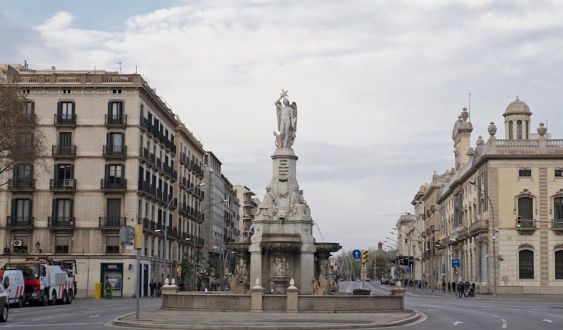
In the heart of Pla de Palau, right in front of the old port that was Barcelona's commercial hub, stands one of the city's least known, strangest, most secular, and at the same time most symbolically charged sculptures: the Font del Geni Català. You will see it crowned by the figure of a naked, winged young man, pensive, with a star in his hand. At the base (which is almost never seen, because it is an inaccessible roundabout) a world of female figures, heads of marine creatures, and heraldic medallions unfolds. The ensemble is, at once, a tribute, an allegory, and an urban curiosity that encapsulates the Barcelona of the mid-19th century, at once booming, confused, prudent, and rebellious.
The fountain was inaugurated on June 1, 1856, at a time when the city was beginning to sense that it could lead a certain modernity, and long before Ildefons Cerdà's Eixample turned expansion plans into reality. The port was still the economic, social, and vital engine of the old city. In this context, the monument project was the work of the municipal architect Francesc Daniel Molina (façade of the Principal Theater, as a reference), while the sculptures are by Faust Baratta (an Italian established in the city, fountain in Plaza Real, for example) and Josep Anicet Santigosa (monument to Galceran Marquet, in Plaza Duc de Medinaceli), artists who worked with the neoclassical and romantic sculptural language typical of the era.
The work was erected in gratitude to the Captain General of Catalonia, José Bernaldo de Quirós, who had promoted the channeling of water from Montcada to Barcelona, solving a problem of drought and public health that had affected the city. This purpose is manifested in the coat of arms that appears on the monument with the motto: "After God, the house of Quirós." The Catalan genius as a symbol of the country, yes, agreed, but at the same time a witness to fidelity to the established powers. Barcelona contrasts.
The central figure of the genius is a naked, winged youth, with a star in his hand. He is not a warrior or a military hero, but a protective spirit, a kind of secular patron who watches over the city and its inhabitants. The star he holds symbolizes the inspiration, talent, and creative capacity of the Catalan people, a concept very much in tune with romanticism and with the idea of the "Volksgeist," the spirit of the people that 19th-century intellectuals were beginning to reclaim as the basis of cultural identity.
Around him, four female figures represent (I fear) the four Catalan provinces. In addition, four marine heads spitting water symbolize the great rivers of Catalonia: Ebro, Llobregat, Ter, and Segre. All of this turns the fountain into a symbolic portrait of the geography and history of Catalonia, and at the same time a message about the prosperity and territorial cohesion of the country.
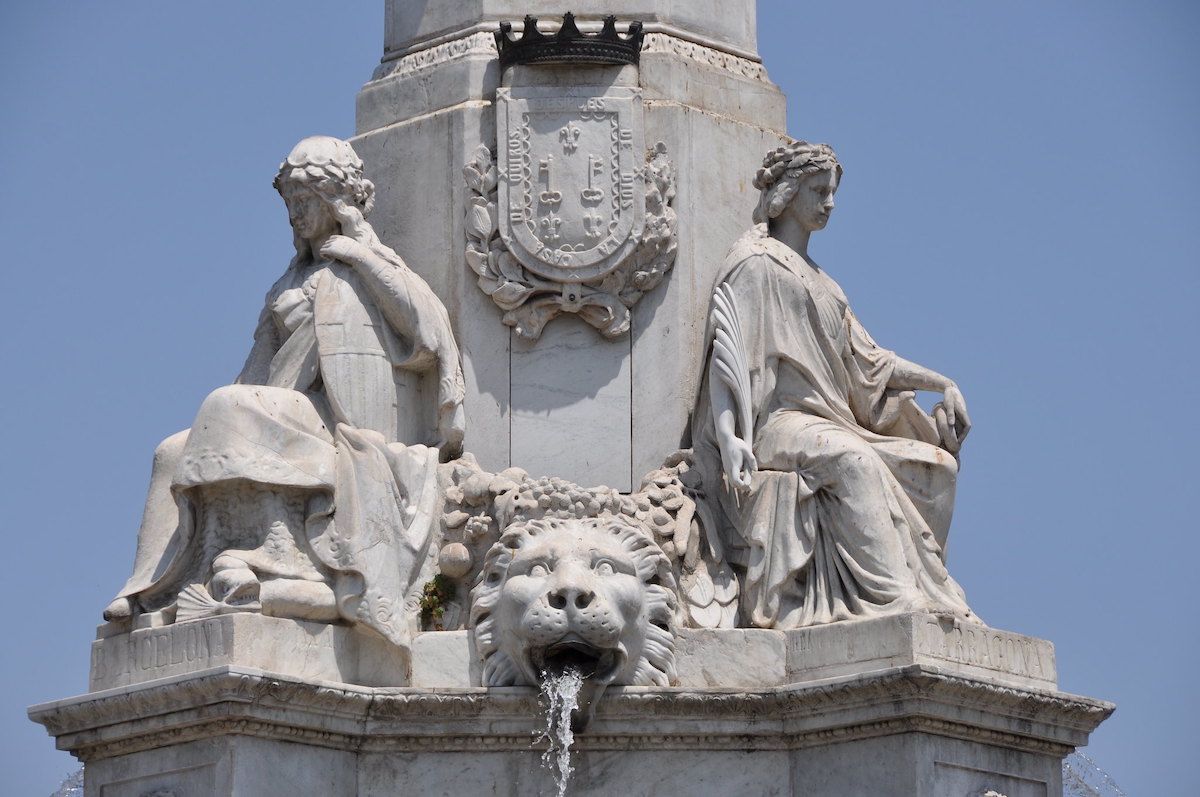
Curiously, the monument also incorporates medallions with political and economic portraits of the era, such as Ferdinand VII, Isabella II, Joan Prim, and Antonio López y López (the dethroned Marquis of Comillas). The presence of these figures confirms that the fountain also recognized the political hierarchy, military power, and economic influence on which the country's prosperity rested. Thus, the Catalan genius does not exist in a vacuum, but on the (more or less attractive) reality.
The genius has also experienced curiosities that make it unique: when it was inaugurated, the male figure appeared completely naked (as it is now), with visible anatomy, which caused the corresponding scandal among the most scrupulous. The bishopric intervened and, according to chronicles of the time, the sculpture's genitals were destroyed by hammer blows and subsequently covered with a marble element.
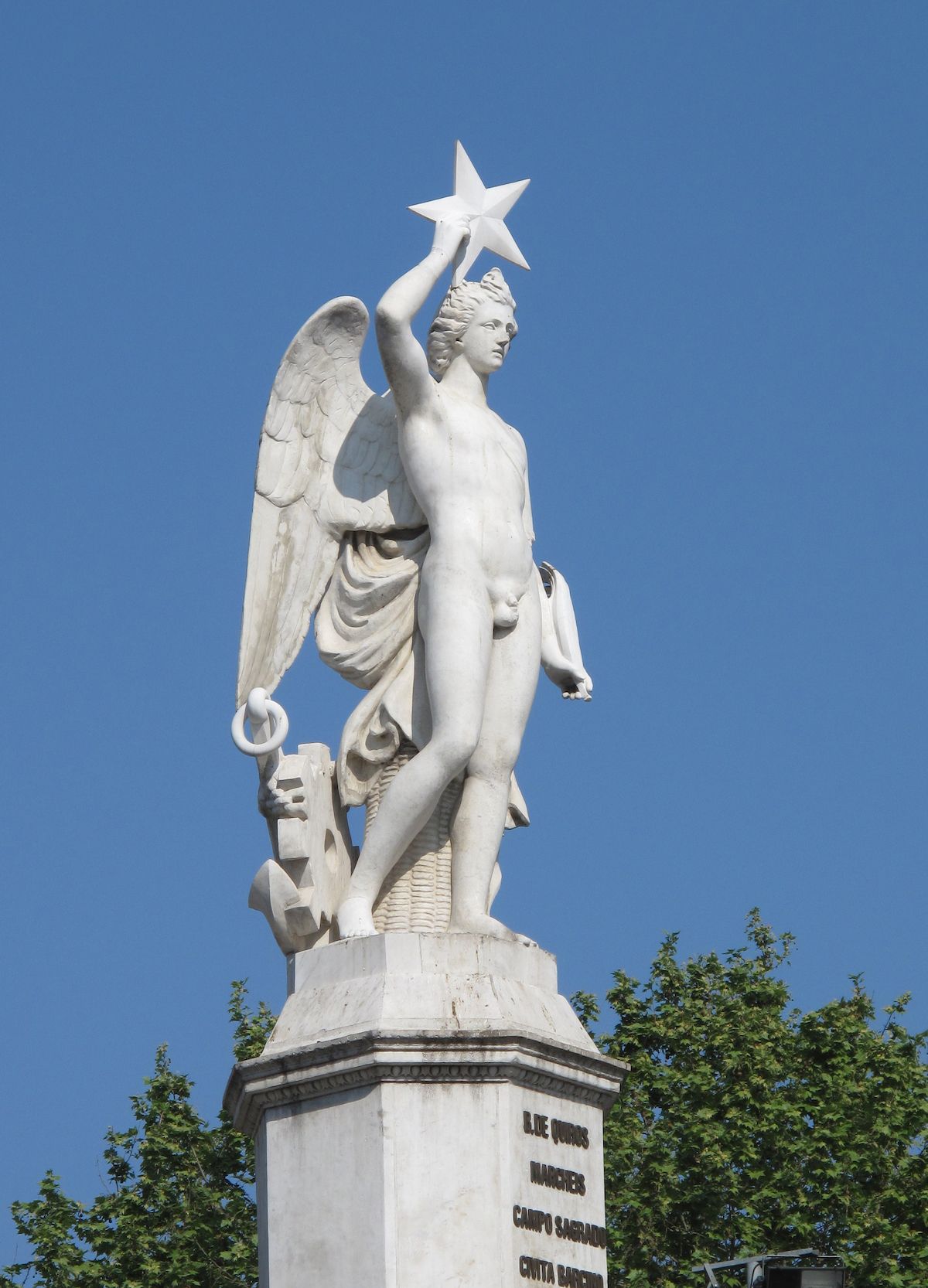
After the Civil War, it was restored by Frederic Marès, who added some fragments that had broken off the wings, feet, hands, star, and palm, but kept the modest plug, which was removed once the "uncovering" era passed, in the mid-1980s. But then, in the early 1990s, another restoration promoted by the Barcelona posa't guapa campaign was carried out, which added a tube-shaped resin penis to the genius, replacing the parts Marès had redone.
All these interventions were replaced in 2008 by Mercè Marquès, rigorously following (and with delicacy, I imagine) the available old photographs. The modeling was done by Abel Vallhonesta and the execution in marble by Ferran Regàs. The wings on the horses were redone in Marès' style (originally they seem to have been butterfly-like), but the famous penis was not redone: no visual or documentary evidence of the element was available. It has finally remained, therefore, a very inspiring, but honestly short-penised statue, which summarizes, like the fountain itself, the mixture in which the legendary Barcelonian genius is configured (and supposedly grows).
Add The New Barcelona Post as your preferred Google source for free
Stay informed with the latest news.
