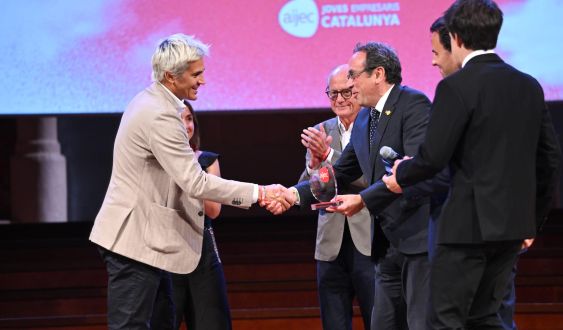
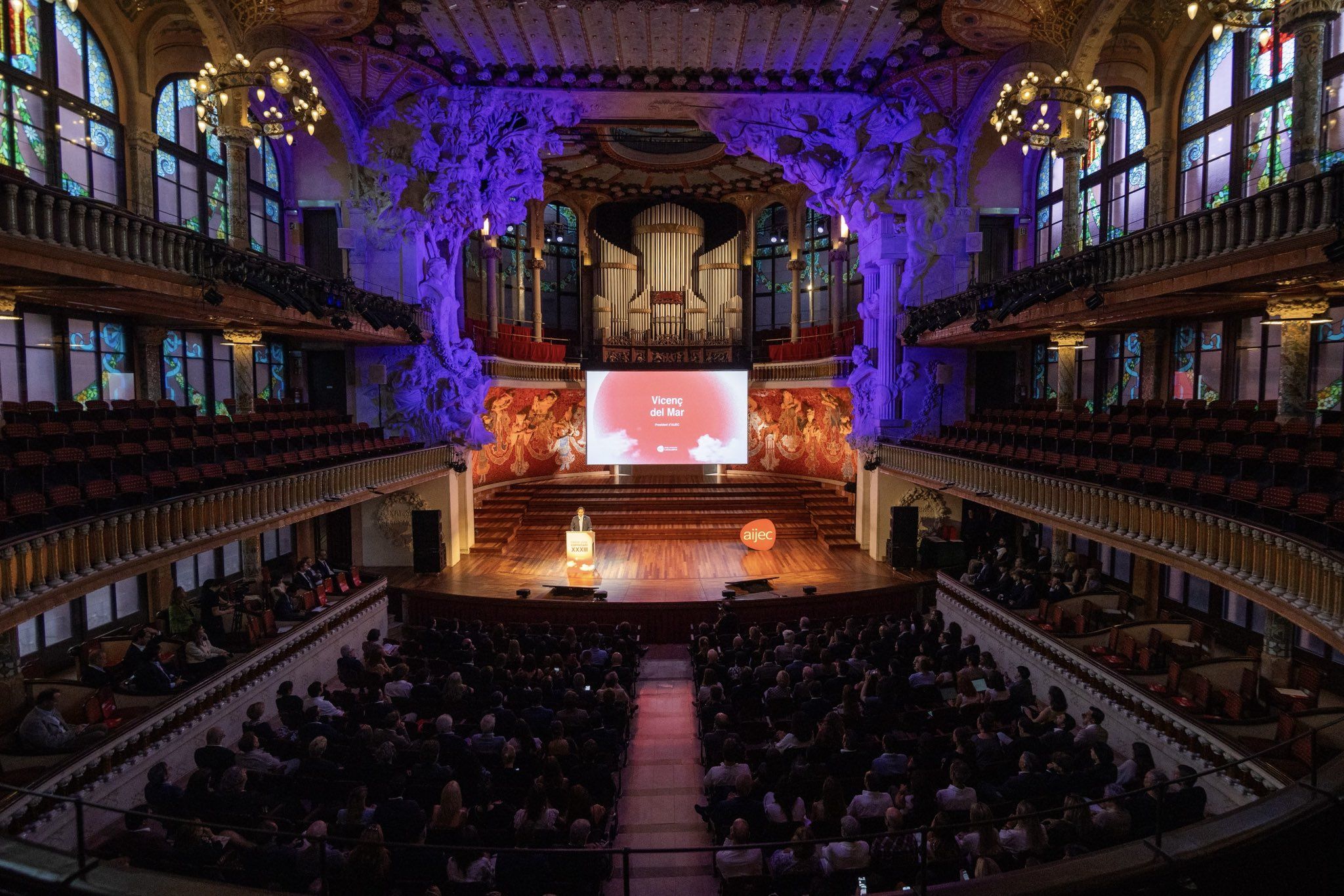
After fire comes air; after the spark, momentum. Once a flame is lit, it must be kept alive. And once you have the spark — and the boldness — to set an idea in motion, the next step is to give it air, movement and direction so it can move forward. So, with this passage between two elements, from fire to air, the AIJEC turned the Palau de la Música into the setting last night for an evening dedicated to entrepreneurship and to those who dare to take their ideas further. Among them was the night's top honouree, Adrià Argemí, CEO of Pangea Propulsion, a company that builds engines for space and carries this very idea all the way to the stars — pushing forward something that was once just a spark: "engines born in Barcelona that will fly around the world."
After marking the AIJEC's 40th anniversary last year by looking back on its own history and celebrating some of the more recent winners of the Young Entrepreneur Award, this year the association wanted to shift perspective and look to the future instead. It did so in one of Catalonia's most iconic venues, the Palau de la Música Catalana, which last night hosted a gathering of business figures, entrepreneurs and representatives from Catalonia's economic and institutional world. The picture was not complete, however: an event held by the president of the Generalitat, Salvador Illa, at Barcelona's Museu Marítim to mark two years in office meant some institutional figures were unable to attend the gala, or arrived later than planned.
"Thank you very much to those of you who are here tonight." With these words, AIJEC president Vicenç del Mar acknowledged the evening's institutional absences before moving into a speech that went well beyond celebrating the awards. Del Mar made the case for young entrepreneurs having role models, and argued that success should stop being treated as an uncomfortable idea. But above all, he made the case for the role the new generation of entrepreneurs should play in building the country: "The time has come to raise or hand."
The AIJEC president called on political leaders to show responsibility, but also to rethink how public debate is conducted: "We don't need to turn anyone who thinks differently into the enemy." Rather than polarising, he argued for the need to mind how things are said and to build together, through collaboration between the public and private sectors. He also raised another point: if there is so much talk about retaining and attracting young talent, then young people's voices also need to be heard; and in that sense, the AIJEC wants to be "useful, not used," its president argued.
This call for voice and space carried through into the speech by the president of the Parlament, Josep Rull, who picked up the metaphor that had guided the evening to talk about trust. Rull recalled that when the AIJEC was founded, in 1985, it was the only employers' association for young entrepreneurs, and that then, as now, "everything was still to be done." An idea, he argued, that still speaks to a generation that must understand what kind of country it is and, above all, what kind of country it wants to be.
On a stage like the Palau de la Música — which Rull described as a space "driven by its people" and one that embodies "a modernisme with no limits other than the creation of beauty" — the president of the Parlament made an explicit defence of the entrepreneur and of the capacity for initiative. "Entrepreneurship is not a euphemism for the businessperson," he warned, championing a capacity for initiative that, he said, Catalonia has traditionally had. And he took the evening's metaphor even further: "the air Catalonia needs is trust" — trust in those who start businesses, who take risks, and who commit to generating prosperity.
Because trust does not mean an end to regulation, but better regulation: "We need to regulate well, but cut red tape better," Rull summed up, warning that excessive bureaucracy risks undermining the very thing the evening's metaphor of air stood for: the capacity to take the initiative.
Polluted air?
But not all the air surrounding business is as clean as the one evoked by the evening's metaphor. If air is what allows progress, there are also factors that make it harder to breathe. Three voices from the business world set out some of the main obstacles facing entrepreneurs and business owners today: regulation, a tax burden they consider suffocating, and a still-negative perception of the entrepreneur.
Antonio Magraner, president of the Spanish Confederation of Young Entrepreneurs (CEAJE), spoke of a genuine cocktail of difficulties. He pointed out that Europe regulates up to five times more than the United States does, a burden that forces business owners to keep constant watch on new rules and to devote resources continually to understanding and complying with them. To this regulatory pressure he added a tax system he called suffocating, and another, more intangible but equally important difficulty: the image projected of the entrepreneur. Magraner argued that businesses are what generate prosperity and progress, while acknowledging that a negative perception of entrepreneurs still persists.
In the same vein, Lorenzo Amor, president of the ATA, denounced the difficult financial situation facing many self-employed workers because of the tax burden. And Àngela de Miguel, president of Cepyme, noted that although Spanish SMEs have improved their productivity, much of that gain has ended up being eaten up by labour costs.
Adrià Argemí and the thrust towards space
And amid this air thick with difficulties, the gala also turned its attention to those who have managed to push their ideas forward. The night's top honour went to Adrià Argemí, co-founder and CEO of Pangea Propulsion, who received the 33rd Young Entrepreneur Award for his work leading a Barcelona-born company developing advanced space propulsion systems. Pangea designs engines and propulsion systems for launchers, satellites and spacecraft with a clear goal: to make space missions more efficient, competitive and sustainable, and to help make our industry "more self-sufficient and competitive."

For Argemí, being an entrepreneur is, above all, about "daring": turning ideas into real projects and pursuing goals that, in Pangea's case, point literally towards space. The award-winning businessman also argued that Barcelona can produce companies that are deeply rooted locally while still being "competitive and global," and he turned to the poet Miquel Martí i Pol to sum up the project's spirit: "Everything is still to be done, and everything is possible." A line that, in Pangea's case, takes on an almost literal meaning: "Everything is still to be done — but at Pangea, we're already doing it." A statement of intent that fits the spirit of an evening devoted to exactly that: giving ideas air, so they can gather momentum and go further.
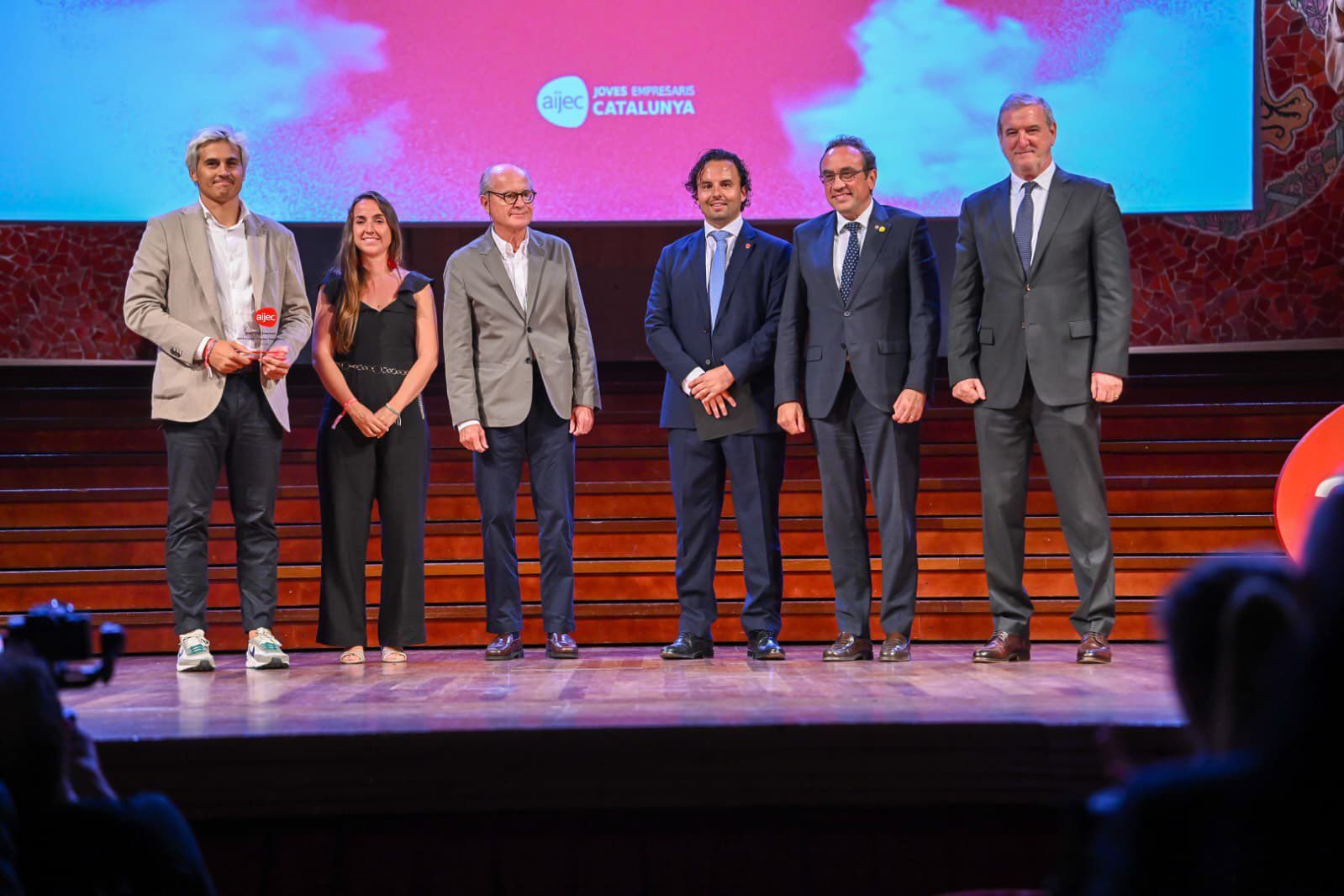
But Pangea was not the only project recognised on the night. The Best Business Initiative Award went to Aurax Technology, a Barcelona deep-tech startup developing assistive technology to expand people's digital autonomy. Its flagship product, MouthX, allows users to control computers, smartphones and other digital devices without using their hands.
The night also honoured careers and projects that approach business from other angles. Jaume Alsina, founder and honorary president of BonÀrea, received the Business Career Recognition award, collected on the family's behalf by his son, Ramon Alsina. "It's not just about building a business, it's about transforming realities," he said, before urging young entrepreneurs to "think big" without losing their roots in the local area.
The Recognition for Business Linguistic Quality went to L2S 1001 – Les Mil i Una, while Arkeobots received the Recognition for Social Entrepreneurship, for a project that champions a way of understanding business as having both "an entrepreneurial calling" and "a social calling."
Finally, the Future Business Recognition went to FEEL-IT, a project developed by students at Colegio Jesús y María Sant Gervasi as part of the Junior Achievement programme, as a showcase of the entrepreneurial talent of the new generations.
"They managed it because they didn't know it was impossible." Adrià Argemí, Aurax Technology, Jaume Alsina, Les Mil i Una, Arkeobots, FEEL-IT and many other entrepreneurs were, last night, the protagonists of an evening that championed exactly that: the drive of those who dare to try. With this line, attributed to the playwright Jean Cocteau, Josep Rull put into words the spirit of a gala that celebrated for the 33rd time the transformative capacity of our country's young entrepreneurs.
Add The New Barcelona Post as your preferred Google source for free
Stay informed with the latest news.