
By invitation, but you enter without anyone asking for an invitation and no matter how prepared you have it. For a few days, entering one of the city's most exclusive private clubs is easy, even entering without being asked to wear a tie, and this is on the occasion of the fifth edition of the By invitation exhibition, a careful selection of galleries and works that must be admitted to maintain a very high standard. The Círculo Ecuestre, which does not Catalanize its name by chance and yet has as its motto El Club de Barcelona, has had the good taste and success of appearing as an entity close to creativity and art. And that despite the fact that, unlike other large Barcelona circles such as the Liceu, it does not have a cultural reason for its existence but rather resembles a Cercle d'Economia with large modernist halls, works by Ramon Casas and one of the best windows in Barcelona through which, shortly, the most beautiful Christmas tree in Barcelona will peek out.
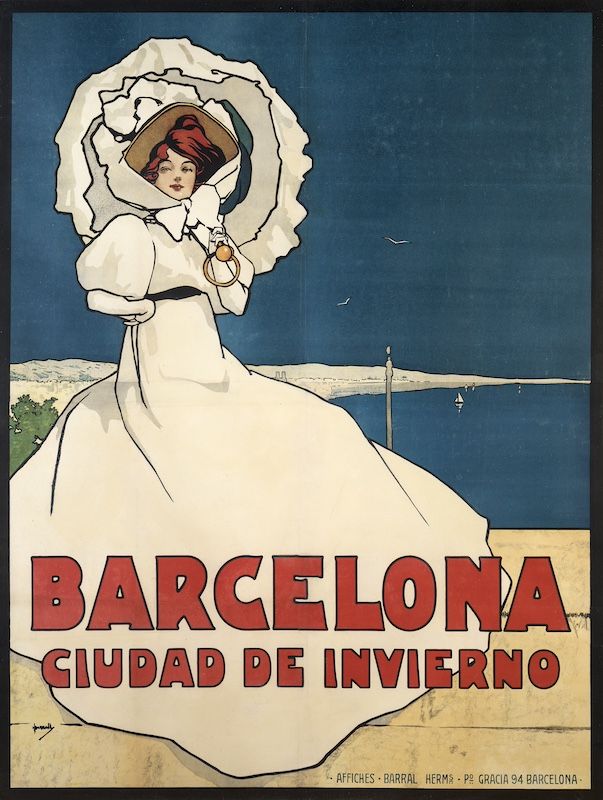
This time, primary market galleries have been incorporated into the exhibition along with secondary ones, allowing for a greater approach to contemporary art: that is, although the Marc Calzada Gallery exhibits an impressive Grand Triptyque Noir by Miró (as David Cervelló exhibits the bluish Oiseaux Etoile II) or the always excellent Gothsland gallery exhibits posters by John Hassal or its classic drawings by Casas, this time we can also contemplate emerging artists such as Marina Vargas (Fernando Pradilla gallery), Regina Giménez (Ana Mas Projects), Lena Laguna Diel (from the Fuga gallery, and arrived from Basel) or Natalia Romanciuc (Arma Gallery).
It is not surprising that Deputy Mayor Maria Eugenia Gay mentions in her speech (prior to that of president-contigoempezótodo Enrique Lacalle) the great commitment to female creativity in this edition. A combination of classic and contemporary that must be admitted to shine, with an undeniable sense of good taste, in all the rooms of the Círculo and that even make old and royal equestrian portraits make a good impression due to such good company.
The rooms but also the corridors, and the bar, the most unexpected corners, the entire building is invaded by a careful selection of works that do not form the appearance of any fair, even though, in effect, all the galleries have come especially to sell. At a time when it is said that people do not buy art in Barcelona, we will see if within certain circles (sponsorship by Engel & Völkers, Hublot, Andbank or La Roca Village) things liven up a bit more. The event is complemented by visits to private museums, awards and specialized conferences, with a kind of undisguised nostalgia for having lost (or not having sufficiently gained) an Arco for the city. We have barely gained a Manifesta full of colauera ideology, if I may be allowed the observation and the wink to the Círculo audience.
The direction of the exhibition was carried out by Dr. in Art History Mariella Franzoni and with the exhibition design by architect Andrea Isola, with 24 selected exhibitors, not all Catalan or from Barcelona (there are also Guillermo de Osma, Arma Gallery, Gärna Art Gallery from Madrid, or Shiras Galería from Valencia). Also a luxurious monographic magazine, sponsored among other brands by Chanel, where Carmen Thyssen-Bornemisza is interviewed as an almost obligatory reference to the collecting impulse (and without missing the opportunity to ask her about the next branch of her museum in the Comedia cinema on Paseo de Gràcia) or Sara Puig, president of the Joan Miró Foundation. Also a courteous reference to the 250 years of the Reial Acadèmia Catalana de Belles Arts de Sant Jordi, with its long list of historical and illustrious members. The entire magazine, in fact, is a vindication of collecting activity. If it has to help reactivate that sector, incomprehensibly stagnant in a city that had been an artistic avant-garde, here is my applause.
I would keep two Gothsland Houses and a Lena Laguna from the Fuga gallery, to follow the criterion used in this edition, which would be a kind of "m'exalta el nou i m'enamora el vell", but also because of all the invited gallery owners, these two are the ones I feel closest to. Anyway, honestly, what I would keep is the Ecuestre building with almost everything it contains (don't make me mention what not, today is not the day) just as I would keep, if I could, the Círculo del Liceo building. There was a belle époque in Barcelona where we made impeccable buildings, where we portrayed Julias to exhibit in both circles, where we bought and sold and above all made art, and made circles, and clubs, and where we had an elite that, apart from being elite, connected with the pulse of the country. Yes, I also have my nostalgias. But, at least, this week, just a few days before putting up the most beautiful tree in the city, the conservative Ecuestre circle has shown that it knows how to preserve good taste.
Add The New Barcelona Post as your preferred Google source for free
Stay informed with the latest news.
