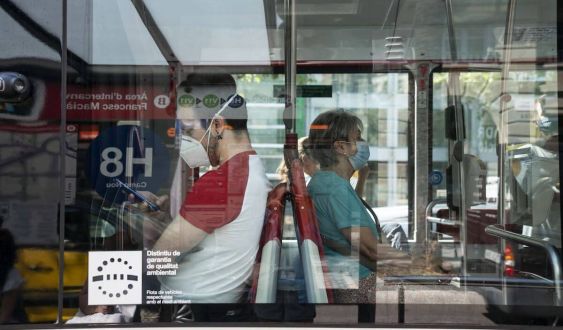
At a time when new ways of moving around the city are emerging, Transports Metropolitans de Barcelona (TMB) does not want to be left behind and is working to integrate them into its offer. The public company is immersed in the elaboration of a new strategic plan, which has to define its immediate future in the next four years and reflect the changes that are taking place in the urban ecosystem. For the president of TMB, Rosa Alarcón, this commitment will promote intermodality and, ultimately, contribute to the main objective of any public transport operator: gaining more users.
In this way, one of the main axes of the new roadmap will be the evolution of TMB, which has to go from being merely a transport company to becoming a provider of integral mobility services, known as mobility as a service (MaaS). This will involve including new means of personal and shared mobility transport, and last and first mile. The metro and bus will continue to be its main business, but providers of scooters, bicycles, shared cars or goods transport will be integrated into a public platform.
Another characteristic of this transformation of TMB will be the reinforcement of its metropolitan commitment in the new platform. Thus, the different means of transport that will be offered will be able to overcome the physical borders of Barcelona and facilitate the mobility of citizens living in the surrounding towns. On the other hand, the company will continue to seek new business avenues that allow generating alternative sources of income to reduce the public transport bill. This group includes the international consulting services offered by TMB, which allow it to export the knowledge it has acquired configuring metro or bus networks to other cities.
TMB thus kicks off the new strategic plan, which is expected to be completed in the next two months, according to the CEO of TMB, Gerardo Lertxundi. For now, the list of projects that comprise it is close to a hundred. The completion of metro line L9; the new express bus to connect the center of Barcelona, the incorporation of electric vehicles or the new public hydrogen station in the Zona Franca are some of them, but more will be defined.
New advisory board
To do so, it will have the support of an advisory board, made up of 22 members from very diverse fields. Among them, the president of the Port of Barcelona, Mercè Conesa; the president of Barcelona Airport, Sonia Corrochano; the dean of the College of Civil Engineers, Oriol Altisench; the president of the Cercle d'Infraestructures and coordinator of the Rodalies Plan, Pere Macias; the president of the RACC, Josep Mateu, or the president of the Association for the Promotion of Public Transport, Adrià Ramírez.
TMB is not the first operator to opt for such an approach. Renfe is also promoting its integral mobility platform, which it has called Renfe as a Service (RaaS). With the aim of continuing to be the main reference at a railway level, RaaS will allow designing the entire journey, from when the user leaves home to catch the train until they reach their destination, offering the possibility of booking all the necessary additional services during the journey, through a single payment and without leaving the application. Renfe estimates that RaaS should help it to add 650,000 new customers in the next five years, who are expected to generate 1.8 million new trips and bring in 156 million euros.
Regarding the competition that may arise with other operators, Alarcón sees no problem and defends that Barcelona residents will have different platforms at their disposal to move from one place to another. Lertxundi expresses himself in the same vein, advocating for combining all possible forces to gain as many users as possible for public transport.
Add The New Barcelona Post as your preferred Google source for free
Stay informed with the latest news.
