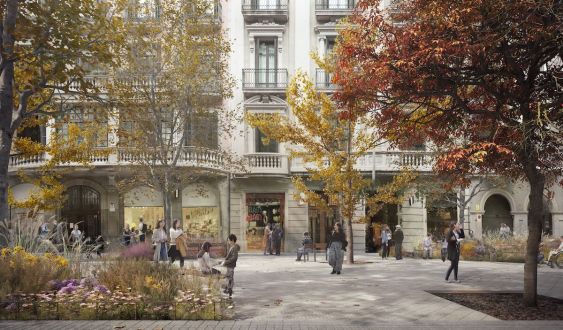
The transformation that the Barcelona City Council wants to undertake in the Eixample will begin to materialize this month. Taking advantage of the decrease in activity during the summer, next Tuesday, August 16, work will begin on the first four green axes that the council has projected on Consell de Cent, Girona, Rocafort, and Comte Borrell streets. The intervention will multiply the greenery on these roads by 12, as well as gain 58,000 square meters for residents. The total budget will be 52.7 million euros, partly financed by Next Generation funds.
Preliminary work for the construction has been carried out during July and early August. The action has served to incorporate new loading and unloading zones, and reallocate services such as Bicing stations and spaces for people with reduced mobility and motorcycles. Once this first preparatory phase is completed, structural interventions will begin, which will be carried out simultaneously on the four streets and will involve ten different teams.
During the development of the works, the sea side and the mountain side of the streets will not be occupied at the same time, guaranteeing at all times a traffic lane for residents, services, and bicycles, as well as for emergency vehicles. There will also be a clear sidewalk for pedestrians and access to parking lots will be maintained. There will be no impact on public transport.
The start of the works will mean that mobility will already be configured as it is expected to be when the works are completed, taking into account that the streets will prioritize walking and a single platform will be established, from facade to facade. In the new scenario, private vehicles accessing any of these Eixample streets will no longer be able to travel them from end to end and will have to circulate at low speed (10km/h). Thus, cars will only be able to drive two blocks consecutively, after which they will have to turn. Those who access one of these new green axes from a transversal street will be able to exit it at the next transversal street. Likewise, the bike lanes on Consell de Cent and Girona will disappear, although cyclists will be able to continue circulating through the central sections of both streets as long as they respect pedestrian priority.
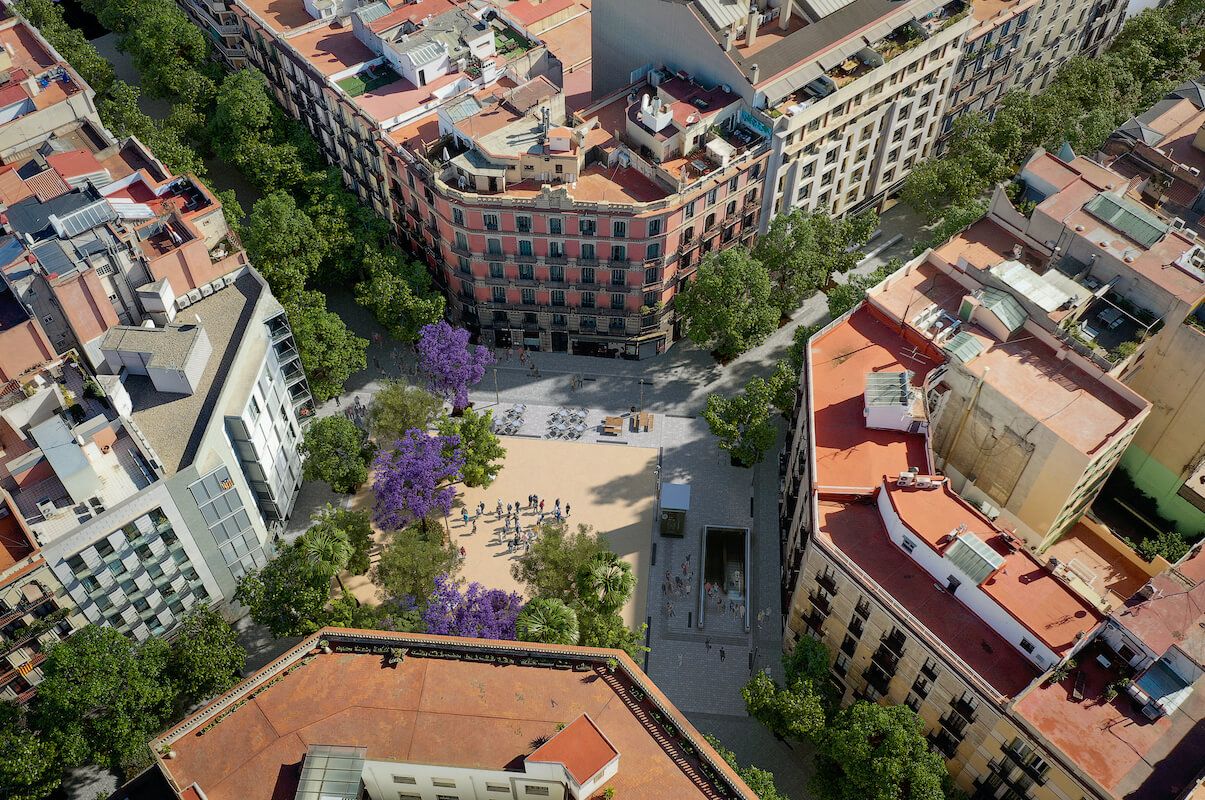
Along with the implementation of green axes, four new squares will be added at the chamfers of Consell de Cent with Girona, Rocafort, Comte Borrell, and Enric Granados. In these squares, which cars will no longer be able to cross and will be forced to turn, landscaped spaces with a total area of 2,000 square meters will be created.
The new spaces in the Eixample will be characterized by the disappearance of asphalt, which will be replaced by granite and a new, more sustainable panot, but one that will maintain the current design. The commitment to convert the streets of Consell de Cent, Girona, Rocafort, and Comte Borrell into green axes will translate into planting 400 trees, which will generate shade and cool the environment. The subsoil will be vegetated, and water will be reused. The roads will also be equipped with more urban furniture, such as benches, fountains, play areas, and tables. Their lampposts will become lower and will be located in central places on the streets.
Add The New Barcelona Post as your preferred Google source for free
Stay informed with the latest news.
