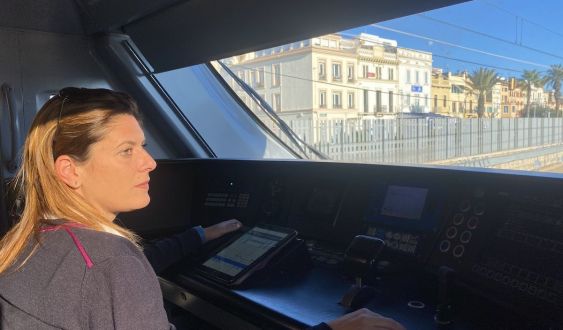
When Geni Camuñez started working as a train driver in Rodalies in 2010, there was only one bathroom for all employees at a multi-line terminal station like L'Hospitalet de Llobregat. She remembers there was a colleague from Seville who would greet others effusively every time she crossed paths with another woman because it was not at all common. "You were very surprised when you met one," Camuñez says. There have been ladies who told her she couldn't enter the cabin, that that place was only for the train driver.
15 years have passed and things have changed, but there is still a long way to go. There are already separate bathrooms, showers, and changing rooms, and it is not so rare to see a female train driver on the trains she crosses during the day. Now the female workers are asking for a lactation room. Even so, the proportion of female train drivers remains low, they only represent 14.5% of the total Rodalies staff, but nothing compared to the 3.4% there was in 2010.
Like so many other Rodalies workers, Camuñez comes from a family of train drivers, hers from Poblenou. In her house, her father was one. She started working in ticket offices and her father did not pressure her to follow his path, he let her decide if she wanted to. "He dropped the hint and I thought, within where I am, where can I be better. It was an opportunity to improve," she points out. That's when she had to start studying technical concepts about trains and tracks. "They said a lot of swear words in class," she jokes. She combined the train driver course with working in ticket offices in the afternoons until she got her license. Here too, the gender gap is noticeable, with only 20% of girls enrolled today, above the less than 10% there was a decade ago but far from reaching parity.
For her, being a train driver was not vocational and the world of trains did not passionate her, as it happens to many lovers of the sector, like her father and her brother, who is now also studying to get his license. But she likes that it is a job that she can leave in the cabin, without taking headaches home. "It gives you freedom and it is rewarding. It is a job with views and you are not locked in an office," she defends. Especially her, who does the R1, which connects L'Hospitalet with Maçanet. It is the one that goes along the coast for most of the journey, between Badalona and Malgrat de Mar, so you always have to have sunglasses at hand. "It's a very easy, very pleasant and flat line," she remarks, "the beach season is the most complicated because there are people everywhere."
Of course, conciliation is not easy. Those who come from a family of train drivers know it, with fathers or mothers absent during Christmas Eve or Three Kings Day while they spend the night in a hotel in Lloret to prepare the trains for the next day. And they work many weekends. It must be said that the tension experienced in the daily life of Rodalies is also suffered by train drivers. From users on the platform who point to their watch when they see them arrive to those who lose their temper. "When there is an incident, I also want to finish and get home," she emphasizes, without forgetting that train drivers are concerned about how the transfer of the service to the Generalitat will be carried out.

But not all are complaints. Users become part of the routine and there are those who even know when she goes on vacation. "As if we were in the office," she says. There are also those who say thank you, "only the tip is missing," she points out. Then come the complicated situations, such as a few weeks ago when a child was left alone because his mother got off the train without him and Camuñez brought him into the cabin. For now, she has not yet had any run-overs, something more common than it seems for train drivers, and she knocks on wood.
For some time now, Camuñez, a train manager, has been working reduced hours and her shifts are more fixed. She lives in Argentona and drops her children off at school before going to Mataró. There she takes the R1 train that takes her to Sants, where she relieves a colleague to complete the journey to L'Hospitalet (one stop). Every day, she makes the journey between L'Hospitalet and Mataró three times. For now, her children don't ask to go see trains, as many do. "I want them to be notaries. If they like being train drivers, I won't tell them no because it's not a bad living, but I would like them to have a Monday to Friday job," she emphasizes.
Add The New Barcelona Post as your preferred Google source for free
Stay informed with the latest news.
