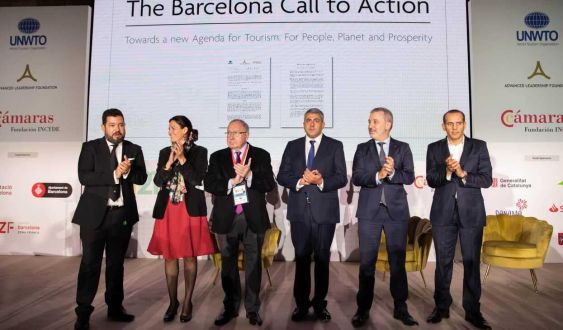
The international tourism sector, gathered this week in Barcelona, has subscribed to the manifesto Barcelona Call-to-Action for the Future of Tourism which will be one of the tools to face the future after covid-19. The document proposes a set of actions with a focus on people, the planet and prosperity and starts from the need to advance as an economic activity towards a new model of tourism that is more innovative, ethical and sustainable.
The declaration gathers the conclusions derived from the debates that during the last two days have been raised within the framework of the world summit Future of Tourism World Summit, which organized by the Advanced Leadership Foundation, the INCYDE Foundation of the Spanish Chambers of Commerce, chaired by José Luis Bonet, and the World Tourism Organization (UNWTO), has taken place at the Casa Llotja de Mar in Barcelona.
Barcelona Call-to-Action for the Future of Tourism assumes that the recovery after the coronavirus pandemic is "the greatest challenge" in the history of the tourism sector, and emphasizes that growth must be based on inclusion and responsibility. Therefore, it determines that tourism must pay attention to the needs of communities and provide decent work, preserve cultures, assume its responsibilities in terms of environmental preservation and be, in short, a fundamental pillar of economic growth and well-being, one of the largest employers in the world and an important generator of opportunities and empowerment.
With a focus on people, the planet and prosperity, more than a hundred international speakers have drawn up a decalogue of measures that they consider essential for tourism to address the most immediate future. These include aspects such as supporting companies to overcome the covid-19 crisis, promoting tourism policies and strategies that guarantee the sustainable use of resources, and deepening the sector's involvement in addressing its effects in terms of housing, use of public space, quality of employment and wages, social exclusion, spatial segregation, environmental problems or infrastructure saturation.
Digitalization, financing or training are other objectivesThey also propose promoting initiatives that promote progress, regional integration and social cohesion and stimulate companies' commitment to the planet, places and people, whether they are citizens, visitors or workers. Sustainability is another of the axes to deepen through, among other measures, the digitalization of tourism, the application of information and communication technologies and the application of intelligent programs for destinations, which generate value and promote sustainability. Other areas of innovation will come from improving training, education, knowledge and research.
Among the most global conclusions: fostering collaboration between countries by promoting an international cooperation mechanism to prepare for crises and manage them, in order to bolster the sector's resilience and reduce its vulnerability to future crisis situations.
The manifesto was made public this Wednesday in Barcelona with the presence of the Secretary General of the World Tourism Organization (UNWTO) of the United Nations, Zurab Pololikashvili, who urged to "build more sustainable leadership" and to bet on "secure financing channels" and guarantee collaboration between governments and the private sector.
Add The New Barcelona Post as your preferred Google source for free
Stay informed with the latest news.
