The ICT sector continues to grow in Catalonia. In 2023, the sector generated a turnover of 26,446 million, which implied a 9% contribution to Catalan GDP. Furthermore, the sector expects to maintain a growth trend, according to the Barometer of the technological sector in Catalonia 2024, prepared by the Cercle Tecnològic with the support of the Generalitat and the Barcelona City Council, based on surveys of 1,537 professionals from 804 companies. Of these, 80% expect to increase their sales in the future, and 60.3% believe they will make new hires.
These 26,446 million represented an increase of 12.5% compared to the previous year, and placed the sector's turnover above that of areas such as the chemical industry, automotive and construction, and only behind tourism, with 33,634 million, and also food, as explained by the president of the Cercle Tecnològic, Joan Ramon Barrera.
The number of workers linked to the sector has also increased: it has reached 135,200 professionals, 8.5% more than in 2022. The sector's workforce represents 4% of the employed population.
"The sector is a driver of job creation," defended the director of Digital Talent at Barcelona Activa, Sara Díaz, along with the director of Digital Society at the Generalitat, Liliana Arroyo. "We are an international benchmark ecosystem," she stressed, and recalled that Barcelona is the third best European city to launch a startup, and represents the fourth emerging ecosystem worldwide.
In fact, 20% of the 72,521 ICT companies established nationwide have their registered office in Catalonia. In this sense, the number of companies linked to the sector also increased in 2023, to 17,854 companies, 0.2% more than the previous year, in a period in which companies nationwide decreased by 0.7%. The increase in turnover in relation to the more modest increase in the number of companies indicates that "companies mature, grow and develop," according to Barrera.
In the European framework, Catalonia ranks sixth in terms of the number of ICT companies, and is seventh in workforce. Despite not occupying the first positions in terms of number of companies and workers —in rankings led by the Nordic countries—, the average turnover of companies is in third European position, with 1.26 million euros.
Talent, "great challenge" for the sector
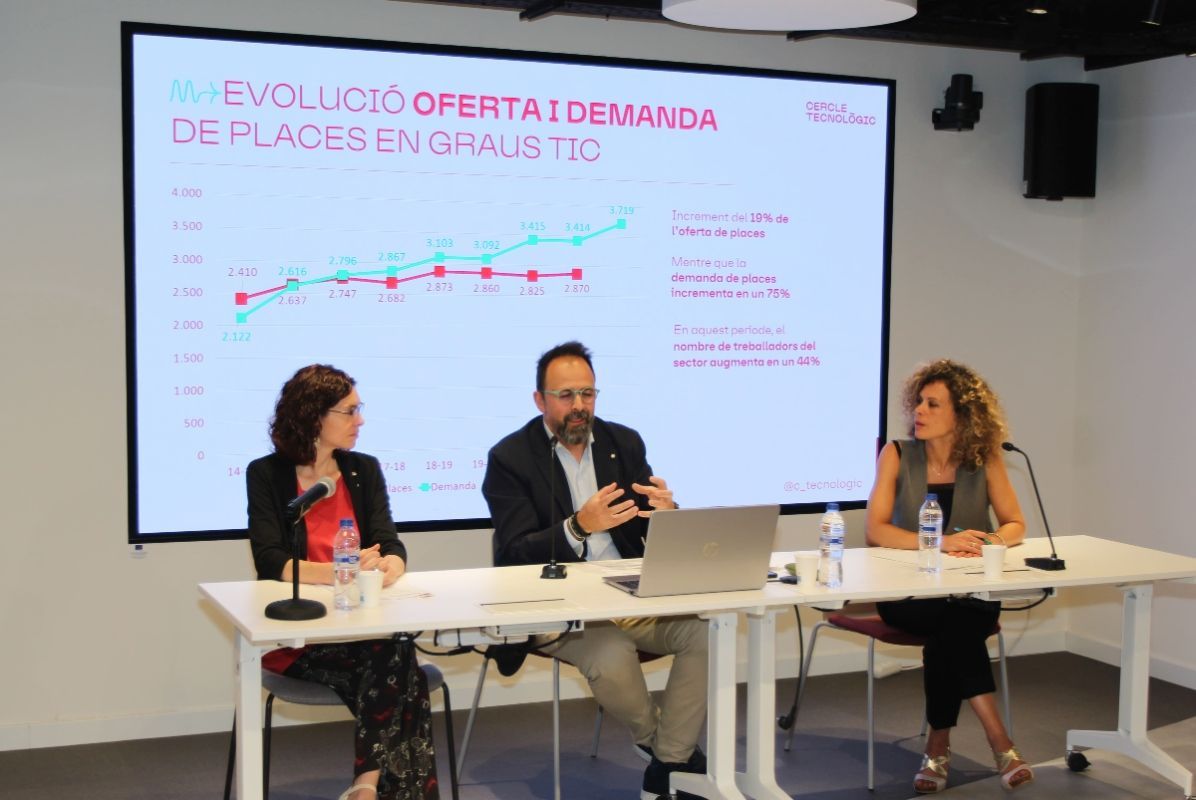
Despite this growth, the lack of available talent "slows down the contribution of ICT to Catalonia's GDP," and the fact is that in 2023, some 9,200 jobs remained unfilled, which would have generated an additional 1,805 million euros in turnover: "It's the big challenge," according to Barrera. The average number of vacancies increased by 23% compared to the previous year, while the number of places in university degrees linked to the technological field has stagnated.
"The fact of not filling these positions generates a deficit in wealth creation," Barrera insisted, highlighting the need to create more university places linked to the ICT sector to cover this imbalance. This gap is also evidenced by the 2,800 university places in the sector offered in the 2021-2022 academic year, and the 3,400 demanded: technological vocations have awakened in recent years, but there is this "bottleneck" that makes it difficult for people who want to dedicate themselves to the sector to train to reach companies that, in turn, demand them.
"Training talent, attracting it, and retaining it: these are the challenges we are working on," defended the director of Societat Digital. Arroyo assured that this issue is being addressed with universities within a "structural situation that goes much further," while Díaz recalled that university is crucial and that there are other training avenues, such as Vocational Training and boot camps, intensive courses designed to train in the necessary skills to immediately enter the labor market.
An opportunity with female talent
This lack of talent is broader in the case of women, who represent 32% of the Catalan ICT ecosystem. This reality positions female professionals as a still untapped source of talent, in a context where, according to Arroyo, the weight of foreign professionals settled in Catalonia is not decisive for the growth of the sector.
Within the technology sector, AI is identified as the area that will have the most impact and demand the most professionals in the future. So much so that, according to Barrera, the field that will demand the most talent will be AI, followed by cloud computing and cybersecurity. In addition, participants in the study also place sustainability as a priority element, something that 95% of respondents advocate. In this sense, they are committed to working to influence energy saving, more efficient waste management and teleworking, according to the barometer, which has been X-raying the Catalan ICT sector for 16 editions.
Add The New Barcelona Post as your preferred Google source for free
Stay informed with the latest news.
