
It's curious how connections are established. While writing about the exhibition Corpus Infinitum, I realized that the spiritual was very present in the work of Denise Ferreira da Silva and Arjuna Neuman, like a leitmotiv that might go unnoticed but is present to the eyes of those who want to see, or rather, those who dare to look. I cannot explain how, as a result of this reflection, I came across Pilar Bonet Julve, a professor of Art Criticism at the Universitat de Barcelona, curator, and manager of the independent research group Visionary Women Art-Research Group, who, in a very risky move, has brought to the MNAC the exhibition I want to tell you about today.
And it is that The Guided Hand is an exhibition that tells us about two visionary women, Josefa Tolrà (1880-1959) and Madge Gill (1882-1961), who never met or had any kind of contact or relationship, but who traveled parallel paths in their lives with a very similar trajectory and profoundly conditioned by what we call the spiritual. Both had lives marked by extreme situations, and linked to esoteric knowledge and the methodology of the creative act guided by the automatism of psychic trance: "the guided hand."
But let's go by parts. Josefa Tolrà and Madge Gill were born in January, under the constellation of Capricorn. As young women, they became involved in spiritualism. Josefa had three children, but lost two, and it was her daughter who cared for her until her death at 79. Madge also had three children, also lost two, and the remaining son took care of her until her death at 79. Both went through periods of mourning for the loss of their offspring that led them to the void of a personal crisis. Madge received psychiatric treatment; Josefa never received medical attention. But both, around forty years of age, found through creative processes, the path to healing, which they expressed in drawings, diaries, and embroideries.
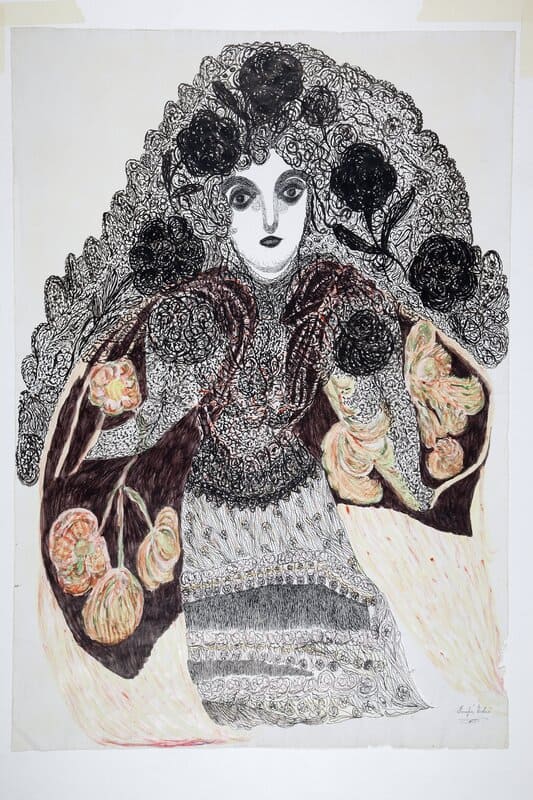
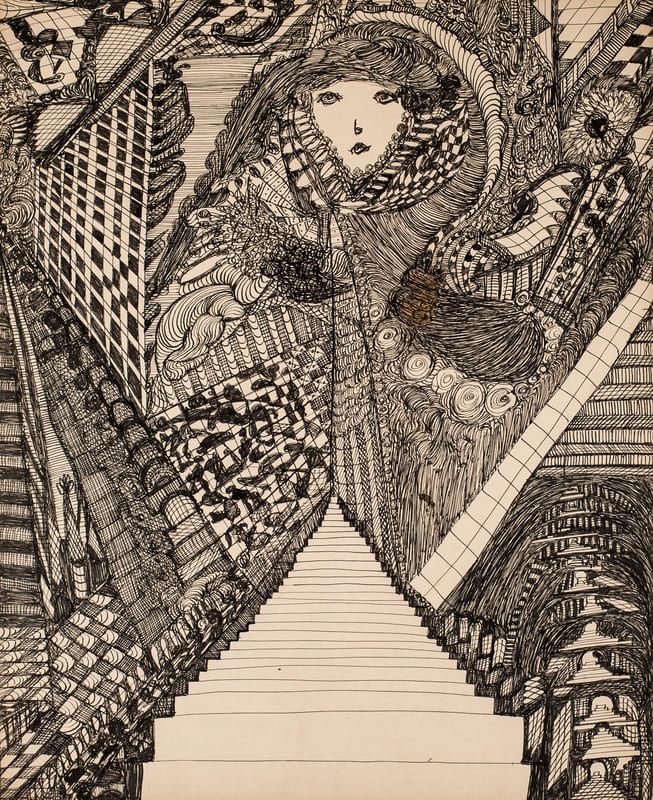
Both found the path to healing through creative processesThus, the exhibition is articulated starting from the most intimate and corporal works, such as postcards and notebooks, to give way to the great figures of the beings of light, who accompany us on a journey between deep gazes, fractal architectures, poetic calligrams, cosmic spirals, quantum times, embroideries of ethereal energy and mystical breath. Pieces from one and the other, exquisitely selected and placed side by side, which surprises and amazes how connected they are in terms of form and motifs.
Neither one nor the other, they never considered that what they produced from their connection with spirits would have any kind of repercussion, thus renouncing all notion of authorship. In fact, Josefa signs works like Dibujo fuerza fluídica alongside her signature, and Madge does so as Myrninerest, the name of the one who guides her hand: they are only mediums.
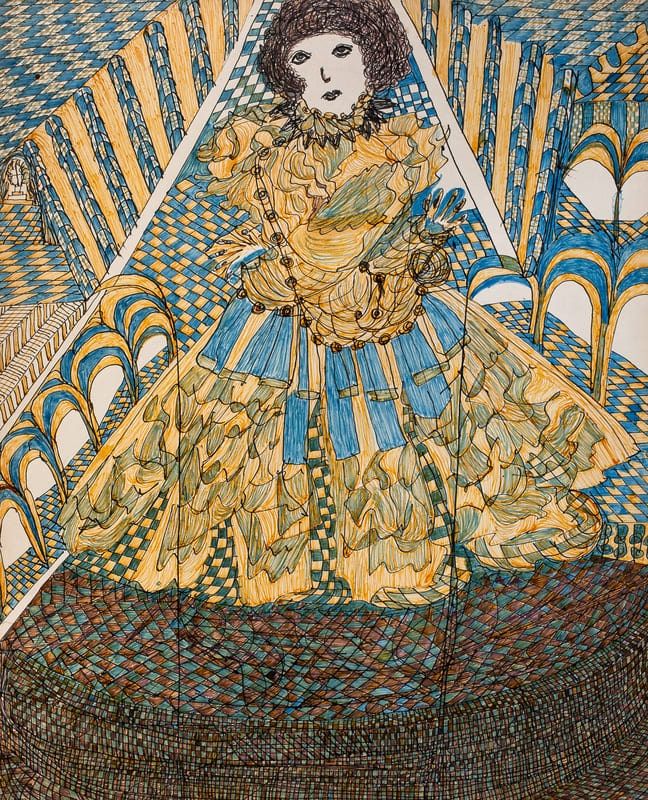
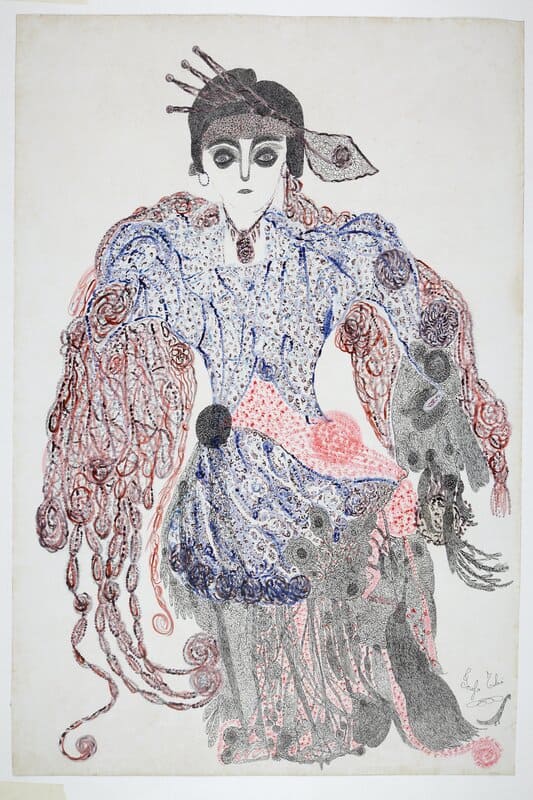
But these artists are part of a genealogy of women's art that, far from the European aesthetic avant-garde, form a mystical "rearguard" that from the domestic space fills the inner exile with an intense psychic experience and powerful creativity. It is not surprising, then, the modernity of their creations, and the parallelism of forms and figures that we find, not only in the pieces of both, but also in works by other women who also had some kind of connection with the spiritual, such as the Swede Hilma af Klint. Here, again, is a link.
But I still want to show you one more curious link. The first time I read about the life of Hildegard of Bingen, a specific fact surprised me a lot: until she was 40 years old, she revealed nothing about her visions and her connection with the spiritual world, and it was from that moment that her written work, whether texts or her musical compositions, began to take shape. This fact would not have to have more relevance if it were not for the fact that, curiously, it is repeated almost like a kind of magical pattern, or conditioned by that connection with the spiritual, in the lives of many other women artists throughout history. And, also, in those of the protagonists of the exhibition.
In fact, when I had the opportunity to interview the painter and writer Paula Bonet for this medium, part of our conversation revolved around this idea of revelation and liberation around forty, and it was she who told me about Hilma af Klint, who also made an important creative turn around her quarantine, after a dark transit, which brought her even closer to the spiritual.
The modernity of their creations is surprising, as is the parallelism of forms and figures that we find, not only in the pieces of both, but also in works by other women who also had some kind of connection with the spiritualThe wounds of the soul guide them in their artistic practice, transformed into the territory of insubordination and a tool for self-conquest. Josefa and Madge rebel and liberate themselves around their 40s, like Hilma, like Hildegard, like so many others. They have traversed their darkness, touched the bottom of the deep well of their souls, and risen again to be reborn, through a guided hand. Some will say that spiritualism, theosophy, or anthroposophy are the key to understanding their work, and it is true. But allow me the license or the audacity to say that the spiritual in art was already present in them and in their works, long before Kandinsky wrote his acclaimed book.
Approach the MNAC before November 5, then, and let yourselves be carried away by the magical lines of these guided hands.
Add The New Barcelona Post as your preferred Google source for free
Stay informed with the latest news.
