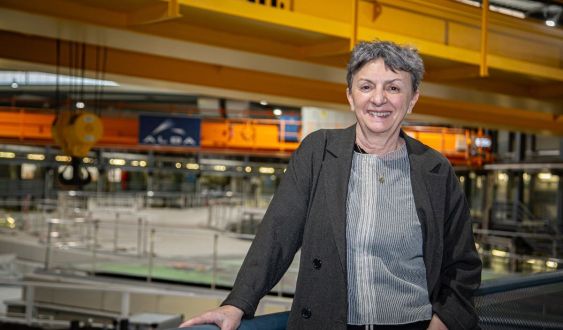
We enter the nerve center of the Alba park, at the Alba Synchrotron light source, the most powerful "glasses" for scientific research, capable of exploring matter down to the atom. This luminous power is obtained from electrons generated by heating tungsten metal to a thousand degrees, which are made to spin inside a giant ring, a particle accelerator that makes a million turns per second, at the speed of light.
The rays flow into laboratories where scientists solve questions in fields such as pharmaceuticals and health, food industries, microelectronics, or the environment. Now, the Alba Synchrotron is preparing to grow and transform into a fourth-generation accelerator. It does so at the same time that around it, in this park named after the first light of day ---alba---, accommodations and services are being built that will make life easier for researchers and enrich the area with housing and commerce for everyone.
--- Let's start by explaining what a synchrotron is.
--- It is a scientific infrastructure that allows producing light emitted by accelerated electrons for the study of matter. We could say it's like a large microscope, but not only that, because its light offers information about electromagnetic characteristics of matter, essential for the development of materials in medicine, life sciences, and in all fields where society has challenges: energy, sustainability, new materials and new technologies, or quantum materials. A synchrotron is the largest particle accelerator system and what we do with it is understand the properties of matter.
--- What kind of research is done there?
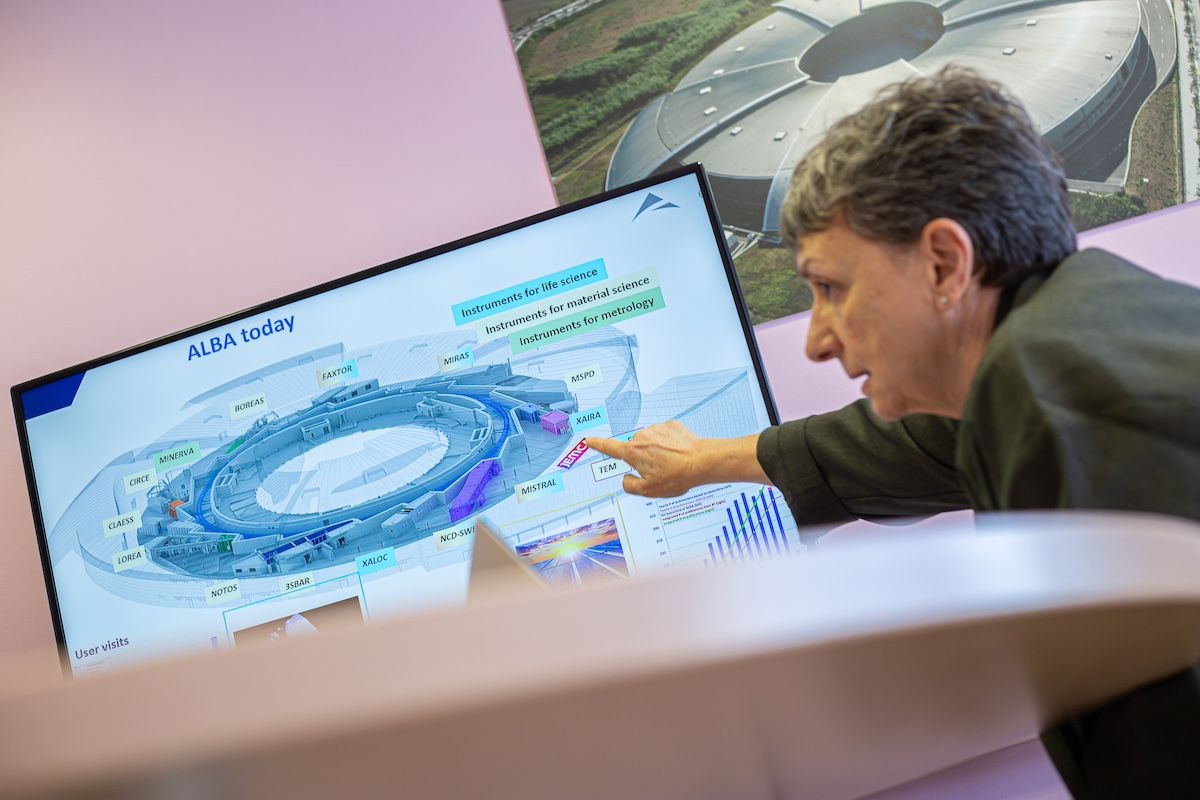
--- We have thirteen experimental lines, plus one under construction, which will be operational in 2027. These are specific laboratories, each developed with a different technology, based on various interactions with matter. Currently, thirteen experiments can be done at the same time, day and night, because the synchrotron is running 24 hours a day, seven days a week, for 220 days a year, and therefore, we offer thousands of hours of light to users.
"Particle accelerators are essential for the development of drugs and vaccines"--- Who are your users?
--- They are researchers who come from outside and the 70 of our staff of 270 synchrotron workers, who do their own experiments and help those from outside. In 2024, we had 3,500 users ---a record number---, 1,000 more than in 2023. Most users are academics. They use the particle accelerator for free and access it through a competitive process. We make two calls a year; an international panel of scientists evaluates the proposals submitted, and access is given to the chosen ones. Over the years, proposals have increased, to the point where now roughly twice as many as we can admit are received. 60% of the experiments carried out are national, and 40% are international. 45% try to solve questions about life sciences, and 55% about materials.
--- And how is it managed?
--- Academic researchers do their experiments for free, but they have to go through a competitive process and publish the results in open scientific journals, accessible to everyone. In contrast, industrial users come directly and pay. Contact with the latter is made through the industrial office we have within the synchrotron, our point of contact with industry, through two channels: on the one hand, with industry that wants to come and research and, on the other hand, with industry that develops the innovations that the synchrotron needs to function.
--- Among industrial users, which sector uses the synchrotron the most?
--- The pharmaceutical industry. Particle accelerators are essential for the development of drugs and vaccines, it is a sector that has always used the synchrotron, because with it proteins can be studied with atomic resolution, and this is essential. At first, the industry did not know what to do with the synchrotron, and we have approached it to explain what they can obtain with our instruments. Above all, they are small and medium-sized companies that need to do an experiment, and we help them analyze the data. This is how we contribute to local innovation. Some projects are done with European funds that provide initial free access to SMEs, thus breaking a first barrier. More than 20 Spanish SMEs have accessed it this way, and 30% have returned as users and are now willing to pay. Of all of Europe, Spain is the one that has taken the most advantage of it.
--- Is there a follow-up on what derives from the study done here?
--- To begin with, as we said, academic users publish in open access. We have done a study with economists from the University of Milan to find out how many of these publications have an impact on innovation, and exceptional numbers have emerged: about 2,900 publications and, of these, 2,600 have been cited for more than 4,000 patents. The impact of the publications of what is researched here places us among the best in the world. We have some patents, but that is not our objective.
"In the field of life sciences, having an instrument of this type gives you incredible possibilities"--- When this synchrotron was inaugurated, it was the most modern in Europe.
--- Ours was the last or second to last third-generation. Now there are already some fourth-generation ones, and we are preparing the prototype of the main accelerator for the Alba 2 Synchrotron, which will also be fourth-generation. If now the dimension of the accelerator's light beam is equivalent to that of a hair, with the installation of the fourth-generation one, it will be ten times smaller, much more focused and intense, to be able to look at details with greater resolution. And we will add three more research lines to the current 14, which we will also renew. The new ones will be longer and will extend outside the current building, gaining resolution. Vision will be achieved in a thousandth of a thousandth of a millimeter, that is, the nanometer. We will be able to see details that we already saw, but in an even more powerful way.
--- Job positions will increase.
--- We have already been growing, and now we have opened more positions. Naturally, we need experienced scientists, engineers, administrators, data scientists, accelerator physicists, many types of profiles. Each position we open is communicated on our website and through channels that reach the entire scientific world at the highest level. We also disseminate through administrations and outreach campaigns. For example, we look for IT professionals at student fairs, and many come from universities, with scholarships. Between May and June, we will open the call; we have about fifteen positions each year, lasting six months. We also work with students in Dual Vocational Training, with great success; we even received an award. This is a very attractive project, and many people come from outside. Of the 270 of us, 28% are foreigners.
--- What kind of studies have passed through the Alba Synchrotron?
--- For example, one on lung cells with the covid virus, and with the Sant Joan de Déu Hospital, rare diseases are studied with difficult clinical trials, because they are very expensive and there are very few people. The effect of drugs on rare disease cells is observed, and it is seen which drugs have had an effect and which have not. Cells with cancer or hepatitis C are observed, and their reaction to one drug or another is seen; if the virus dies and the cell regenerates. This is the beauty of understanding. In medicine, one first works with trial and error. But here, medicine becomes an exact science. Because you see it. And this is fantastic. In the field of life sciences, having an instrument of this type gives you incredible possibilities.
--- And in the field of industry, what innovations have had to do with the synchrotron?
--- For example, the efficiency of solar panels in obtaining energy has been studied. A study was published in the journal Science showing that, if normally 20% of the light received by a solar panel can be distributed, with another type of specific panel, the efficiency exceeded 30%. Energy is one of the biggest problems today, like data production and the enormous water consumption it requires. Well, here we also study how to produce green oxygen through catalysts, to try to develop electronics that do not produce so much heat. That is why it is important to develop spintronics; in electronics, what you move are electrons to produce energy, and you have to give them energy to keep doing it. In contrast, the magnetic movement of electrons, spin, is a system that makes electrons consume less energy. Here, however, we neither produce batteries nor solar panels, but we do the research that allows them to be made.
"In the development of AI, it is essential that there are women because, otherwise, it will be sexist"--- As a director at the helm of such a powerful tool for science, why do you think there aren't as many women in this field of work?
--- First, it is necessary that they choose science careers at university. That's why working with schools is so necessary, because they have to decide when they are girls. The idea that science is a subject for men must be erased from their minds. We all work with technology. I hope it changes in the future. In the development of AI, it is essential that there are women because, otherwise, it will be sexist. If the data is dominated by men, AI will provide sexist solutions. Therefore, women are absolutely necessary. The model of society is based on the fact that women work, but also do things that serve to care for others.
--- Walking inside the building where the particle accelerator is located, we encountered a group of teenagers, a school visit. And she greeted them and told them: "I am the director."
--- I always do it, so they can see that a woman is the director of all this. And the message I transmit more and more is that, without technology, we no longer care. And it would be good if more of them took care of caring, but what I want to emphasize is that, even to care, you need to develop technology. It is important that there is this change in education in the schools themselves.
--- In your school years, was it already clear to you that you would choose a science career?
--- I really liked mathematics, and I had a knack for it. When I studied physics at the Italian Lyceum, I liked it a lot, also drawing and architecture, but in the last year of physics, I asked myself so many questions that no one could answer, that my choice became a matter of curiosity, the need to understand. And in this, education for thinking counts a lot, humanist education is very important. The philosophy teacher influenced my desire to understand more than the math or physics teacher, because he was the one who explained why humanity asked itself questions.
--- What will all the planned transformation around the Alba Synchrotron mean for it?
--- The approval of the urban plan foresees a very powerful activity, and that is very positive. It is, in general, for the economy, for the Universitat Autònoma de Barcelona (UAB), for Cerdanyola, for the Alba park and for us. Being able to have a residence for researchers who can come on foot and be here in five minutes is fantastic, because we work day and night. The synchrotron was installed here because the previous geological studies that were carried out determined that the characteristics required by an installation like this were met, which has to be on very stable ground due to the activity that is carried out observing thousandths of thousandths of a millimeter. And the idea was from the beginning that a scientific park would grow around it, with institutes and industries, but due to the economic crisis, all extra activity stopped, and now it is reactivated.
Add The New Barcelona Post as your preferred Google source for free
Stay informed with the latest news.
