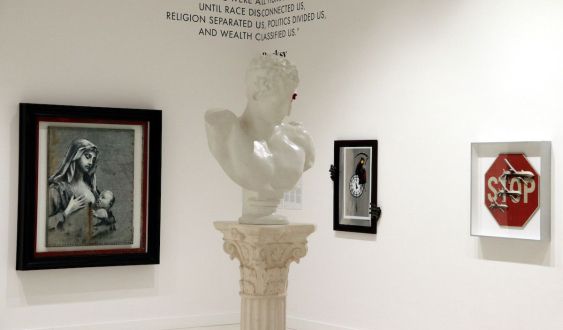
"Art should comfort the disturbed and disturb the comfortable." This is how Banksy's new exhibition at the Moco Museum welcomes visitors. With a total of 25 works, the exhibition adds 16 new pieces to the collection that this modern and contemporary art museum in Barcelona already displayed, with two pieces never before exhibited in a museum. However, this phrase goes beyond a mere statement from the famous —though always anonymous— urban artist. At the Moco Museum, it becomes a full-fledged declaration of intent. For Banksy, as for the Moco Museum, art is not just contemplated from a distance; it must move, challenge, and provoke. In short, its mission is to make the viewer feel welcome, while also challenged, confronting them with the uncomfortable truths that the works reveal.
The Moco Museum achieves that rare sense of comfort: it manages to get an audience that is not normally attracted to contemporary art —from young people to those who admit they don't like art— to enter, photograph, and even share the exhibited works on social media. And, at the same time, it manages to unsettle these visitors with the questions the works pose, generating deep reflection in each of them.
"Museums are often presented as cold, silent spaces, where it seems one must have extensive knowledge, even to dare to look at the works," reflects Birthe Faessen, exhibition director at Moco Museum and responsible for the design of its London and Barcelona venues. The objective of this modern and contemporary art museum located in the heart of El Born is precisely to break with these stigmas. In its halls, art is presented without asking permission or requiring prior knowledge: it simply cuts through.
Banksy's art emerged without asking for that prior permission, simply intervening on walls and buildings with a direct and deeply provocative language. His anonymity, which he has managed to maintain for more than three decades of artistic career, has become an argument that what is important about these works is not the signature or the context, but what they pose: the uncomfortable questions they reveal, on topics as diverse as power, beauty, or violence.
As Banksy's goal is to reach the public directly, his usual channel of expression is public walls and surfaces. And Moco Museum's intention is to amplify that purpose: by showing the pieces to the nearly one thousand visitors who, on average, access its rooms. An unprecedented fact, since "many times, these canvases, sculptures or installations end up in private collections," laments Faessen. Furthermore, the halo of mystery and anonymity surrounding the British artist has also led to imitations, unauthorized works, or works passed off as authentic without being so. However, all the works in this collection have authentication certificates, issued by Pest Control Office ---the 'pest control' office created by the artist to prevent plagiarism and fake works---.
Art that challenges art history
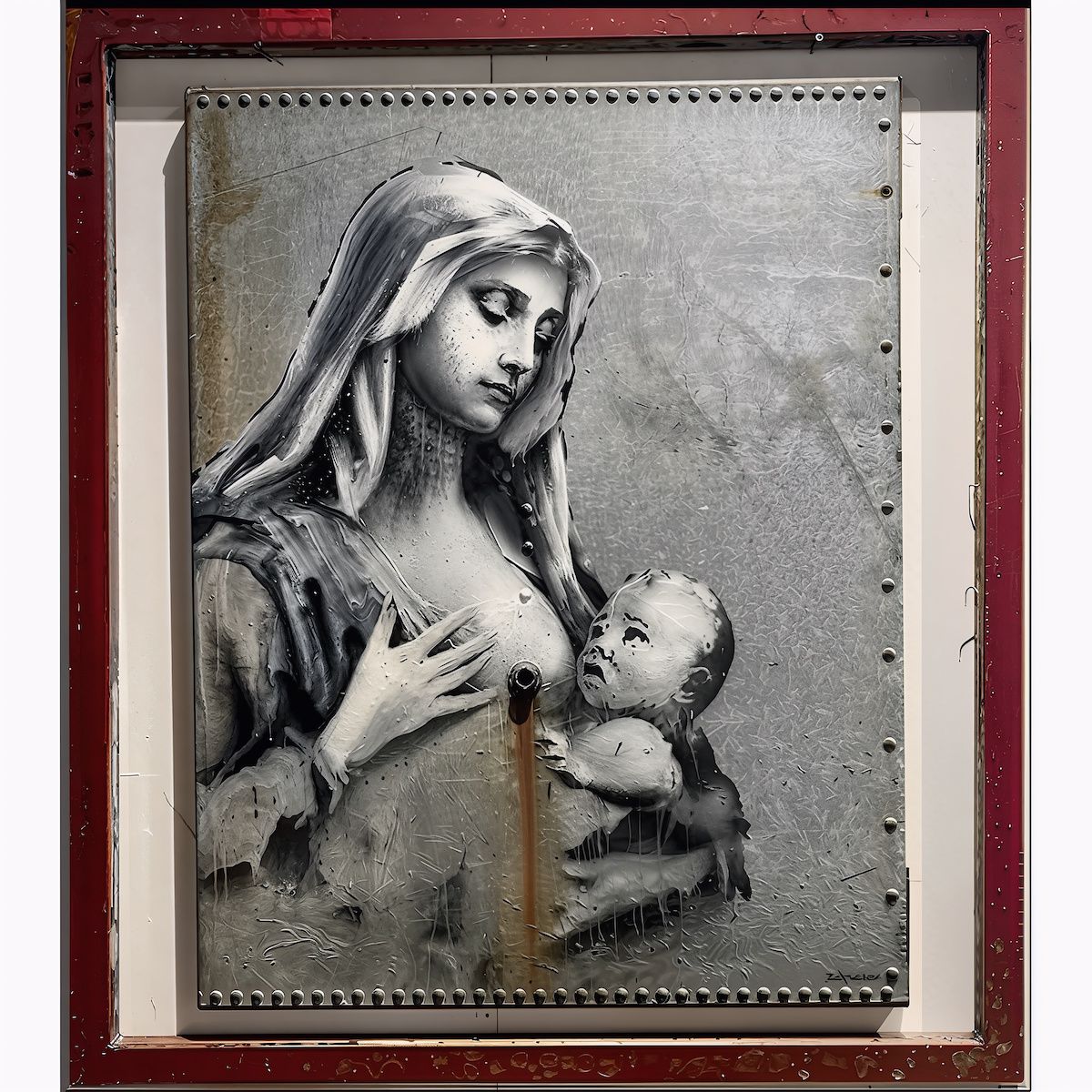
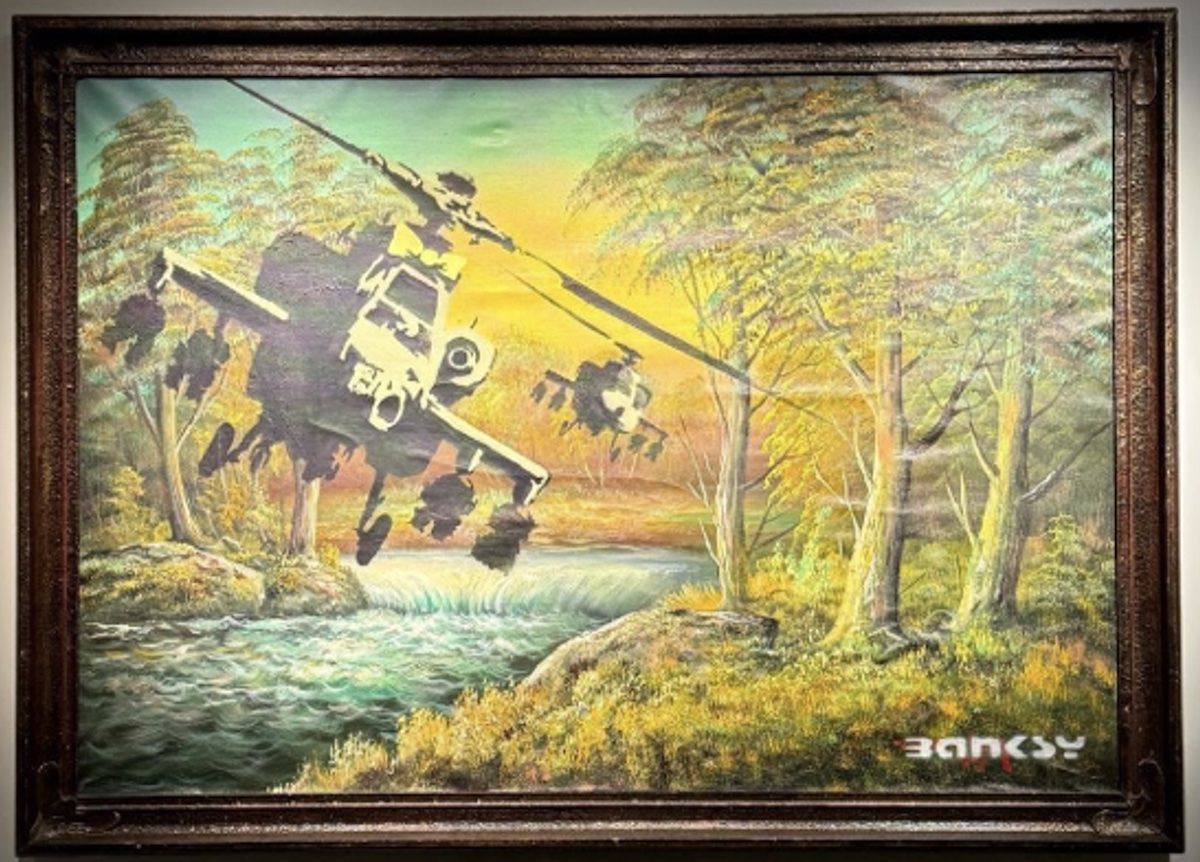
Of the 25 works that are part of the exhibition, 16 are additions that join the collection that the Moco Museum already exhibited and two are pieces never before exhibited on museum walls: Happy Choppers andMadonna and Child. These works do not require prior knowledge of art history, but rather connect with the viewer through simple, yet powerful messages. Pieces where it doesn't matter to understand the references, becausethe impact, before intellectual, is emotional.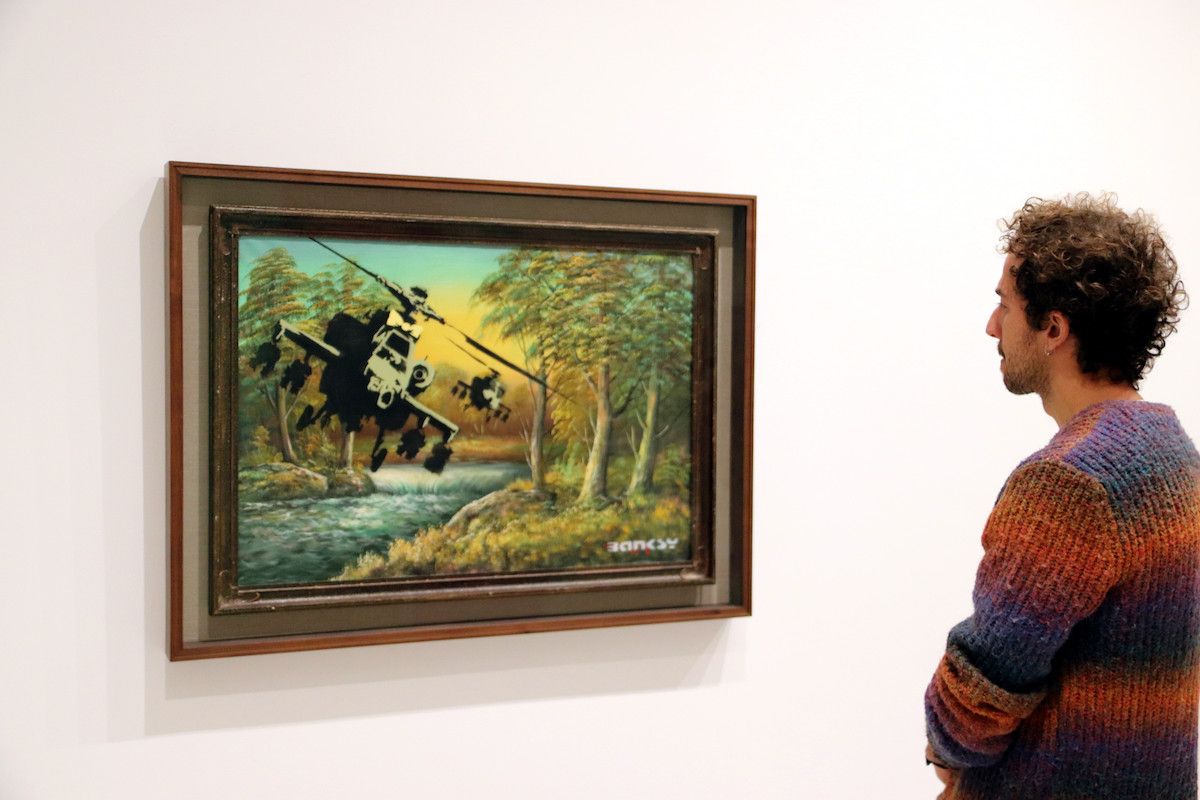
In fact, Banksy himself is in charge of subverting art history by reinterpreting classic icons. Thus, the always pristine Virgin Mary appears with her chest oozing a strange rusty liquid while breastfeeding a Jesus who, instead of being serene and calm ---as is usual in biblical representations---, appears vulnerable and distressed.
What does that hole in Mary's chest represent? Is it a wound that oozes or a corrosive liquid? As always, Banksy does not give answers, but opens questions. In fact, the work was originally published by the artist on his Instagram, without any accompanying text. "This is a very typical gesture of the artist: he does not want to impose a message, but rather that we feel something and that we talk about what it provokes in us," summarizes Faessen.
Purity coexists with decadence. So does it in Happy Choppers, where a bucolic landscape is disrupted by fearsome military helicopters superimposed with graffiti. "Banksy buys these old landscape paintings in second-hand shops or flea markets, but introduces a modern element that disturbs and creates this contrast: war interrupts calm," says the exhibitions director.
These two works, exhibited for the first time on museum walls, dialogue with emblematic pieces by the British artist such as Girl with Balloon ---created in 2002 and recreated on several occasions, it was chosen as the UK's favorite artwork---, Bullet Hole Bust ---originally acquired by Brad Pitt and Angelina Jolie and now part of the museum's permanent collection--- or Laugh Now. Globally recognizable images, with simple but provocative symbolisms. Messages that question consumerism, war, or authority.
Because this is Banksy's purpose: "to make art accessible to all visitors and make them reflect on uncomfortable truths." A goal shared by the Moco Museum in Barcelona ---which defines itself as an anti-traditional museum---, and which seeks to capture the attention of new audiences with impactful visual works and experiential experiences. It does so "without falling into simplifications, always respecting artists and their contexts," as Faessen defends, but without the elitism that usually characterizes contemporary museums. A philosophy shared by the three venues of this modern and contemporary art museum: Amsterdam, Barcelona, and London, which bring together pieces by Andy Warhol, Jean-Michel Basquiat, Yayoi Kusama, or Salvador Dalí.
Amsterdam, London, and Barcelona: a virtuous artistic triangle
The project was born in a small art gallery, founded in 1999 in the Dutch capital by the married couple Kim Logchies and Lionel Logchies,which soon saw how the space was becoming insufficient. It was then that they decided to inaugurate a new space in, no more and no less, than the city's great museum square (Museumplein), next to the imposing Rijksmuseum or the center dedicated to Van Gogh.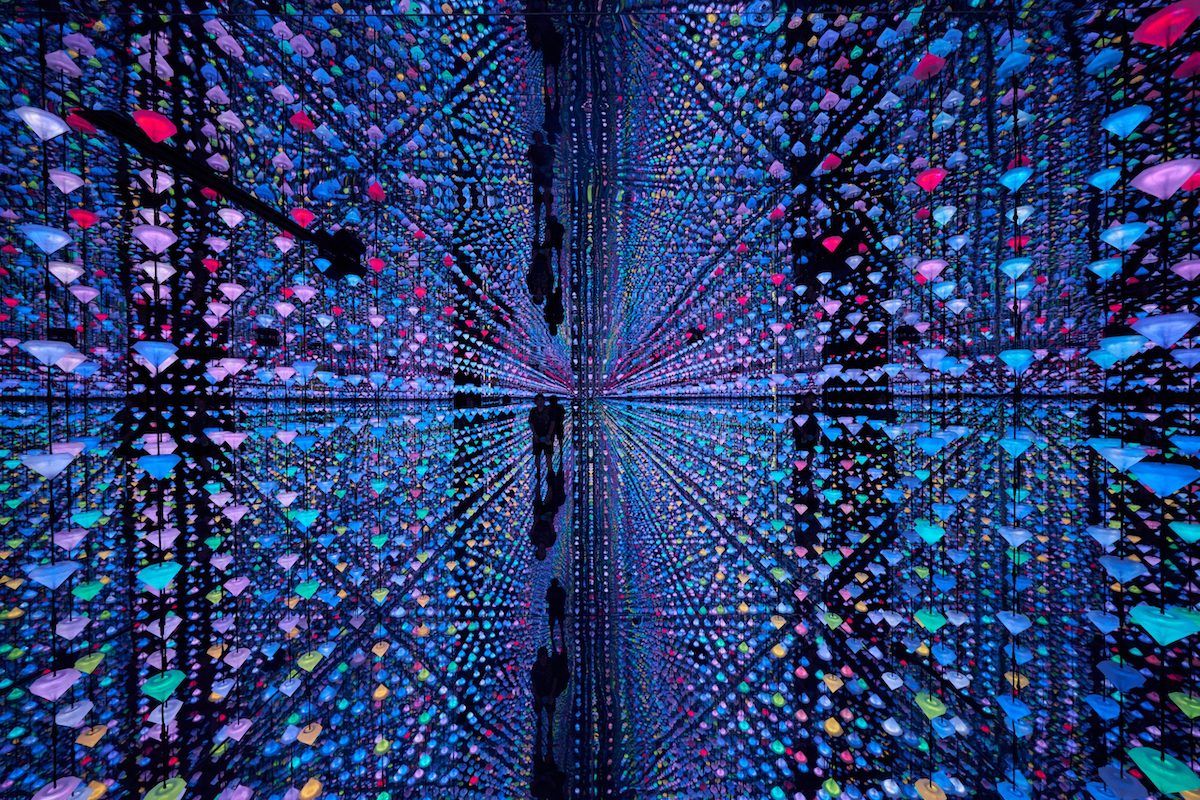
It was in 2021 when Moco Museum expanded outside the Dutch country, landing in the historic Palau Cervelló in the Catalan capital. This choice was not casual, the couple had always felt a special connection with the city: "every time they came to Barcelona they felt more attracted, by its creativity, history and open spirit," Faessen recalls. And the imposing Gothic facade of the palace finally convinced them, "before having seen the building inside they already knew that it had to be the place," and so they rented it, for at least twenty years.
Today, Moco Museum also has a new headquarters on the central Oxford Street in the British capital, but it still maintains the same leitmotiv: "to create a collection that directly appeals to the visitor, in which we do not impose what they should think or feel, but rather that they feel comfortable letting themselves go and, simply, feeling," Faessen concludes. Even when these reveal uncomfortable truths.
Add The New Barcelona Post as your preferred Google source for free
Stay informed with the latest news.
