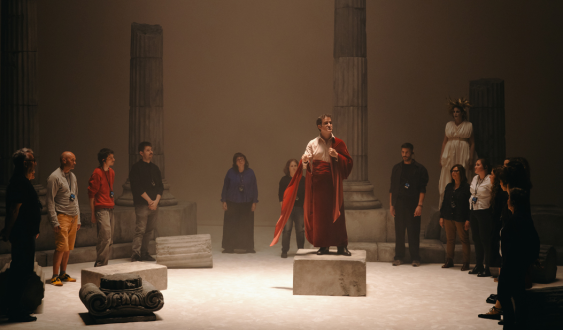
Going to the theater to see a Sophocles classic might make you think you'll encounter the usual drama, but Contra Antígona breaks the mold from the very first minute. The show proposes a very original theatrical experiment: what if the protagonist of the story wasn't the famous heroine, but the Greek chorus? This is the premise of a groundbreaking work that turns the stage into a civic meeting place to interact directly with the audience.
It is a mischievous, provocative, and very lively proposal that sets aside the usual heroine to make a much more powerful change: giving all power to the people. The result? A collective conversation where theater becomes a live performative experiment.
Andrea Jiménez and Victoria Szpunberg sign this piece at the Lliure
The show is responsible for closing the 25-26 season in the Sala Fabià Puigserver of the Teatre Lliure, in a co-production with the Centro de Cultura Contemporánea Condeduque in Madrid. At the helm of the project is Andrea Jiménez, the creator of the successful production Casting Lear, who now once again uses a universal myth to shake the spectator.
For this new theatrical adventure, Jiménez has once again relied on the dramaturgy of Victoria Szpunberg, with whom she had already collaborated on other pieces such as Vulcano and Mal de coraçon. The complicity between the two creators translates into a powerful proposal that conceives theater through the body and questions traditional forms. The result is a very original show where fourteen spectators, strangers to each other, go on stage every night to become an active Greek chorus. Together they trace live the path of a tragedy that resists being told as always.
Sophocles and the tragedy of Antigone
Written by Sophocles and first performed in 5th century BC Athens, Antigone is the most studied, adapted, and debated classical tragedy in theater history. The plot presents a moral dilemma: Antigone rebels against the decree of King Creon, her uncle, who has forbidden the burial of her brother Polynices for having betrayed the city. She decides to disobey the tyrant out of love and without fear of having to face a death sentence.
In antiquity, Greek theater functioned as a public agora where the limits of power, the legitimacy of human laws versus divine laws, and, above all, the price of polarization were debated. As director Andrea Jiménez well reminds us, the core of Sophocles' tragedy is born from a conversation that fails, from a clash of totally opposite positions where no one yields, tension explodes, and everything ends in death.
Sophocles' Antigone has always been presented to us as the typical story of a brave and idealized heroine. But the original text actually hides many more political layers, where the chorus (which is the people who see everything) has always remained as a witness. And it is precisely this forgotten role of the people that the Lliure takes as a basis for staging its entire show.
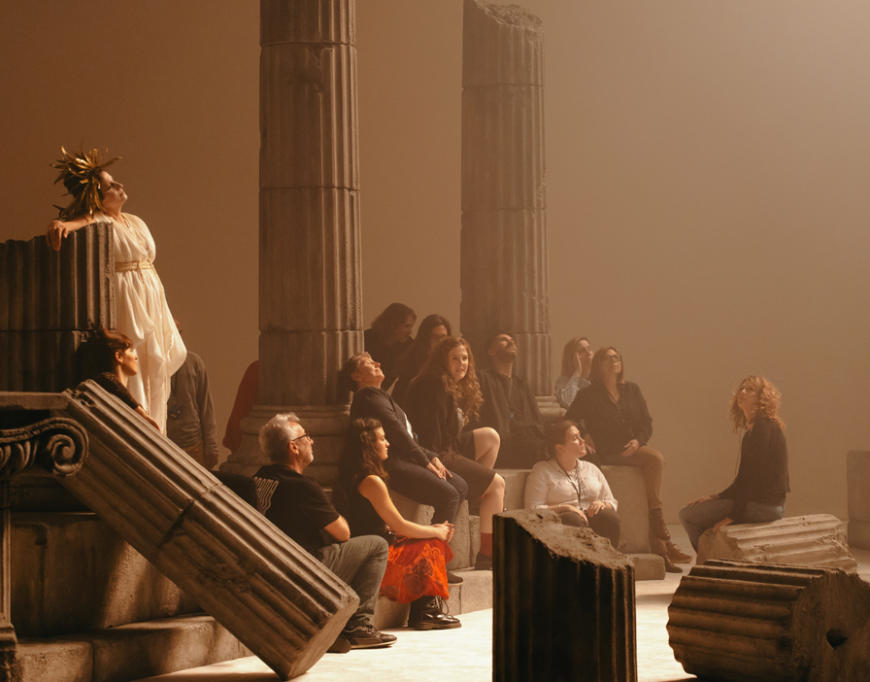
The Lliure's stalls become the Greek chorus
Contra Antígona presents itself from the first moment as a groundbreaking work. As its name indicates, we are facing a modern and different revision of Sophocles' text. The great success of the starting point is the strength that the chorus takes. It is curious, because in the theater we are used to seeing today, it has been disappearing, but in classical Greece, the chorus was an essential element because it represented the voice of the citizenry. And Contra Antígona recovers this role of the chorus, which ceases to be a passive observer to become an active element that moves, interacts, and accepts or rejects what is happening on stage.
Antigone (Júlia Truyol, member of La Calòrica) is a woman who rebels against unjust laws that promote hatred instead of love, as presented on stage with this well-known phrase from the classical text: I was not born to share hatred, but love. In this proposal, the people take a voice, protect, and accompany.
Guided by the facilitator (Mònica Molins) and the Coryphaeus (Olga Onrubia), there are moments where volunteers position themselves on one side or the other of the dialogues. It is a very powerful decision because of the very topic being discussed: seeing how the community rebels against a tyrant, Creon (Xavi Sáez). A tyrant, however, who is also not black or white, because there are speeches of his with which we can empathize, and which show that in this world there are grays, many grays.
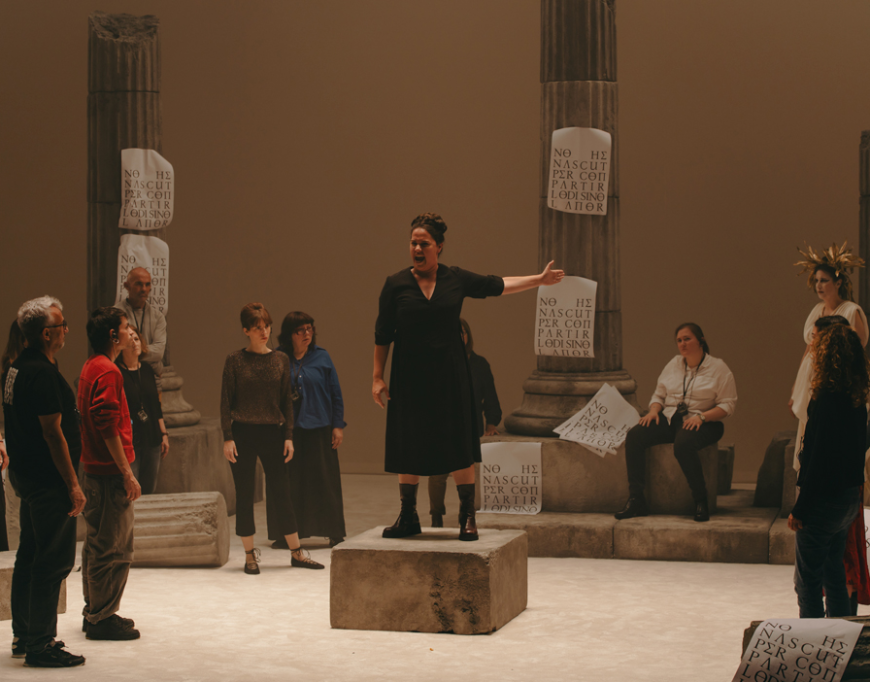
An experiment that works... halfway
But not everything is perfect: the experiment works halfway. The audience standing on stage throughout the performance is strange and uncomfortable in the very development of the plot: their movements interrupt the most powerful and literary part of the proposal. This especially happens in the scenes where Corifeo recites some of Sophocles' original reflections: the text is hidden because the audience's attention is diverted to the fourteen volunteers. They take so much prominence that the literature is lost and the reflections of the classical text go totally unnoticed.
However: the final image compensates when the humanist message is launched that defends that the human being is wonderful. Hearing this phrase as the curtain closes with real people from the audience on stage, makes the show have a very social reading. A message that highlights the individual from the mass and puts the accent on each of the people in the collective.
The result is a theatrical experiment as original as it is necessary where power is once again handed over to the people.
The humor of tragedy
Against the dramatism that Greek tragedies usually have, Jiménez and Szpunberg insert very fresh and intelligent doses of humor. This is the case of Corifeo's interventions, which are hilarious, as they manage to remove the dramatism and create more proximity with the audience. In this same vein, the treatment of Ismene (Clara de Ramon) is also very surprising: the contempt she suffered from Sophocles is evident, and the metatheatrical twist where the actress recites Chekhov gives it a very funny layer of contemporaneity.
The staging also hits the mark with the decision that Tiresias be played by a child (Bruna Luz / Nora Pàmies Ricart). This choice functions as a very clear metaphor: the figure of the traditional wise old man gives way to youth and new generations. This view is also reaffirmed in the parent-child debate where Hemón (Marc Soler) confronts Creon to claim the right of young people to be understood and included in political decisions.
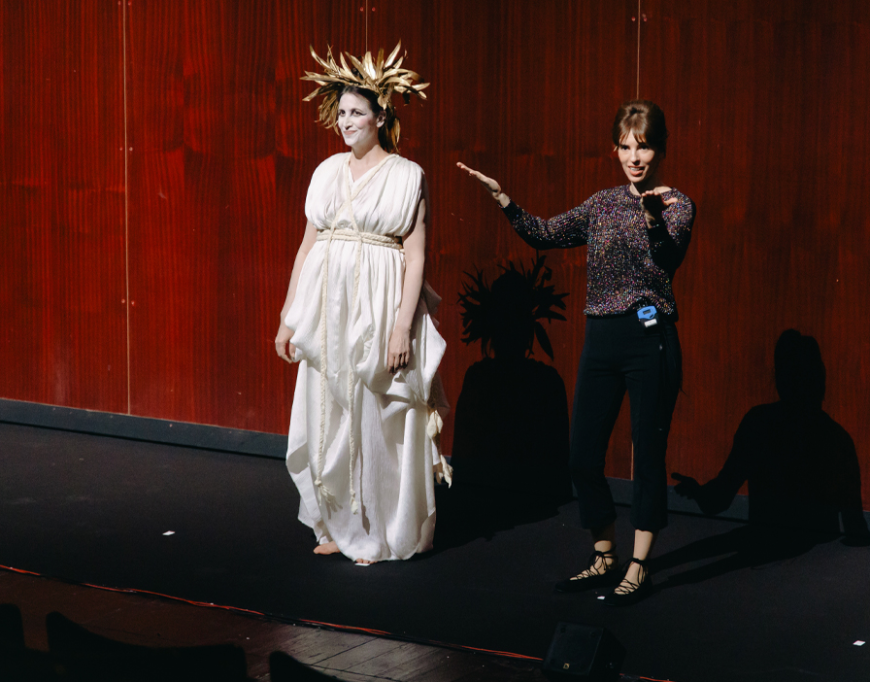
The Greco-Roman ruins frame the power of the interpretation
At the staging level, the work of Judit Colomer is spectacular. The Greco-Roman ruins with very tall columns greatly dress up the space, as do the banners that fill the stage and a very careful lighting design. These ruins serve as a perfect framework to witness the interpretive pulse between Júlia Truyol and Xavi Sáez which is, without a doubt, one of the highlights of the production.
Sáez, especially in the final scene, stars in a scene of striking intensity; under the image of the inflexible tyrant, the actor manages to extract a humanity so moving that the spectator immediately connects with his repentance. A masterful way to humanize the monster from the purest and most visceral pain.
Contra Antígona has been able to take a classical tragedy, endow it with a contemporary poetic, and, above all, enhance all those sub-messages that traditional readings usually overlook. The result is a theatrical experiment as original as it is necessary where power is once again handed over to the people.
Add The New Barcelona Post as your preferred Google source for free
Stay informed with the latest news.