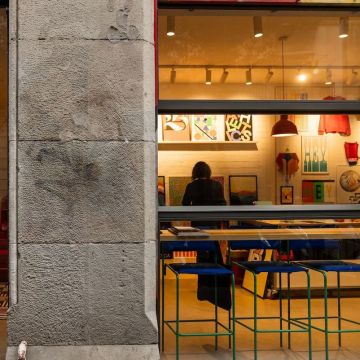
There is something I constantly hear when we talk about commerce: "Before, stores had more soul." And surely there is some truth in that phrase. There was more conversation, more time to recommend, more product knowledge, and a much closer relationship between seller and buyer. Entering a store meant feeling that there was someone behind the counter who truly understood what they were doing.
But I also believe that small businesses make a mistake when they live too focused on recovering what once was. Because the past is not coming back. And perhaps the real challenge is not to try to reproduce it, but to understand how to maintain the essence in a completely different reality.
We see it more and more in some supply markets and historic shops in Barcelona. Businesses that for decades worked very well because the customer was loyal, the neighborhood was stable, and consumption habits changed slowly.
Now everything moves much faster. The way of buying changes, the pace of life changes, the value we give to time changes, and even the way we relate to the city changes. The problem does not appear because the consumer evolves, but when the business stops doing so with them. And that's where many businesses begin to lose what precisely made them special.
For years, part of small businesses has tried to compete with large chains by doing exactly what suits them least, trying to resemble them. Conversation has been reduced, the relationship with the client has been automated, and human interaction, something that had always been differential, has been relegated to the background. Everything becomes faster, more practical, more efficient… but also colder. Then an inevitable question arises. If the experience is exactly the same as anywhere else, why should the customer choose you?
Because retail is still, above all, a business of people. Technology helps, of course. Having a good e-commerce helps. Social media helps. But nothing replaces the feeling of entering a place where someone listens to you, recommends with criteria, and makes you feel that behind that business there is still real interest in whoever walks through the door. And that still has a lot of value. In fact, probably today more than ever.
The problem is not modernizing; the problem is dehumanizing in the attempt.
Today's consumer wants speed and convenience, yes, but also seeks authenticity. They want to be able to shop online, but still enjoy discovering places with personality. They want efficiency, but also connection. And there, small businesses still have an enormous opportunity if they understand that adapting does not mean losing their soul.
Adapting can be something as simple as reviewing opening hours, improving display, learning to better communicate what you do, or understanding new customer profiles. Sometimes we think that innovating means filling a store with screens or copying models from abroad, when in reality, innovating often consists of rekindling interest in the experience the customer has within the space. Because the problem is not modernizing. The problem is dehumanizing oneself in the attempt.
Barcelona still has extraordinary shops, stores with history, and professionals with product knowledge that is not learned in any business school. Markets where there is still craftsmanship, discernment, and passion for selling well. But this heritage cannot be preserved solely from nostalgia or aesthetic protection. It needs to be made sustainable and relevant for new generations.
Because a business does not disappear only because of Amazon, rent, or changes in consumption. Many times it disappears because it stops connecting with the reality it faces. And that is hard to accept.
Retail is changing and will continue to change. But there is still space for local commerce, for stores with personality, and for businesses where human things still happen. The customer still values feeling well attended, discovering something new, or having the feeling that someone is truly dedicating time to them.
The future of small businesses probably does not involve becoming more like large platforms, but rather strengthening precisely what they can never fully copy: the human relationship. Because the city changes. The consumer changes. And the past, no matter how much affection we have for it, is not coming back. But that does not mean that local commerce has no future. It means it will have to build a new one.
Add The New Barcelona Post as your preferred Google source for free
Stay informed with the latest news.